
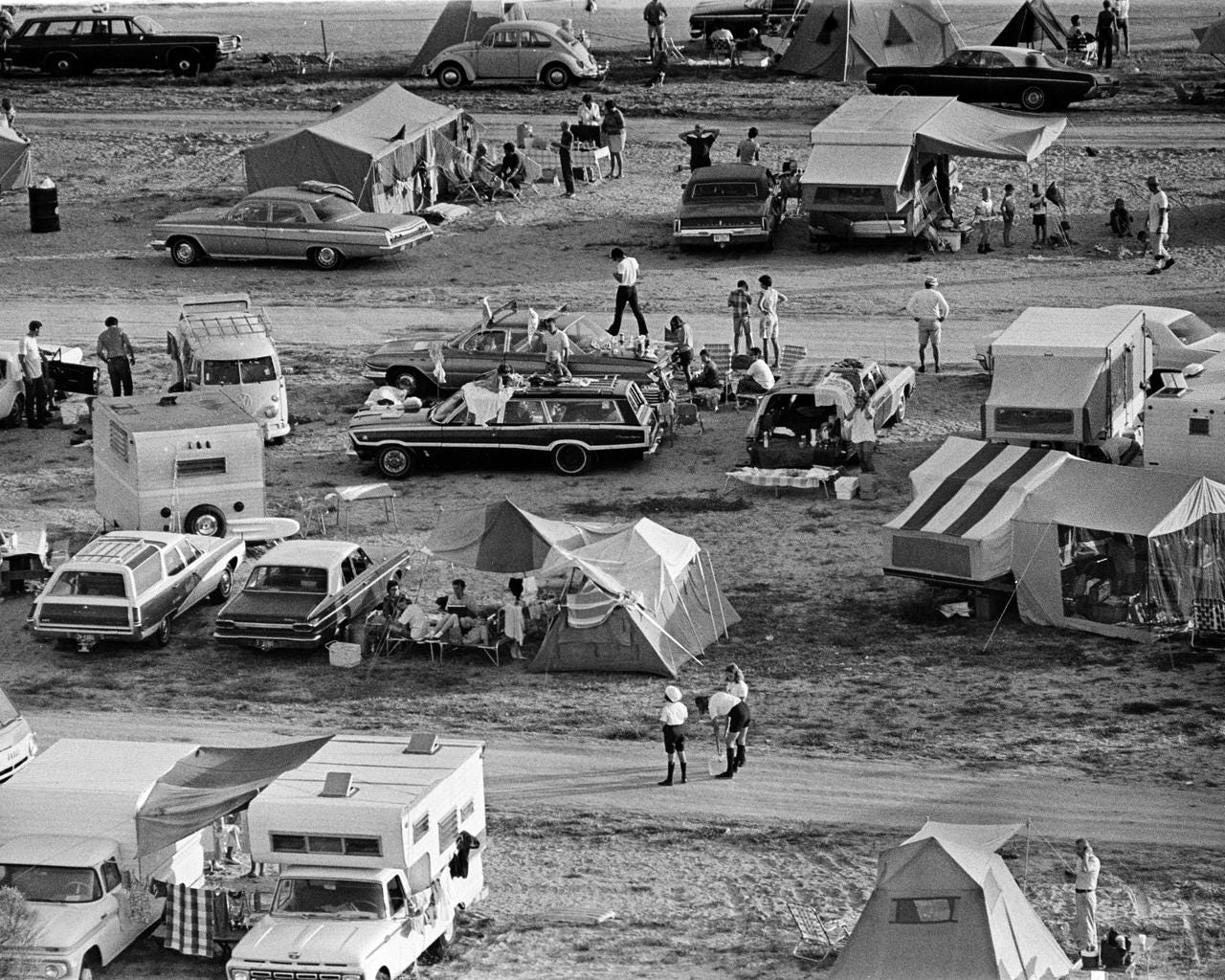
Crowds camp at roadside awaiting the Apollo 11 launch on July 16, 1969. Image source: NASA.
The Greatest Show on Earth
We’ve yet to hear a final count but, by government and media estimates, an estimated 400,000 to 600,000 people were expected to descend on Brevard County to watch the April 1 Artemis II launch.1
It’s been a long time since that many people showed up for a Space Coast launch.
During the COVID era, crowds still showed up for historic crewed events but nowhere near Apollo or Shuttle numbers. About 150,000 showed up to witness the SpaceX crew Dragon Demo-2 test flight in May 2020.2
In February 2018, about 100,000 people showed up to witness the first SpaceX Falcon Heavy launch.3
The last launch that topped the Artemis II attendance record was STS-135, the final Space Shuttle mission, that launched on July 8, 2011. The crowd estimates were anywhere from 750,000 to one million.4 The estimate was the same for the first Space Shuttle flight, STS-1, that launched on April 12, 1981.5
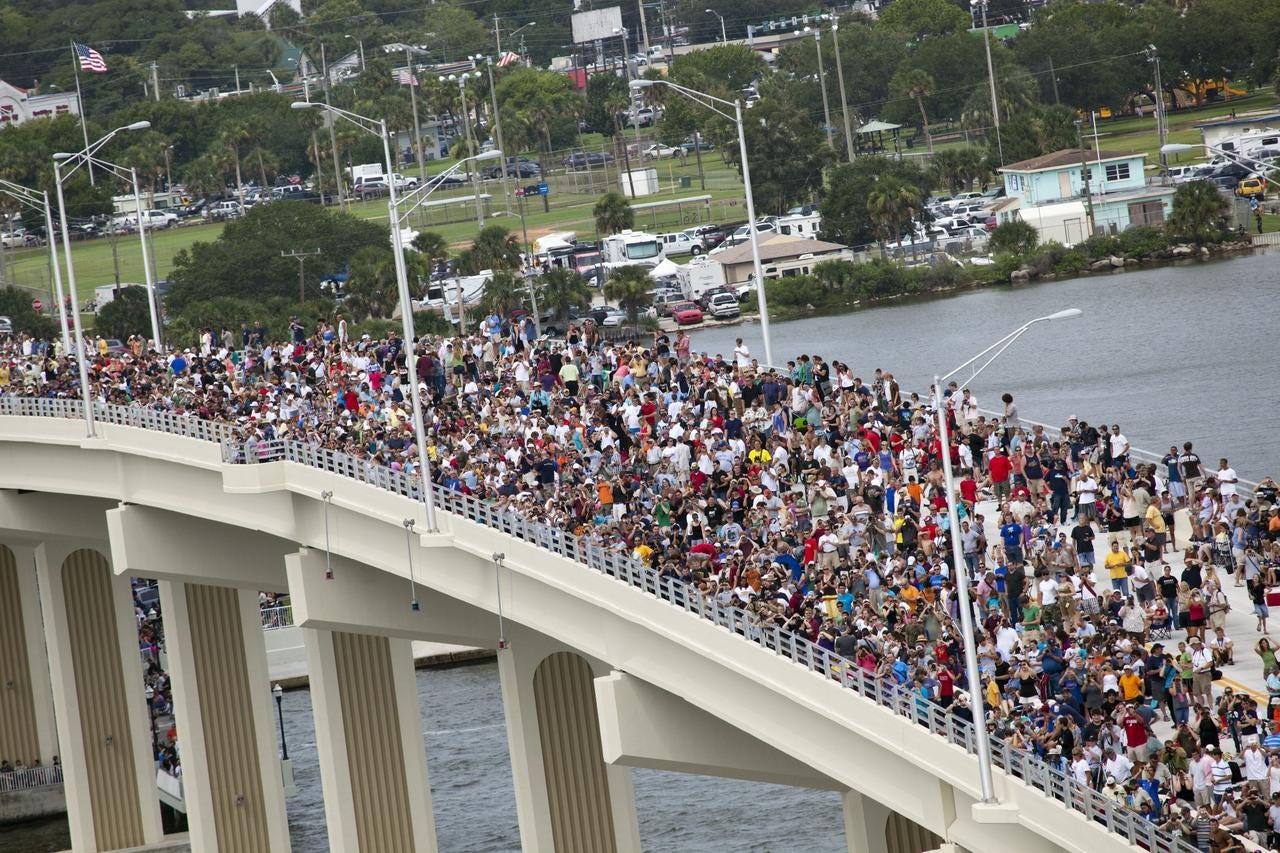
Titusville’s Max Brewer Bridge on July 8, 2011. Almost one million people gathered in the Space Coast that day to watch the final Space Shuttle launch. Image source: NASA.
That would rival the estimates for the Apollo 11 and Apollo 17 launches, about one million each. Apollo 11 was the first lunar landing, while Apollo 17 was the last lunar landing.6
Brevard County’s population in 1970 was estimated to be about 230,000 according to the US Census. Titusville’s population was about 30,000.7 The US Census estimates that Brevard’s current population is about 606,000, with Titusville at about 49,000.8
Less than ten years before, at the dawn of the 1960s, Kennedy Space Center didn’t exist. It would have been incomprehensible to the few people living in north Merritt Island that, not only were they about to lose their homes, but that a million people would descend on their island to witness one of the most significant events in human history.
Just Passing Through
When President John F. Kennedy announced in May 1961 his crewed lunar mission proposal, very few people lived in north Merritt Island. Most people drove through.
The first space presence in the area was the Merritt Island Launch Annex, also called the Merritt Island Launch Area. Either way, the acronym was MILA.
The site was an annex to Marshall Space Flight Center in Huntsville, Alabama. Since Marshall initially was responsible for NASA launches at Cape Canaveral, the NASA presence on north Merritt Island was considered an annex to Marshall’s Cape operations. But “Area” was also in use.
The November 4, 1962 Orlando Sentinel reported plans for a “‘Banana River - Orsino - Causeway, NASA Merritt Island Launch area.’ Plans will call for a two-lane causeway and road from the Cape Road at Cape Canaveral across Banana River to intersect with Highway A1A at Orsino on Merritt Island, a distance of about six miles.”9
If you’ve never heard of Orsino, that’s because it doesn’t exist any more.
Orsino was a small town roughly at the intersection of today’s NASA Parkway (State Route 405) and Kennedy Parkway (State Route 3). In the early 1960s, SR-3 was Highway A1A. At one time, Highway A1A ran through Cape Canaveral, but was rerouted after the US Air Force took over the Cape. The new route went westbound from Cocoa Beach on State Route 520 to Tropical Trail, then north through small towns such as Courtenay, Orsino, and Shiloh before reaching the Volusia County border. Once State Route 3 was built later in the 1950s, it became A1A, relieving traffic from the two-lane and largely remote Tropical Trail.
In March 1962, MILA became its own standalone NASA Center, christened the Launch Operations Center. Dr. Kurt Debus, who oversaw MILA for Marshall, was promoted to become the LOC’s first director.10 MILA remained as a tracking station that opened in 1966, intercepting transmissions from Project Apollo and Space Shuttle missions, until it was decommissioned in 2011.11
The US government used eminent domain to acquire 144,000 acres on north Merritt Island for NASA. By spring 1963, land clearing had already begun near Orsino. An April 1963 photo shows land already had been cleared for what was about to become the Industrial Area. The image showed that, at the intersection of Highway A1A and Orsino Road, a convenience store still stood that had once been a roadside stop for travelers. It had a gas station, restaurant, and post office.
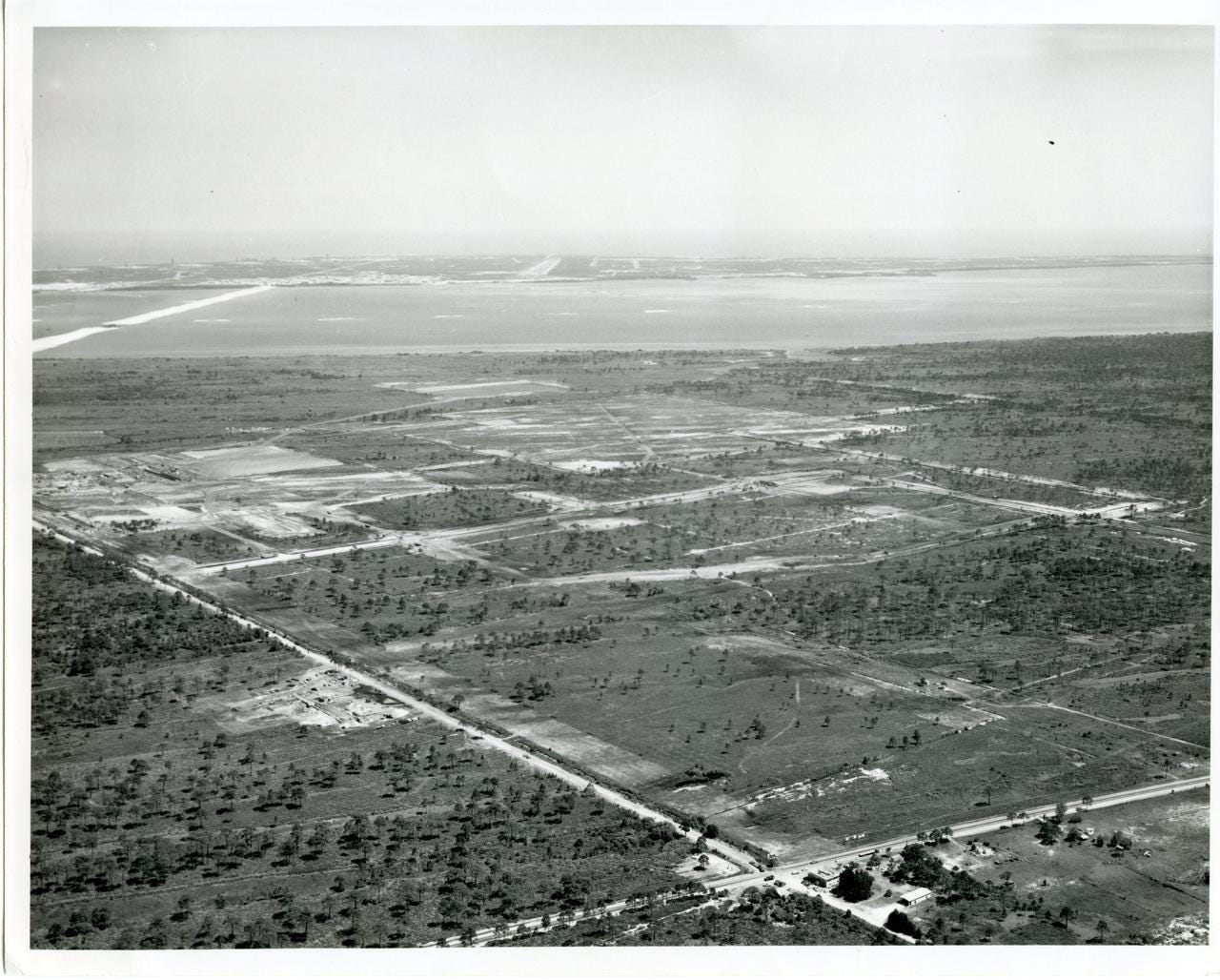
Orsino on April 19, 1963. At the bottom center of the image is the intersection of the old Highway A1A and Orsino Road. In the distance is Cape Canaveral. Image source: NASA.
Behind the convenience store was the Orsino Baptist Church. The church relocated south on Highway A1A to Courtenay, where it remains today. Newspaper accounts vary on the old church’s fate; although many newspaper articles report that the church was torn down, the November 28, 1963 Orlando Sentinel has a photo showing it being moved to Courtenay. Orsino resident Roy Roberts recalled that the church was moved but it was in poor condition due to termites.12
A December 1963 NASA map showed where significant facilities were to be located. The map was titled, “Merritt Island Launch Area.” The headquarters building was titled, “Launch Operations Center Headquarters.”
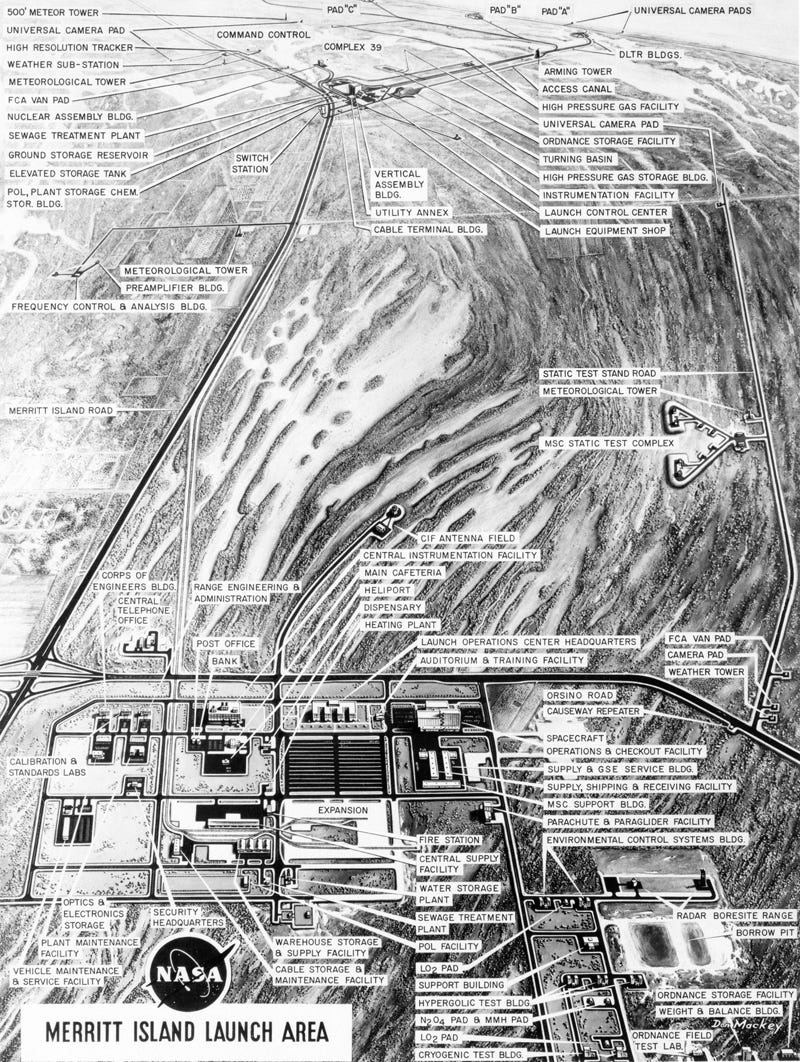
Note some abandoned ideas. Launch Complex 39 was to have three launch pads — 39A, 39B, and 39C. Pad C was never built. The VAB was originally the “Vertical” Assembly Building. North of the VAB was a Nuclear Assembly Building, because a sequel program called Project Nova might have had nuclear-powered upper stages.13
Be Our Guest
People being naturally curious, the public began showing up at Cape Canaveral wanting to see more of the US space program.
In December 1963, the US Air Force opened Cape Canaveral Air Force Station to public drive-through tours. A book was prepared for drivers with a tour route of checkpoints, descriptions, and rules. In case you’re wondering …
DON’T stop or park except in emergency
Kennedy Space Center opened to public tours in early 1965. The first visitor center was a trailer parked in a lot on the mainland side of NASA Causeway just west of the Indian River.
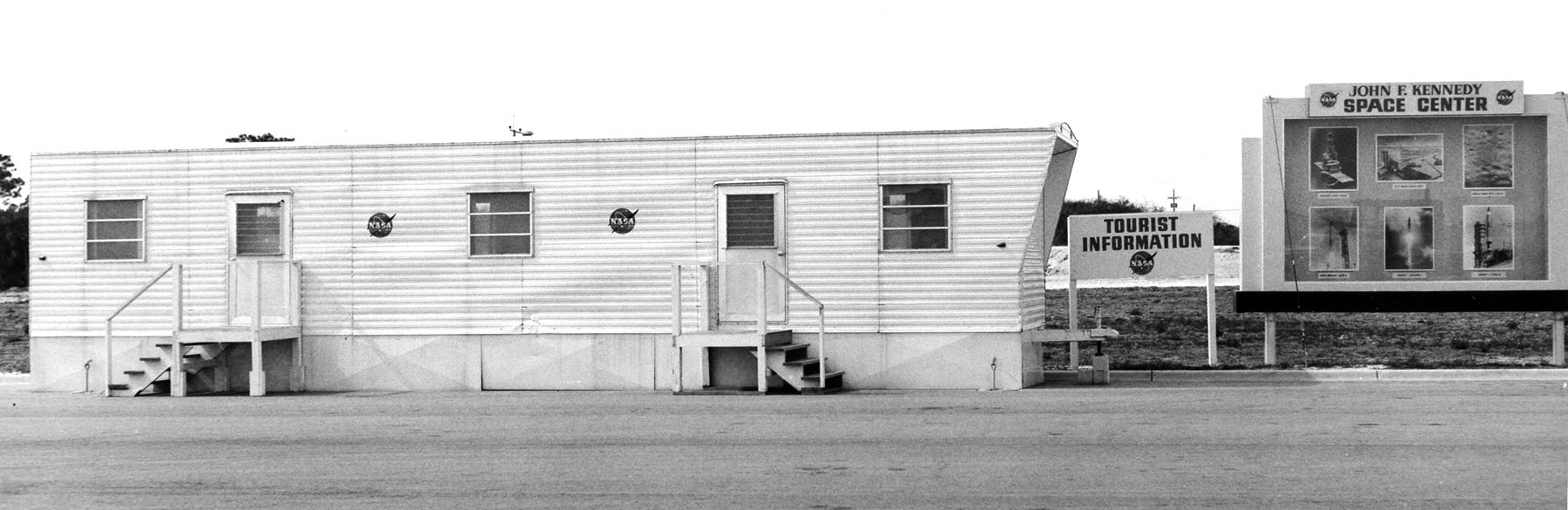
The tourist information trailer on NASA Causeway. Image source: NASA.
This site expanded into what was called the Visitor Information Center. Bus tours ran from “The VIC” through KSC under construction.
A permanent facility, also called the Visitor Information Center, opened on August 1, 1967. At the time, visiting KSC was a true pilgrimage — about a one-hour drive east from Orlando. Disney World and other central Florida attractions did not exist.
By early 1969, the VIC was the second most popular attraction in Florida, after Tampa’s Busch Gardens. A September 1969 Spaceport News article estimated that almost 400,000 people had visited the VIC since the Apollo 11 launch, with a record 8,373 patrons on August 12. Ninety percent of the visitors were from out of state, and six percent of those were from foreign nations. Total attendance for 1969 was 1,159,254.
Over the years, attendance has waxed and waned. Attendance in mid-1990s was averaging about 2.4 million per year. In the months after the September 11, 2001 terrorist attacks, attendance dropped by forty percent.
Delaware North, the company that operates the Kennedy Space Center Visitor Complex today for NASA, doesn’t release attendance numbers, but most estimates guess an average of 1.5 million to two million a year. In July 2025, Tripadvisor named KSCVC its top attraction in the United States.14
Florida and the world are much different than in 1969. It’s still a pilgrimage to reach the Space Coast. Tourists have many more options than just watching a rocket launch.
But put people a top of the rocket, and tourists tend to show up.
J.D. Gallop, “What to Expect from Traffic, Brevard Roads for Artemis II Launch,” Florida Today, April 1, 2026.
Chelsea Gohd, “SpaceX’s Historic Astronaut Launch Try Draws Huge Crowds Despite NASA Warnings,” Space.com, May 28, 2020.
Caroline Glenn, “SpaceX Falcon Heavy Launch Brings Back Excitement for Space Lovers,” Florida Today, February 7, 2018.
Heather Deiss, “STS-135: The Final Voyage,” NASA webpage, April 19, 2023.
Cynthia Holmes, “Police Expect Well-Behaved Crowd,” Today, April 10, 1981, 5A.
US 1970 Census, “Number of Inhabitants — Florida,” 11-14, 11-18.
US Census QuickFacts, “Titusville city, Florida.”
“Relieving Canaveral Traffic Congestion,” Orlando Sentinel, November 4, 1962, 13D.
“Dr. Debus’ Post Unchanged Here in NASA Shifts,” The Cocoa Tribune, March 8, 1962, 1.
James Dean, “Annex Had Little Known, Important Launch Role,” Florida Today, July 29, 2011, 1A, 3A.
Nancy Yasecko, Roy Roberts interview transcript, Brevard County Historical Commission, 5, 16-17.
“A National Space Vehicle Program,” NASA, January 27, 1959, 3-4.