
NASA astronaut Chris Williams, and Roscosmos cosmonauts Sergey Kud-Sverchkov and Sergei Mikaev, launch to the International Space Station from Baikonur, Kazakhstan on November 27, 2025. Video source: NASA YouTube channel.
All seemed nominal (the current space-biz version of A-OK) after an international crew of three launched on the Soyuz MS-28 mission from Baikonur, Kazakhstan.
Crew launches to the International Space Station are so routine now that, outside of the space-biz, few members of the public are even aware that astronauts and cosmonauts come and go to the ISS.
Unless something goes wrong.
Something did go wrong yesterday. The anomaly (another space-biz term) poses no threat to the MS-28 crew but the implications, in a worst-case scenario, could significantly impact ISS operations.
Reports began to surface in social media yesterday that the service cabin beneath the concrete launch pad somehow collapsed and fell into the flame trench.
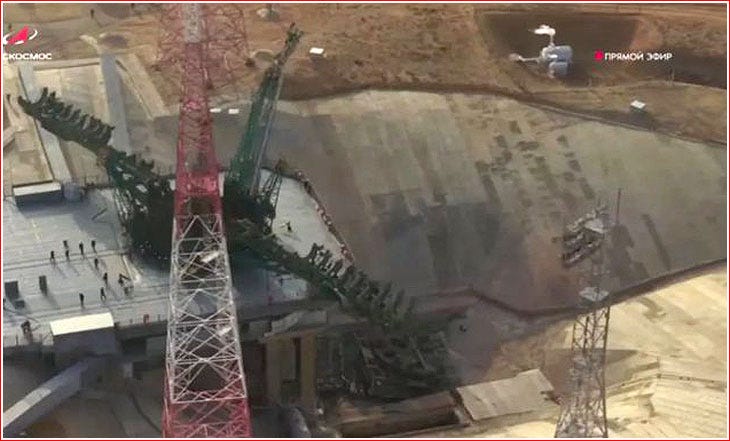
The service cabin lies in the flame trench after the November 27 Soyuz launch. Image source: Anatoly Zak, RussianSpaceWeb.com on X.
Anatoly Zak, proprietor of RussianSpaceWeb.com, has been covering the Russian space program since 1998. He’s arguably the leading online expert. Anatoly is where I turn for insightful analysis in times such as now.
His website has a page explaining how the service cabin works. The cabin is a service structure below the pad that gives technicians access to the business end of the Soyuz rocket.
The cabin is supposed to retract into a shelter before launch. Anatoly’s early speculation is that the cabin may not have been secured in its shelter.
Whatever the cause, the main concern is how this will impact ISS operations.
Katya Pavlushchenko posted on X a Roscosmos statement assuring that all is well. Translated from Russian, the statement reads, “All necessary spare components are available for repair, and the damage will be repaired shortly.”
Given Russia’s recent lack of transparency, if not honesty, with most international matters, it’s best to be skeptical for now. Anatoly Zak believes it could be up to two years before the pad is operational again.
Are other pads available? Not right now. Site 1, the same pad used to launch Yuri Gagarin into space on April 12, 1961, has been inactive since 2019. The updated Soyuz-2 rocket launches from Site 31. Although Roscosmos hoped to upgrade Site 1 for Soyuz-2, the lack of funding has left Site 1 incapable of launching payloads to ISS. Anatoly suggests that parts could be cannibalized from Site 1 or other compatible Russian launch sites — but that would take time.
Another complication is who owns Baikonur. The cosmodrome is in Kazakhstan, which was part of the Soviet Union when the pads were built in the 1950s. After the Soviet Union fell in 1991, Kazakhstan declared its independence, leaving Baikonur’s ownership in question. Russia finally agreed in 1994 to lease Baikonur from Kazakhstan for twenty years at $115 million per year.
The relationship has been far from stable. In 2010, Kazakhstan finally ratified an extension to 2050 negotiated six years earlier. Arguing that the host nation is undercompensated, Kazakhstan seized Roscosmos Baikonur assets in March 2023. The dispute must have been resolved, because Roscosmos launched a Progress cargo ship from Baikonur to ISS in May 2023.
According to Anatoly Zak, Site 1 has been transferred to the Kazakh company Infrakos. Gagarin’s pad could be a tourist stop. If Site 1 has a spare service cabin, technically it belongs to Infrakos, which might be reluctant to part with it given their dubious relations with Russia.
Soyuz-2 launches to ISS have only been from Baikonur. The Soyuz-2 has launched missions from other sites in Russia, Plesetsk and Vostochny. A variant called the Soyuz-ST has launched from Guiana Space Center, but Russia suspended those launches in response to European sanctions after Russia invaded Ukraine in 2022.
It’s not easy to switch ISS missions to another site. Just as NASA has an ISS launch support infrastructure at Kennedy Space Center, so does Roscosmos at Baikonur. It would be quite impractical to shift payloads, especially time-sensitive items such as biological specimens, to a site without life support for those creatures. Many ISS experiments also require temperature-specific shipping containers.
Russia built the Vostochny Cosmodrome in the Amur Oblast with the eventual goal of shifting launches from Baikonur but, as with other Roscosmos setbacks, funding and corruption have delayed the transition.
Vostochny is at a higher latitude (51.8° N) than Baikonur (45.9°N), which poses problems with orbital mechanics.
Planet Earth rotates on its axis from west to east. If you could somehow hover above Baikonur, you would observe it rotate away from you to the eastern horizon. In about twenty-four hours, you would observe Baikonur return to you from the western horizon.
How fast is Baikonur going? About 725 mph (1,167 kph). Vostochny is going about 643 mph (1,035 kph).1
The closer the launch site to the equator, the larger velocity boost. Plesetsk is at 62.9° latitude, traveling only 474 mph (763 kph). The less velocity, the more fuel (and/or less cargo weight) necessary to reach the ISS.
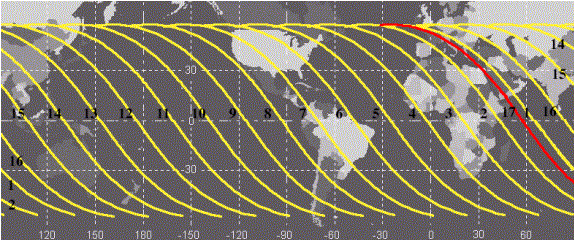
The ISS orbit track during one day. One orbit is about 90 minutes. The maximum latitude in both hemispheres is 51.6. Image source: NASA.
The ISS orbits Earth at a 51.6° inclination to the equator. That angle was chosen so that station would fly over launch sites at KSC and Baikonur. As a result, launch sites beyond a 51.6° latitude are impractical, if not impossible, for reaching ISS.
This effectively rules out Plesetsk. Vostochny might be possible if the Soyuz performs a “dog leg” maneuver after launch to change orbits, but that would require more fuel. Guiana, at 5.2° N latitude, would be a viable launch site — the European Space Agency in 2005 foresaw the day when crew might launch to ISS from Guiana — but the site was never upgraded for crewed flight.
During NASA’s commercial cargo era, Northrop Grumman has launched Antares Cygnus missions from the Mid-Atlantic Regional Spaceport at Wallops Island, Virginia. It just so happens that the ISS orbit also passes over Wallops (37.9° N). Cygnus has also launched from Cape Canaveral (28.4° N) on a United Launch Alliance Atlas V as well as a SpaceX Falcon 9.
But there’s another problem unique to Baikonur.
Pad 31 launches not only Soyuz crew capsules to the ISS, but also robotic Progress cargo ships. Progress is unique in that it’s the only visiting spacecraft that can fully adjust the station’s orbit.
Over time, the ISS slowly falls from orbit towards Earth. The station orbits in an environment where there are still a few particles from Earth’s atmosphere, as well as microgravity and other molecules it encounters that slow it down.
Inside the ISS during an orbital reboost. Video source: NASA Johnson YouTube channel.
Progress and the SpaceX Dragon can use propulsion to boost the station to a desired orbit of about 250 miles (400 km). But only Progress can service the station’s Control Moment Gyroscopes (CMGs). Click here for a technical explanation; the upshot is that, without Progress, eventually ISS will lose its ability to control its attitude. According to SEDS USA, Progress launches to ISS are scheduled for December 2025 and February 2026.
Could a Progress launch atop a SpaceX Falcon 9 or Falcon Heavy? That’s beyond my knowledge, although SpaceX has shown they’ll attempt the impossible. It’s very unlikely, in my opinion, that Vladimir Putin would tolerate the disgrace from watching Progress launch atop a Falcon 9 from Cape Canaveral.
As for crew, refurbished SpaceX crew Dragons rotate ISS crews about three times a year. The Boeing Starliner, one-time congressional darling, has been reduced to an afterthought. NASA recently demoted Starliner’s next flight to a cargo-only mission, no earlier than April 2026.
ISS is targeted for retirement circa 2030. Russia already has plans for its own new space station, called the Russian Orbital Station. Given the generally decrepit state of Russian space technology, it’s hard to take that seriously. Russia’s inability to support ISS for two years could mean an early end to one of the most significant achievements in humanity’s history.
NASA is all but rudderless as well. President Trump canned his NASA administrator candidate Jared Isaacman in May, only to renominate him earlier this month. Other than grand rhetoric about a crewed Mars mission during his term, Trump has done nothing substantive for the agency, cutting its budget by about 25%. NASA is not an agency that can nimbly react to a crisis such as this one.
For now, we await a sober and honest assessment of Site 31. If the damage is as bad as feared, with no immediate viable options, the ISS partnership may be forced to euthanize the station before the end of its natural life span.
The vCalc webpage has a handy formula for calculating rotational speed at any latitude. Click here.
Wow, this does seem like a potential early end to ISS, all things considered. Russia nearly pulled out a couple of times already, and Musk said he wants it deorbited early, and nobody in power right now is very keen on the kind of scientific research done on ISS. Hard to picture a heroic effort to save it, unless there's a clear path to PR glory for someone.
Only weird part to me is the suggestion that a spare cabin for the launchpad would be withheld out of spite for Russia. Is there more money to be made from selling tourist tickets to Gagarin's pad than from leasing an active launch site?