
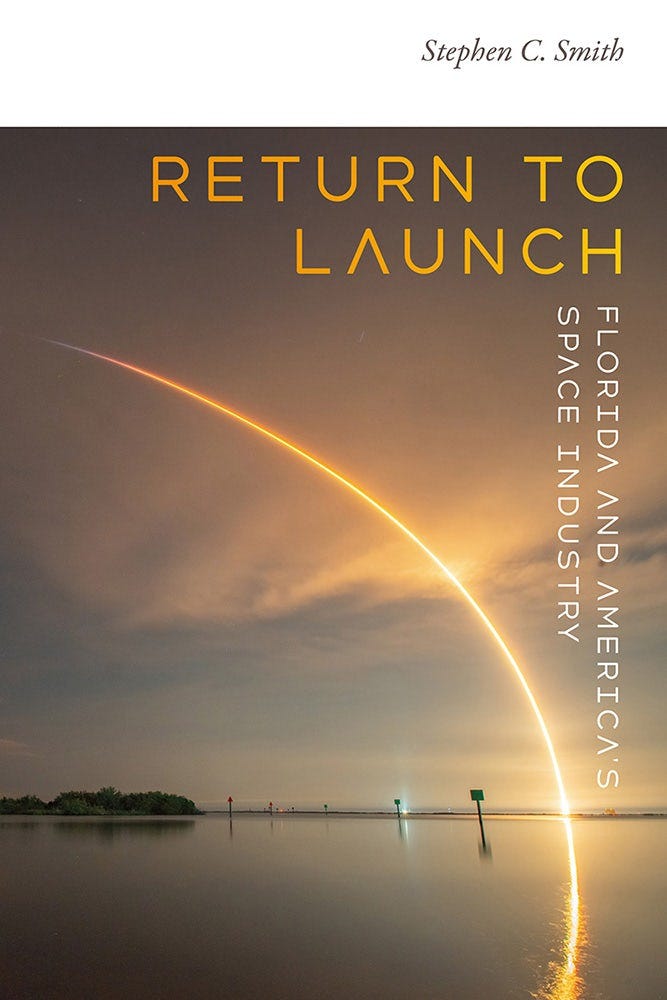
“Return to Launch” is being published by the University of Florida Press. It’s scheduled to ship starting March 26, 2026. Image photo courtesy Julia Bergeron.
The publisher lists Return to Launch for $38. If you order before January 31, 2026 and use the promo code 31AU126 it’s only $25. Click here to order.
When we moved from California to the Space Coast of Florida in 2009, I saw demonstrations by union laborers protesting the end of the Space Shuttle program.
Although the decision was announced by Republican President George W. Bush on January 14, 2004, the protestors blamed the then-president, Democrat Barack Obama.
I found this a bit odd because traditionally labor unions side with the Democrats. But these unionists were in league with the local Republican party.
That’s not much of a surprise, because Brevard County has had a Republican majority for decades. County voters sometimes chose Democrats, but those were typically centrist to conservative, such as its one-time congressman Bill Nelson. Like much of the South, after the Civil War Floridians almost always voted for Democrats, because the Republican party was the party of Abraham Lincoln. Richard Nixon’s “Southern Strategy” in the 1968 election is typically cited as when southerners became willing to vote for a Republican, including Brevard County.
As Shuttle’s denouement approached, the protests and rhetoric became hysterical and shrill. People claimed Obama was doing the bidding of Russia and China.
Obama came here on April 15, 2010 to deliver a speech the locals had demanded, but it made no difference. They wanted the status quo to continue. Many of his critics were offended by Obama’s tour of upstart SpaceX instead of going to see retiring Space Shuttle orbiters and infrastructure.1
President Barack Obama tours the SpaceX launch site at Launch Complex 40 with Elon Musk on April 15, 2010. Video source: Barack Obama Presidential Library YouTube channel.
As an occasional political consultant and general policy wonk, as well as a space geek, I followed all this with fascination.2 There was a sense that the nation was at a turning point in its space exploration and commerce, as significant as when President John F. Kennedy on May 25, 1961 proposed the crewed lunar program with an end-of-decade target date.
In April 2011, I began a ten-year career as a communicator with the Kennedy Space Center Visitor Complex. “Communicator” conjures a mental image of a Star Trek prop but, in this sense, we are the front line interface for NASA with the public. A communicator is part educator, part tour guide, and occasionally retired astronaut escort.
From that experience I learned what the public, foreign and domestic, wanted to know about the US space program. It wasn’t how many ping-pong balls can fit in the Vehicle Assembly Building. It was, “What’s next?”
Starting the day after the final Space Shuttle launch, I began my tours with:
Welcome to our third age of American human space flight. We’ve finished the International Space Station; it’s fully operational. To get there, commercial cargo flights have begun, and commercial crew flights with astronauts are targeted for the middle of the decade. By the end of the decade, NASA will be flying a new rocket called the Space Launch System. The crew capsule is called Orion. That will give us the ability to send astronauts beyond Earth orbit for the first time since 1972. NASA’s vision for Kennedy Space Center is to be the world’s premier spaceport for both government and commercial launches, so humanity can work and explore in space.
In those early days, it was quite common for someone to raise a hand and ask, “Wait, didn’t Obama cancel the space program?” I replied no, and gave them the same explanation I just gave you. Most were shocked to find out they’d been misled by US mainstream media across the partisan spectrum. A few even called me a liar, because they’d been told by some local that “Obama hates space” and had sold NASA to the Chinese. (Yes, I really heard that, several times.)
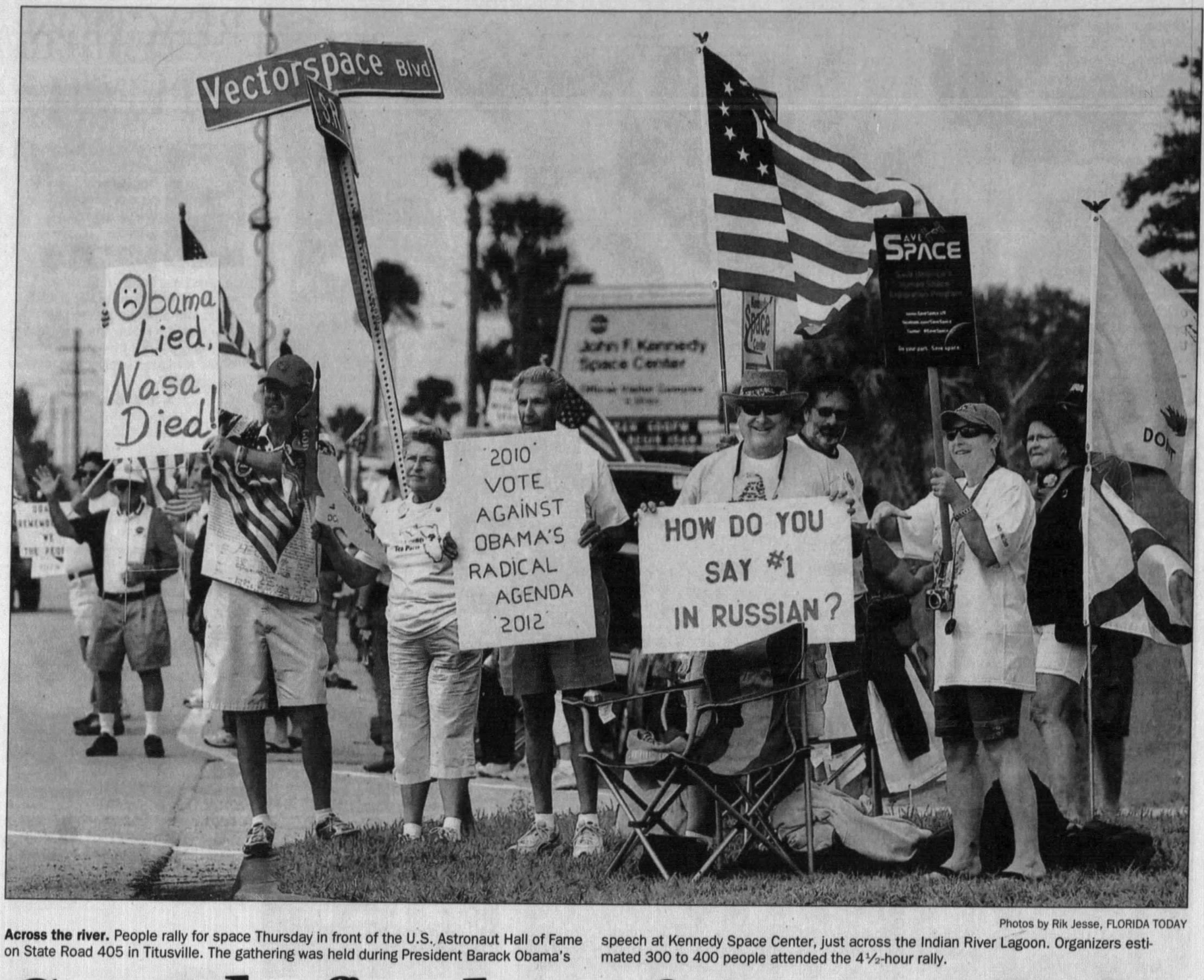
Protestors outside Kennedy Space Center on April 15, 2010, the day President Obama delivered his space policy speech. An Orlando TV station reported that some of the protestors said they were members of the far-right Tea Party. Image source: Florida Today.
By the end of my decade, everything I’d predicted had come true, although not always on schedule. April 2021 was my mic-drop moment. I retired. Peace, out.
For those ten years, it was always in the back of my head that, “This is a good story.” The Obama administration had changed the course of US spaceflight for the better, with Florida at the heart of the tale, but no one knows it.
After writing three sample chapters for the book, I submitted the proposal to the University of Florida Press.3 They bought it. Wow, stop the presses! Neophyte writer sells book proposal on his first submission!
It took about four years to complete the book, through research, drafts, revisions, internal and external reviews. The publisher gave it the title, Return to Launch.
You can buy it now. The book ships on March 26.
Everyone who’s read it has been positive. It’s a history book, but I feel it’s almost like a novel. The plot has protagonists and antagonists; who is which is up to you. The plot has subplots that weave throughout the story; some subplots go dormant only to awaken later as we reach the climax.
Heroes emerged along the way I never knew about. I trace the Florida NewSpace era to a group formed in 1986 called the East Central Florida Space Business Roundtable, led by a space evangelist named Stephen Morgan. They proposed to Florida governor Bob Martinez (a Republican) their idea for a “space chamber of commerce.”
Their proposal led to the creation of a state agency called the Spaceport Florida Authority. This was a public-private partnership designed to encourage commercial use of Cape Canaveral launch sites and herald a new era of space enterprise.
Other states later tried to emulate Florida — Virginia hired Stephen Morgan to start their space authority — but Florida has always been the best success story. Today, it’s called Space Florida.
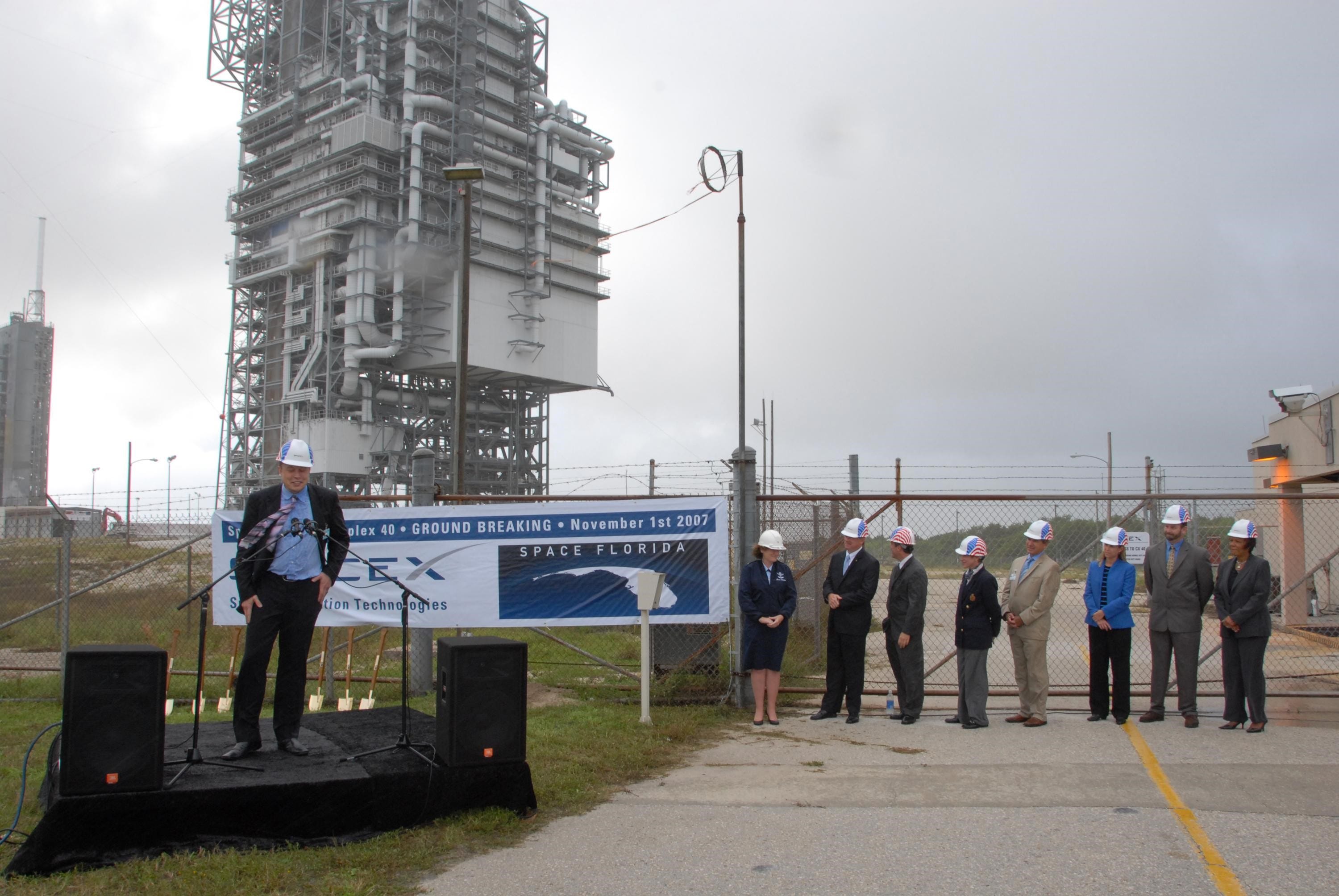
Elon Musk addresses the assembled on November 1, 2007 as Space Florida helps SpaceX take over Launch Complex 40, a former Titan rocket launch pad. Image source: NASA.
If not for Space Florida, it’s highly unlikely that SpaceX would be at Cape Canaveral, at least as early as they were. Elon Musk initially planned to launch from Vandenberg Air Force Base in California, but was frustrated by the military bureaucracy, so he relocated his test launches to Kwajalein Atoll in the Pacific. Space Florida arranged for funding to help SpaceX renovate Launch Complex 40, and later other facilities.
Much is being written about Elon Musk, SpaceX, and other NewSpace companies but, as far as we can tell, no one has written about Florida’s role in the SpaceX success story.
Three main subplots intertwine throughout the story:
Florida’s efforts to commercialize and diversify its space economy
Elon Musk and other space evangelists spending billions to prove NewSpace is possible
Reformists seeking to change the federal space program business model, and those who opposed them.
The most famous reformist is Lori Garver. At one time the executive director of the National Space Society, during the 2008 presidential election she was space policy advisor to first Hillary Clinton and then, once Clinton left the race, Barack Obama.
Garver helped Obama develop a cohesive and comprehensive space policy. She tells that story in her own book, Escaping Gravity. I’ve told Lori that I consider Return to Launch a complement to her book. She tells what transpired in Washington, DC while I tell what’s happening at the same time in Brevard County.
Bill Nelson generously provided his time and insights. As a House member, he flew on the Space Shuttle in 1985 as a congressional observer. His experiences helped Congress comprehend the Challenger disaster and its consequences. Nelson was elected to the US Senate in 2000, where he represented Florida for eighteen years. He served as President Joe Biden’s NASA administrator.
Although generally perceived as a fierce protector of OldSpace, Bill walked me through the political negotiations that led to the 2010 NASA authorization act. As much as the Obama White House wanted reform, Congress on both sides of the aisle had little interest, especially during the Great Recession. The “grand compromise” was negotiated between Senate members and the White House, then walked through the House by Nelson and Kay Bailey Hutchison (R-TX).
I view Return to Launch as a backdoor political science textbook. What happens when reformists and pragmatists collide? What if one side is right but the other side doesn’t care because of their own parochial interests? Return to Launch delves into that conflict.
Any good writer will tell you that drama comes out of conflict.
All those who’ve read Return to Launch say it’s an enjoyable read. It has nearly a hundred pages of endnotes, because I know much of the content will be controversial. With the exception of Lori’s book, this is the first peek behind-the-curtain at the evolution of the Obama administration’s space policy and the resistance it faced from defenders of the status quo. I’ve no doubt that I’ll be called a liar, and much worse, once the locals read it. Here are my sources. Show me yours.
Although I interviewed Bill Nelson and Lori Garver, I also interviewed a lot of witnesses who were in the trenches. Not everyone cooperated. I consider this book to be the first on the topic — but not the last. I’ve left bread crumbs for others to follow.
Once the book is available, I look forward to your feedback.
A KSC employee told me that day, “I want him to come to the VAB so we can throw tomatoes at him.”
I have a bachelor’s degree in political science and a master’s degree in public administration. I’ve worked for local government in various capacities, and consulted on several election campaigns. The space geekery goes back to watching the original Star Trek as a child as well as the 1960s “Space Age” on television. Yes, I’m old.
It’s also known as the University Press of Florida. They tell me the two terms are interchangeable and are equally valid.