
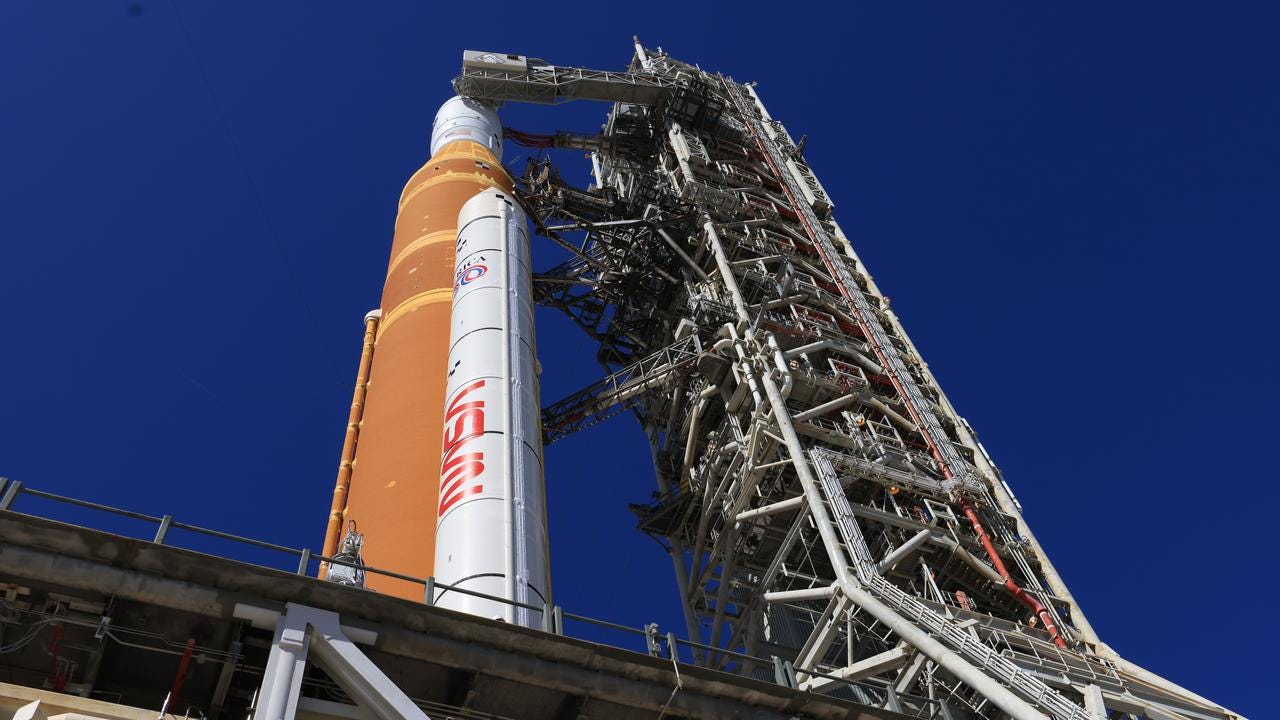
The Artemis II Space Launch System at Kennedy Space Center’s Pad 39B on February 10, 2026. Image source: NASA.
NASA announced on February 27 a reorganization of Project Artemis that administrator Jared Isaacman hopes will result in at least one crewed lunar landing a year starting in 2028.
The announcement came right after the Artemis II Space Launch System rolled back into the Vehicle Assembly Building to fix a helium leak.
As was its Space Shuttle predecessor, the SLS has been plagued by liquid hydrogen (LH₂) leaks. I wrote on February 4 about why LH₂ is a very bad idea for a launch fuel.
NASA is cancelling a planned SLS upgrade, hoping that this will somehow improve launch cadence. The current SLS version is called Block I, while the upgrade is known as Block IB.
But so long as SLS is its core launch vehicle, Artemis will struggle to launch anywhere close to a reliable launch cadence.
The Monster Rocket
As early as February 1970, NASA required contractors bidding on the Space Shuttle orbiter’s main engine (SSME) contract to plan on it using LH₂ as a fuel. NASA sought “a reusable system with a high launch rate capability and short turnaround and reaction times compatible with rescue missions.” The request for proposal required the SSME to use a “hydrogen-oxygen propellant design.”1
Why use such a difficult chemical as a fuel? Reusability.
Most liquid-fueled rockets at that time, including the first stage of the Saturn V, used RP-1 kerosene as a fuel. While safer and cheaper, burning RP-1 left carbon soot and hydrocarbon residues on the pad and in the engines. Even today’s SpaceX Falcon 9 rockets, which land on a drone ship or a landing pad, require their Merlin engines to be cleaned before the rocket can fly again. Before the Falcon 9, boosters using RP-1 were considered to be expendable, meaning they fell into the ocean and were not recovered.2
What’s the byproduct from combusting liquid oxygen and liquid hydrogen? Water vapor! That was why NASA was willing to tolerate LH₂’s eccentricities. The hope was that the engines could be turned around and launched again.
But LH₂ turned out to be one of the many reasons why Shuttle was so inefficient. In 1990, NASA became aware of hydrogen leaks in both Columbia and Atlantis. The shuttle program was down for six months. The incident became known as “The Summer of Hydrogen.”3
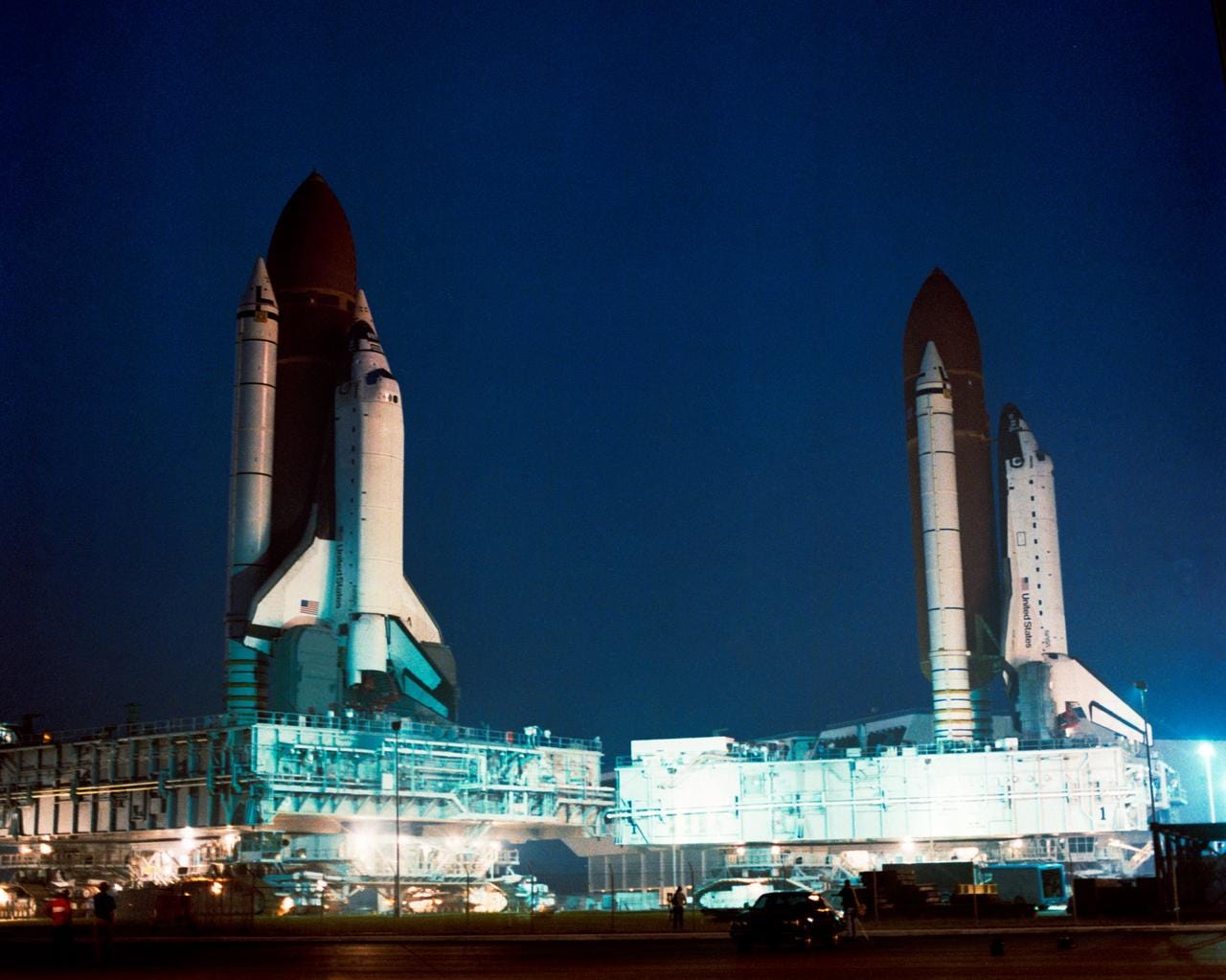
STS-35 Columbia and STS-38 Atlantis pass one another on the KSC crawlerway, August 22, 1990. Both rolled back to the Vehicle Assembly Building to identify the source of hydrogen leaks. Image source: NASA.
If LH₂ was so troublesome, why did NASA choose to use it as a fuel for Shuttle’s successor?
Congress.
We’ve discussed in prior columns how Congress used the 2010 NASA authorization act to protect NASA legacy contractors and their employees during the Great Recession, rather than doing what was best for the nation’s human spaceflight program. This legendary 2011 column by the Competitive Space Task Force sums it up.
Section 304 required NASA to use existing technologies from Shuttle and its failed successor known as Constellation. That meant LH₂ as a fuel, which meant more hydrogen leaks.
At least LH₂ for Shuttle engines was justified by reusability. SLS isn’t designed to be reusable. It’s expendable. The core stage, with its four Shuttle-era engines on the bottom, falls into the ocean and is destroyed. So there was no justification for LH₂ other than protecting legacy contracts and jobs.4
The 2022 Artemis I uncrewed test mission was delayed due to hydrogen leaks. The 2026 Artemis II mission was delayed due to hydrogen leaks. After that was resolved, the SLS experienced a helium leak, which necessitated rolling back the stack to the Vehicle Assembly Building for repairs. NASA determined that a seal was blocking helium flow from ground systems.
Unlike hydrogen, helium isn’t all that dangerous. It’s used to pressurize tanks and purge engines. Helium is inert, so it can’t catch fire like hydrogen can.
But it’s slow, cumbersome, and expensive to roll back a stack to the VAB. The journey from Pad 39B to the VAB is about 4.2 miles (6.8 km). Depending on circumstances, the journey takes about eight to twelve hours. A rollback impacts KSC operations, because the crawlerway crosses or parallels various roads.
Why do it this way at all?
Because Congress mandated that NASA use the same ground systems and infrastructures used by Shuttle. Those were inherited from the Apollo program in the 1960s.
The VAB is far from the launch pad because, in the 1960s, it was feared a Saturn V explosion on the pad might send debris and concussion waves for miles.
SpaceX at their launch sites, and Blue Origin at their Cape Canaveral launch site, have hangars close to the pad. The SpaceX hangar at Pad 40 survived a Falcon 9 explosion on the pad, on September 1, 2016, during a static test fire. The Falcon 9 is certainly not the scale of a Saturn V or Shuttle or Blue Origin’s New Glenn or the SpaceX Starship now in testing. But it did demonstrate that, for their technology, SpaceX doesn’t need to be four miles away.
SLS was unveiled by members of Congress on September 14, 2011. Senator Bill Nelson (D-FL) called it the “monster rocket.” The SLS legislation required NASA to develop two variants. The initial version, the one we have now, is called Block 1. A more powerful version, called the Block 1B, was also mandated by Congress. The 2010 authorization act directed that NASA should have the goal of Block 1 “operational capability” by December 31, 2016. (Artemis I launched on November 16, 2022, almost six years behind congressional mandate.)
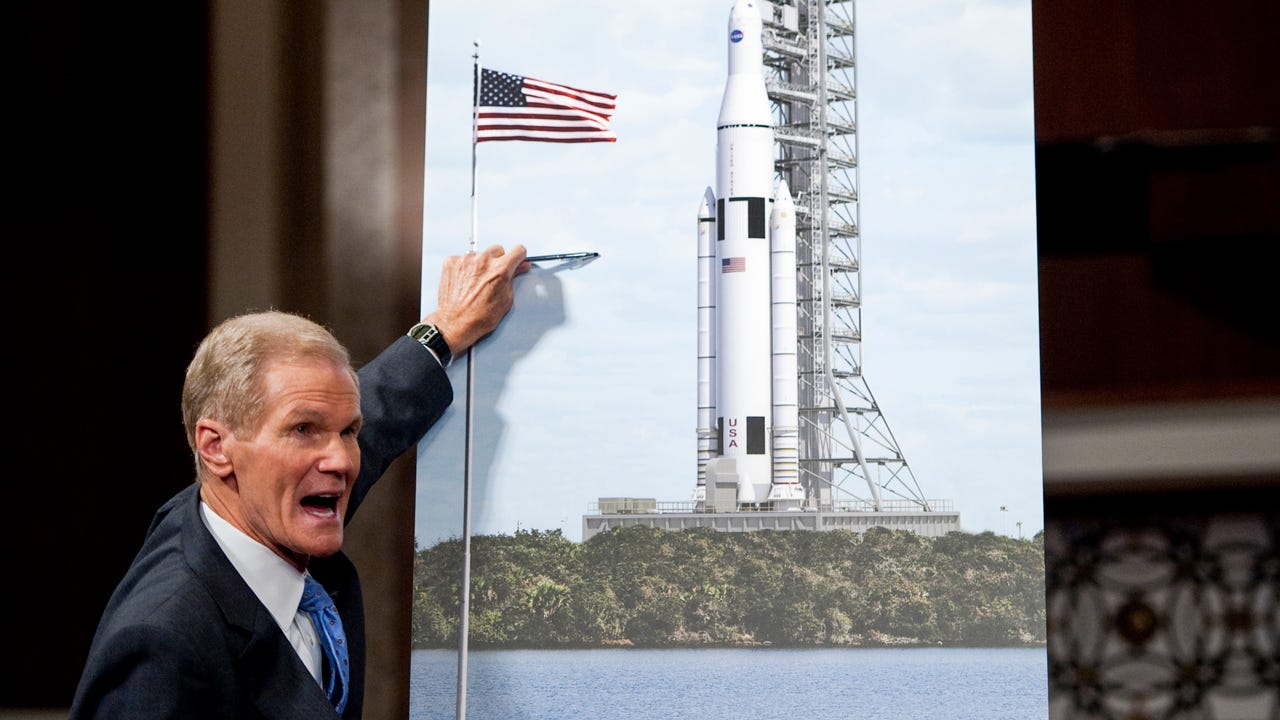
Senator Bill Nelson unveils the Space Launch System design at a congressional media event, September 14, 2011. Image source: AP via Science.org.
Block 1 was to be used for only three SLS flights. NASA chose to renovate an existing launch tower, built for Constellation, for those three flights. In 2020, the NASA Office of the Inspector General (OIG) found that the renovation for Mobile Launcher 1 was already three years behind schedule and $300 million over budget. NASA planned to spend $693 million to modify ML-1 for three flights, or about $230 million per mission.5
Block 1B would require a bigger launch tower, Mobile Launcher 2. The OIG concluded in 2024 that ML-2, originally projected to cost under $500 million, would cost up to $2.7 billion when completed somewhere around spring 2029.6
In 2021, the OIG estimated that NASA would spend $93 billion on Project Artemis through Fiscal Year 2025, with an estimated cost of $4.1 billion each of Artemis I through IV.7
Bull in the China Shop
The return of Donald Trump to the White House, followed by Elon Musk’s scythe slicing through NASA’s budget, badly damaged the agency’s workforce. By one account, NASA lost 20% of its workforce. Trump attempted to reduce NASA’s budget by about one-fourth, although much of it was finally restored by Congress. Musk certainly had a conflict of interest, being the owner of one of NASA’s primary launch vendors, but no one in power seemed inclined to do anything about it.
Musk departed the White House at the end of May, having offended many Trump administration officials and finally Trump himself. After Musk made public comments critical of Trump, the president retaliated by firing his NASA administrator nominee, billionaire and space evanglist Jared Isaacman, who had flown twice on SpaceX commercial flights.
Transportation secretary Sean Duffy served as interim administrator until a successor was nominated. The new nominee, announced in November, was … Jared Isaacman.
During his first administration, Trump jokingly suggested that NASA send a crewed mission to Mars by 2020, when he would be running for re-election. On December 18, 2025 — the day after Isaacman was confirmed by the Senate — the White House released Trump’s space policy. The executive order directed that NASA use the Artemis program to send astronauts to the moon by 2028, the end of Trump’s second term.
The administration has declared it’s a priority to return US astronauts to the moon for a seventh time before China lands crew for the first time. Why this is important hasn’t been explained, at least to my satisfaction. In my January 10, 2026 column, I revisited the 1960s rhetoric, which justified Apollo strictly on the basis of “prestige.” That seems to be the justification now, substituting China for the Soviet Union.
Having been axed once, it’s easy to understand that Isaacman believes it’s his top priority to put astronauts back on the moon by the end of Trump’s term, never mind the wisdom, the cost, or the alternatives. In public statements, Isaacman has said that he believes the most expedient way to do that is to continue with SLS, despite its expense and inefficiency. The logical alternatives — the SpaceX Starship and the Blue Origin New Glenn — can’t assure a 2028 crewed launch.
A NASA media event at Kennedy Space Center on February 27, 2026 announced a revision to the Project Artemis launch schedule. Video source: Space SPAN YouTube channel.
On February 27, Isaacman announced revisions to the Artemis cadence and architecture.
Artemis III was intended to land crew at the moon’s south pole. Neither of the lander vendors, SpaceX or Blue Origin, are likely to be ready. Artemis III will now be a 2027 docking in low Earth orbit between four astronauts aboard the Orion crew capsule and one of the landers. This sets up a competitive race between the two vendors to see who can be ready first.
Artemis IV targets early 2028 for the crewed lunar landing. Artemis V would be a crewed landing in late 2028.
Isaacman cancelled Block 1B as well as its upper stage, the Exploration Upper Stage. The EUS, like much of SLS, was behind schedule and over budget. An August 2024 NASA OIG audit found that the EUS cost had grown from $962 million to $2 billion, yet another black eye for Boeing, the EUS vendor. OIG estimated that EUS wouldn’t be delivered until April 2027, more than six years behind schedule.8 Isaacman also cancelled the ML-2 tower, so it will sit outside the VAB, abandoned in place.
With the EUS cancelled, NASA announced today that it intends to award a no-bid contract to United Launch Alliance (a partnership of Boeing and Lockheed Martin) to build a variant of its Vulcan Centaur upper stage.
Award of a no-bid contract to an “OldSpace” company blares red-alert klaxons. The Interim Cryogenic Propulsion Stage, used on SLS to date, has a thrust of only 24,750 pounds. The EUS thrust was projected to be 97,360 pounds. Vulcan Centaur provides 47,650 pounds of thrust. But the SpaceX Falcon 9 upper stage has 220,500 pounds. The Blue Origin New Glenn upper stage (NGUS) provides 400,000 pounds.
The justification document (JOFOC) on the SAM.gov website states that NASA studied only the Vulcan Center and NGUS. NASA concluded that Centaur would be more compatible, has a longer history, and would require fewer modifications than NGUS. SpaceX isn’t mentioned. Perhaps NASA concluded the SpaceX upper stage wasn’t viable; it uses RP-1 as fuel, while the other candidates use LH₂. SLS’s Pad 39B isn’t equipped for RP-1 fueling. (It was during Apollo.)
The fate of Gateway is unclear. Gateway is to be NASA’s first cislunar space station. I wrote in April 2025 why I think Gateway is important but, if this administration’s priority is to plant the seventh US flag on the moon before China plants its first, Gateway becomes irrelevant. Eric Berger at Ars Technica believes Gateway teeters on the precipice of cancellation. Once again, science is scrubbed for symbolism.
China has yet to demonstrate any capability for sending crews beyond low Earth orbit, much less to lunar orbit, or the far more difficult ability to land and launch from the surface. But once again, science is sacrificed for politics and an illusion of expediency.
With Artemis relying on historically unreliable technologies, personally I don’t expect any nation to land crews on the moon this decade. NASA, prove me wrong.
NASA Office of Manned Space Flight, “Statement of Work, Space Shuttle System, Program Definition (Phase B), RFP No. 10-8423, February 1970. The RFP can be found starting at page 286 of the PDF at this link. The reusability requirement is on page 2 of the document. The LH₂ requirement is on page 14.
Both SpaceX and Blue Origin are migrating to launch systems that use methane as a fuel. Methane burns cleaner than RP-1.
Dennis R. Jenkins, Space Shuttle: Developing an Icon — 1972-2013, Volume III - The Flight Campaign (Forest Lake, MN: Specialty Press, 2016), III-120-121, III-154.
Despite visual appearances, the two solid rocket boosters provide more than 75% of the thrust at launch time. The core stage is so big because LH₂ is so rarefied.
“Audit of NASA’s Development of Its Mobile Launchers,” NASA Office of the Inspector General, March 17, 2020, 10.
“NASA’s Management of the Mobile Launcher 2 Project,” NASA Office of the Inspector General, August 27, 2024. See the “What We Found” introduction.
“NASA’s Management of the Artemis Missions,” NASA Office of the Inspector General, November 15, 2021. See the “What We Found” introduction.
“NASA’s Management of Space Launch System Block 1B Development,” NASA Office of the Inspector General, August 8, 2024, introduction.