
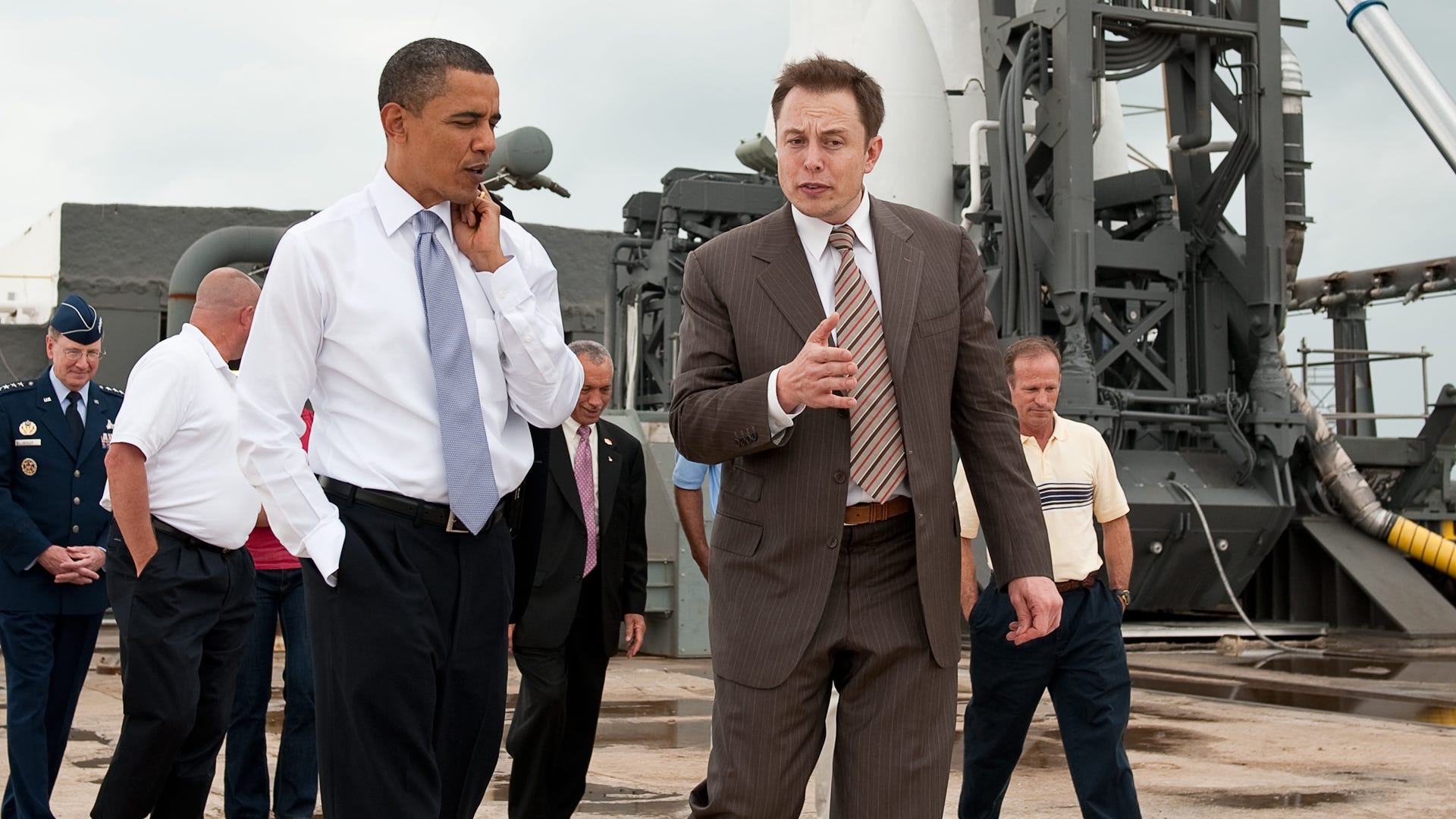
President Barack Obama tours SpaceX Launch Complex 40 with SpaceX founder Elon Musk, Cape Canaveral Air Force Station, April 15, 2010. Image source: NASA.
“Why would God choose an obscene child to be His instrument?” — Salieri, Amadeus
The Hobbyist
President Barack Obama’s reformist Fiscal Year 2011 NASA budget proposal was the most controversial by any president since John F. Kennedy proposed the US send a man to the moon by the end of the 1960s.
Obama proposed cancelling Project Constellation, which was over budget and behind schedule. A 2008 Government Accountability Office (GAO) report found, “… there are considerable unknowns as to whether NASA’s plans for these vehicles can be executed within schedule goals and what these efforts will ultimately cost.” An Obama-appointed committee in 2009 agreed, “The US human spaceflight program appears to be on an unsustainable trajectory.” The committee members concluded that NASA required an additional $3 billion a year to make Constellation viable.
The Obama administration proposed increasing NASA’s budget, but not to fund Constellation. The George W. Bush administration had planned to decommission and destroy the ISS in 2016 to pay for Constellation; Obama extended the International Space Station to at least 2020. He intended to increase funding for the Bush-era commercial cargo program, and begin funding another Bush-era plan for commercial crew, which had gone unfunded.
Obama wanted to introduce competition and innovation into NASA procurement. Until then, NASA mostly used “cost-plus” contracts that guarantee the contractor a profit regardless of performance or expense. Some are these were no-bid contracts. Cost-plus contracts were a holdover from when technologies were uncertain and risks were high. The commercial programs used “fixed-price” contracts. The contractors had to invest their own money and assume some of the risk. The taxpayer would no longer be left with a big bill for a failed program.
The “OldSpace” legacy contractors passed on commercial cargo, but several “NewSpace” startups applied. One of them was Space Exploration Technologies, commonly known as SpaceX. The company was founded by Elon Musk, an entrepreneur who made his fortune from various high tech startups. His first was Zip2, a digital business directory with interactive Bay Area city maps. He sold the company to Compaq; his share was $22 million. Musk then co-founded an online financial services company called X.com, which eventually merged with what became PayPal. When PayPal was acquired in 2002 by eBay, Musk received $175 million in shares.
Around this time, Musk decided to start his own rocket company. Musk wanted to send a greenhouse to Mars, with a camera streaming live video back to Earth. He and others went to Moscow, intending to buy a Russian ICBM to launch the greenhouse, but were rejected. On the flight home, Musk used an Excel spreadsheet to estimate how much it would cost to build the rocket himself.
And so SpaceX was born.
Unlike OldSpace contractors, SpaceX didn’t have its hand out demanding guaranteed profits. OldSpace saw no guaranteed profit in it for their shareholders. But SpaceX and the NewSpace companies were willing to assume the risk in exchange for milestone payments that helped establish their legitimacy.
Contrary to what some revisionist historians have claimed, these were not “subsidies.” No company was paid until it achieved a milestone. If a company failed, it was out of the competition. Click here to read the August 2006 SpaceX milestone agreement.
By 2009, when Obama’s proposal was released, SpaceX had become the NewSpace poster child. The company accepted failure as part of its R&D process, learning as they flew.
Musk and his rocketeers had plenty of OldSpace enemies who viewed SpaceX as a clear and present danger to their guaranteed profits. One of their more prominent critics was Richard Shelby, the Republican senior senator from Alabama. His state was the home of United Launch Alliance, a joint partnership of two legacy aerospace companies, Boeing and Lockheed Martin. Shelby called Musk and the other competitors “rocket hobbyists” and claimed these companies would ask for a handout. (That’s what OldSpace companies did when they fell behind schedule and went over budget.)
Some former NASA Apollo-era astronauts were also critics. Neil Armstrong, Gene Cernan, and Jim Lovell wrote an open letter claiming that Obama’s proposal would devastate NASA. Armstrong and Cernan testified their opposition to a Senate committee in May 2010; Cernan accused Obama and NASA leadership of imposing “a calculated plan to dismantle America’s leadership in the world of Human Space Exploration.” In a March 18, 2012 60 Minutes interview, Musk invited these astronauts to come see SpaceX for themselves, but none did.
The Elon Musk interview by “60 Minutes” correspondent Scott Pelley aired on March 18, 2012. Video source: 60 Minutes YouTube channel.
Musk was an obvious target for these critics. He was awkward, he was obnoxious, he was arrogant, and he was new money. Even worse, he was a foreigner from South Africa. False rumors circulated on the Internet that Musk was secretly funded by an “apartheid emerald mine.”
On April 15, 2010, Musk took Obama on a tour of the SpaceX pad at Cape Canaveral; the photos of them together outraged those who spun tales of sinister conspiracies. (I personally witnessed a ULA employee circulating at launches telling the gathered, “Obama secretly owns SpaceX.”) The hobbyist’s rocket, they claimed, would “blow up and kill people,” dooming the US space program to eternal dependence on the commies in China and the former Soviet Union.
Unlike corporations such as Boeing and Lockheed Martin, SpaceX was privately held. The critics claimed that Musk would go bankrupt, lose interest, and NASA would be forever crippled.
Do Not Pass Go
In the 2012 interview, 60 Minutes correspondent Scott Pelley said that Musk’s personal worth was estimated at $2 billion. Earlier this month, after SpaceX offered its shares publicly for the first time, Musk is now believed to be the world’s first trillionaire.
He didn’t go bankrupt.
But he nearly did in 2008.
The best source for Musk’s early years is the eponymous 2015 biography Elon Musk by Ashlee Vance. More than ten years later, the book remains fundamentally sound. Musk and others have quibbled about details, but it’s an excellent resource for understanding Musk’s personal and financial history.
Vance wrote about how Musk nearly lost his fortune starting both SpaceX and its fraternal twin Tesla. As with most startups, Musk was not the only investor in his companies. Among early SpaceX investors were Craft Ventures and Founders Fund. But the early months of the Great Recession dried up investor capital. Musk started selling off his personal assets to keep the companies afloat. His wife Justine filed for divorce in June 2008.
In September 2008, SpaceX achieved its first successful orbital flight with a prototype rocket called the Falcon 1 (for one engine). That milestone qualified SpaceX for a NASA commercial cargo contract, issued by the outgoing Bush administration. SpaceX was required to make twelve cargo deliveries to the ISS to earn $1.6 billion. The award kept SpaceX afloat; NASA approved a loan from SpaceX to Tesla, which helped Musk find new Tesla investors (Vance, 208).
If SpaceX failed to make a delivery, it wasn’t paid. (So much for the “subsidy” allegation.) The CRS-7 launch on June 28, 2015 exploded about two minutes after launch. As compensation for its loss, NASA chose to negotiate additional missions at discounted prices.
While NASA nurtured SpaceX, the Department of Defense circled the wagons to protect United Launch Alliance.
By the early 2000s, the US commercial launch industry had dwindled to a few launch companies. Commercial satellite payloads were going overseas where launches were cheaper — Europe, Russia, Japan, and even China.
To keep a domestic launch capacity viable, DOD allowed Boeing and Lockheed Martin to form United Launch Alliance. DOD wasn’t interested in affordability, only “assured access to space.” The Bush administration granted ULA a legal monopoly in May 2007; the company was guaranteed a profit in exchange for remaining in business. SpaceX sued in October 2005 to stop the monopoly, but a federal court dismissed the claim in February 2006, finding that SpaceX had not demonstrated any financial loss because the company didn’t have an operational launch vehicle.
The Falcon 9 (for nine engines) was quite operational by 2013, when DOD was ready to issue new launch contracts. But no competition was allowed — DOD awarded ULA a no-bid contract for 35 booster cores over the next five years, worth $9.5 billion. In April 2014, Musk announced that SpaceX would sue. SpaceX and DOD settled the lawsuit in January 2015; DOD agreed to provide SpaceX with launch opportunities and speed up its military payload certification.
Elon Musk and ULA CEO Michael Gass testify before the Senate Appropriations Committee, March 5, 2014. Video source: Space SPAN YouTube channel.
The turning point may have been a US Senate defense appropriations subcommittee hearing on March 5, 2014. Musk testified alongside ULA CEO Michael Gass.
In his prepared remarks, Musk accused ULA of receiving an annual $1 billion subsidy. He also noted that the ULA Atlas V used the Russian-made RD-180 engine. (ULA depended on the commies, not SpaceX.) Russia had just invaded the Crimea region of Ukraine in February, so US-Russia relations were uncertain at best.
The so-called $1 billion “subsidy” was a “launch capability” annual payment that kept ULA’s two rockets (the Atlas V and Delta IV) operational even if DOD didn’t need them. Some quibbled over the definition of “subsidy,” but Senator John McCain (R-AZ) implicitly backed the reform. McCain was chair of the Senate Armed Services Committee. He called for “a freeze on launch subsidy payments” and criticized ULA’s “apparent attempts to create an artificial need for relief from legislative restrictions on the use of Russian rocket engines.”
McCain went to war with Alabama’s Richard Shelby, who intended to protect ULA’s reliance on Russian engines. McCain said he wanted competition in military launch procurement; ULA responded by saying it would no longer bid to launch military GPS satellites, leaving the market to SpaceX. Senator Bill Nelson (D-FL) negotiated a compromise between the two warring Republican senators that transitioned ULA off the RD-180.
By the mid-2020s, SpaceX had a de facto US launch monopoly. Although no one in government has granted SpaceX a monopoly, the failure of ULA and other companies to effectively complete let SpaceX dominate the industry. In 2025, SpaceX launched 85% of US orbital missions. Many commercial satellite companies came back to the US to launch on affordable SpaceX boosters.
All of This Has Happened Before, and It Will All Happen Again
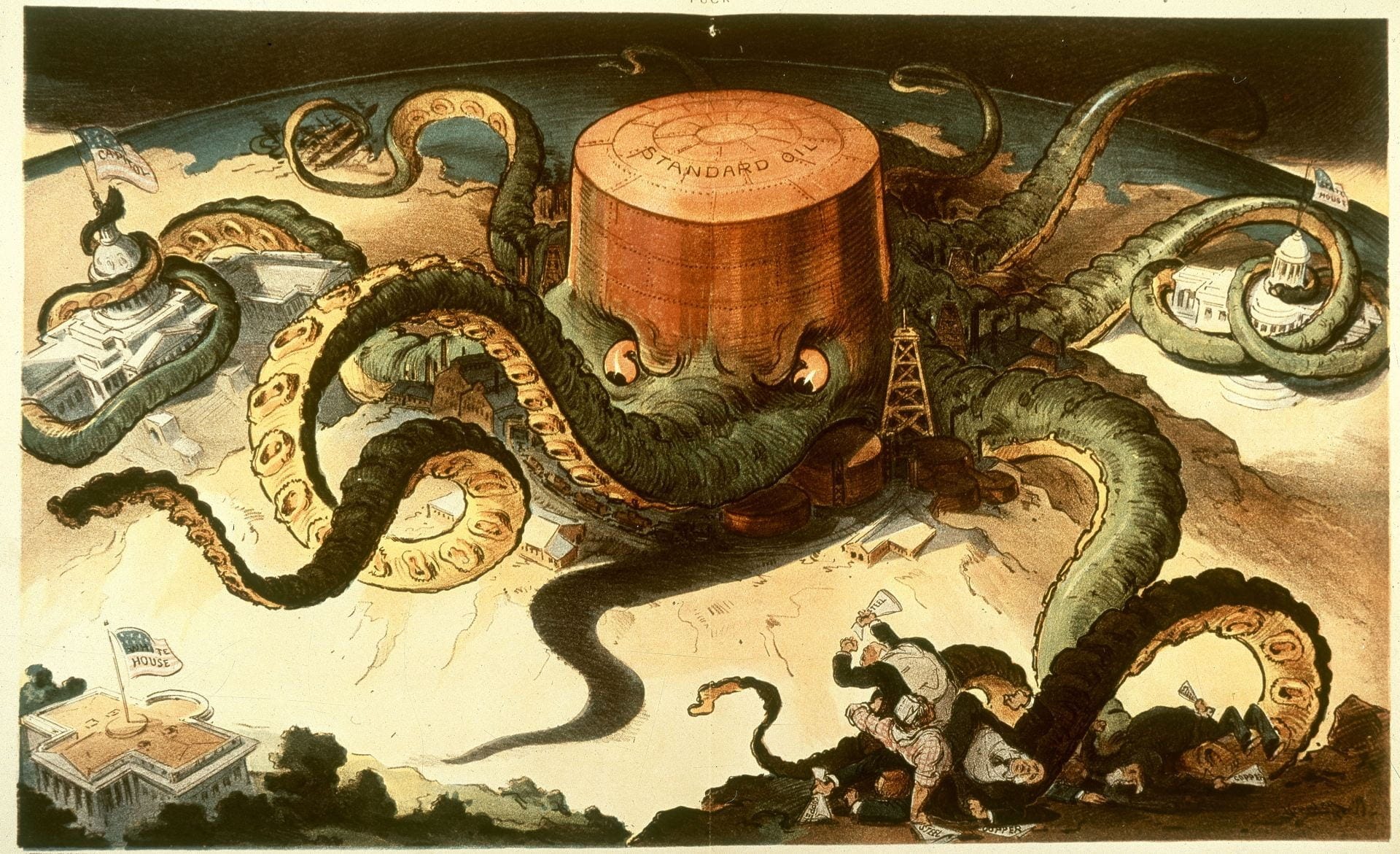
A September 7, 1904 issue of “Puck” magazine showed the octopoid Standard Oil reaching its tentacles into the White House and the Capitol. Image source: US Capitol Visitor Center.
The front page of the September 29, 1916 New York Times reported that Standard Oil founder and largest stockholder John D. Rockefeller had most likely become the first billionaire after the company’s stocks passed $2,000 per share. (That’s about $60,000 in today’s currency.)
Mr. Rockefeller also holds vast interests in various banks and railroads, besides enormous blocks of national, State, and municipal bonds.
As Elon Musk is today, Rockefeller was the villain of his time. Philosopher Bertrand Russell wrote in 1934:
Two men have been supreme in creating the modern world: Rockefeller and Bismarck. One in economics, the other in politics, refuted the liberal dream of universal happiness through individual competition, substituting monopoly and the corporate state, or at least movements toward them.
In his 1998 book Titan, biographer Ron Chernow wrote that Rockefeller “has remained an elusive figure. A master of disguises, he spent his life camouflaged behind multiple personae and shrouded beneath layers of mythology.” The same can’t be said for Elon Musk who, despite his social anxiety, relishes his public persona. Musk bought Twitter, the planet’s dominant social media platform, to espouse his worldview free of editorial constraints.
As Musk has, Rockefeller intervened in presidential politics. He backed William McKinley for president, who favored trusts such as Rockefeller’s Standard Oil. But McKinley was assassinated in 1901, succeeded by trustbuster Teddy Roosevelt.
Chernow wrote of Standard Oil’s “byzantine dealings with oil producers, refiners, transporters, and marketers, as well as railroad chieftains, bank directors, and political bosses. This panorama of greed and guile should startle even the most jaundiced students of the Gilded Age.” As Musk is, Rockefeller was a polarizing personality.
Like many moguls of the Gilded Age, Rockefeller was either glorified by partisan biographers, who could see no wrong, or vilified by vitriolic critics, who could see no right.
Those who passed legislation in the first two decades of the 21st Century encouraging commercial competition and innovation in the US aerospace industry midwived the most successful space transportation company in history. But SpaceX has diversified beyond anyone’s imagination. Just as Standard Oil’s tentacles reached into many aspects of the economy and government a century ago, SpaceX is the modern octopus, reaching far beyond space delivery services into satellite constellations, military communications, artificial intelligence, orbital data centers, and computer chip production.
Tesla, its fraternal twin, is evolving away from electric cars and solar power towards mass production of humanoid robotic servants. (Anyone who watched Caprica knows where this could lead …) Rumors abound that SpaceX and Tesla might merge. SpaceX has bought $700 million of Tesla battery storage systems, purchased Cybertrucks for use at its facilities, and acquired xAI which makes the Grok large language model used in Tesla vehicles.
Just before the IPO, SpaceX posted on X an interview in which Musk described his vision for the company’s future.
SpaceX CEO Elon Musk and Satellite Engineering Director Ian Dahl discuss their vision for the company’s future. Original source: SpaceX on X.com.
For longtime SpaceX employees, the IPO turned many of them into millionaires. SpaceX from its origin compensated employees with company shares; as the company succeeded, they became wealthier. The New York Times reported on June 10 that 4,400 SpaceX employees may have become millionaires after the IPO. Chief Operating Officer Gwynne Shotwell, with the company since 2002, is now estimated to be worth $2 billion. Tom Mueller, the first SpaceX employee, left in 2020 with his shares and is now estimated to be worth $2.2 billion. As have many early SpaceX employees, Mueller has gone on to found his own space company.
The company has become the Standard Oil of our time. According to one media report, after the initial public offering SpaceX now has $100 billion cash on hand. SpaceX is so far ahead of its domestic and international competitors that it seems unfathomable it could lose its market dominance. If SpaceX and Tesla merge, the company will be an unstoppable colossus unless the US government brings antitrust charges.
That’s unlikely during the Trump administration. Even though the relationship between President Trump and Elon Musk is often strained, Musk spent $290 million supporting Trump during the 2024 presidential election, and Trump typically rewards financial loyalty.
In May 1911, the US Supreme Court ruled that Standard Oil was an illegal monopoly under the Anti-Trust Act of 1890. Once the Trump administration passes into history, perhaps it will be succeeded by a reformist administration more inclined toward trustbusting. But the federal government is very much entwined with Musk companies, national security interests in particular.
If Elon Musk were likeable, it might be easier to tolerate his trillionaire status. But he’s not. Neither were John Rockefeller, Thomas Edison, Howard Hughes, Bill Gates, Steve Jobs, or Jeff Bezos. Perhaps capitalism needs these ruthless people to advance our state-of-the-art.
History tends to repeat itself.