
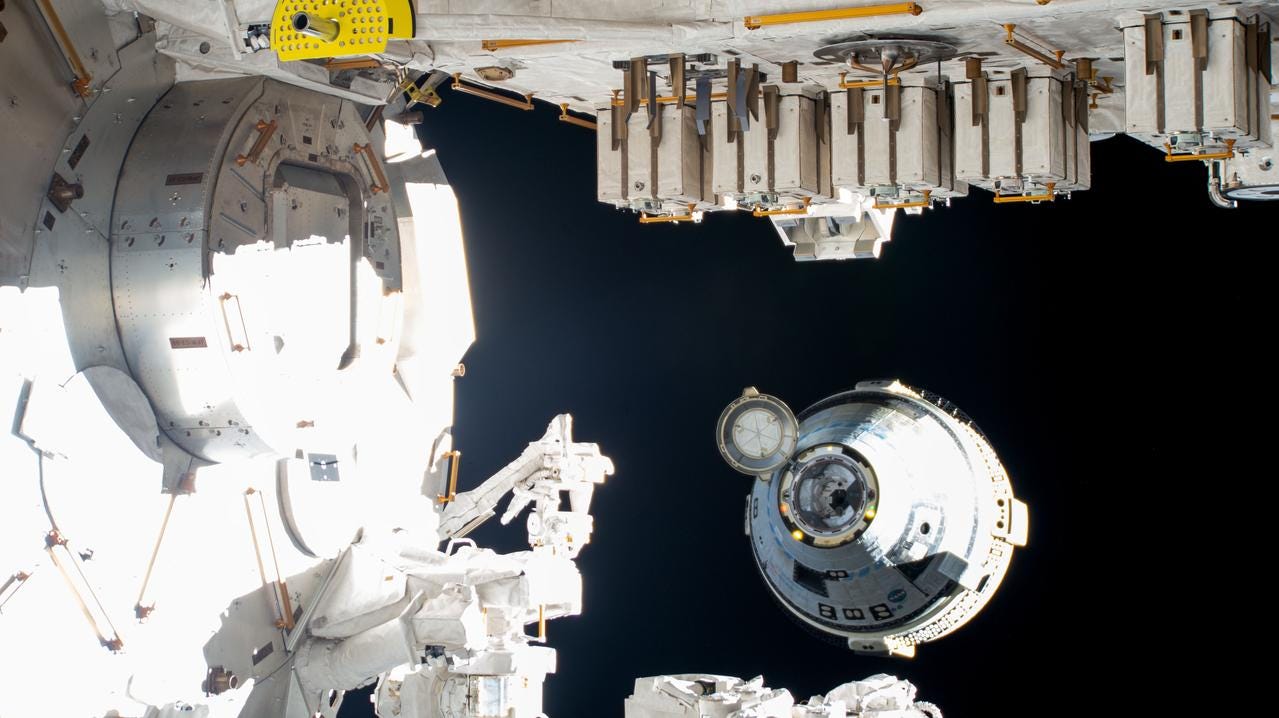
An uncrewed Boeing Starliner departs the International Space Station on September 6, 2024. It was supposed to have two astronauts aboard. Image source: NASA.
Leaks, Failures, and Anomalies
NASA’s Office of the Inspector General (OIG) released on June 30 an audit of the agency’s commercial crew program.
It did not go well for the Boeing Starliner.
The report cited “three long-standing technical challenges that have prevented Boeing from obtaining the human-rating certification — helium leaks, propulsion systems failures, and parachute anomalies.” The leaks and failures remain unresolved. “NASA is uncertain as to when this testing will be completed or human-rating certification for the Starliner will be obtained.”
Thanks to Congress, NASA relies on only two US aerospace companies for crew rotations to and from the International Space Station — Boeing and SpaceX.
If Congress, certain astronauts, and the NASA bureaucracy had their way back in 2014, NASA would have relied solely on Boeing.
Twelve years later, Boeing has still failed to fly a successful crew rotation mission to ISS. SpaceX has successfully flown twelve — and returned to Earth the test pilots who flew on Boeing’s failed certification flight.
Critics complain about the de facto monopoly SpaceX has, but that’s not the company’s fault. It’s the fault of those who, for over a decade, have sheltered Boeing’s incompetence.
Cash on Delivery
The commercial space program goes back to the days after the space shuttle orbiter Columbia was destroyed on entry, February 1, 2003.
Nearly a year later, on January 14, 2004, President George W. Bush delivered his Vision for Space Exploration speech. Buried in the details was a proposal to, “Pursue commercial opportunities for providing transportation and other services supporting the International Space Station and exploration missions beyond low Earth orbit.”
NASA opened the Commercial Crew and Cargo Program Office (yes, C3PO) on November 7, 2005. Out of that came a program called Commercial Orbital Transportation Services (COTS). Just as the US government had partnered with private enterprise in the 1860s to build the transcontinental railroad and in the 1920s to birth commercial aviation, so did NASA seek private partners to establish commercial cargo delivery to the International Space Station. These partners would spend their own money to compete for contracts by meeting NASA-defined milestones. If they achieved the milestone, they received an award and proceeded to the next step. If not … they went unpaid and were out of the competition. (So the awards were not subsidies, despite what some people may tell you.)
“OldSpace” legacy companies such as Boeing and Lockheed Martin weren’t interested. “NewSpace” startups such as SpaceX were. In the end, two companies received fixed-price cargo delivery contracts — SpaceX and Orbital Sciences (today’s Northrop Grumman). The SpaceX cargo Dragon was designed to be reusable, while the Orbital Cygnus was designed to burn up on entry (to dispose of ISS waste).
The President Barack Obama administration decided to fund the Commercial Crew program. Using the COTS model, NASA in 2010 began a new competition with multiple rounds of milestones. Boeing, this time, entered the competition, pitching a crew capsule originally called CST-100 and later renamed Starliner.
In the final round, three companies survived — SpaceX with a crew Dragon, Boeing with Starliner, and Sierra Nevada with a delta-shaped spaceplane called Dream Chaser.
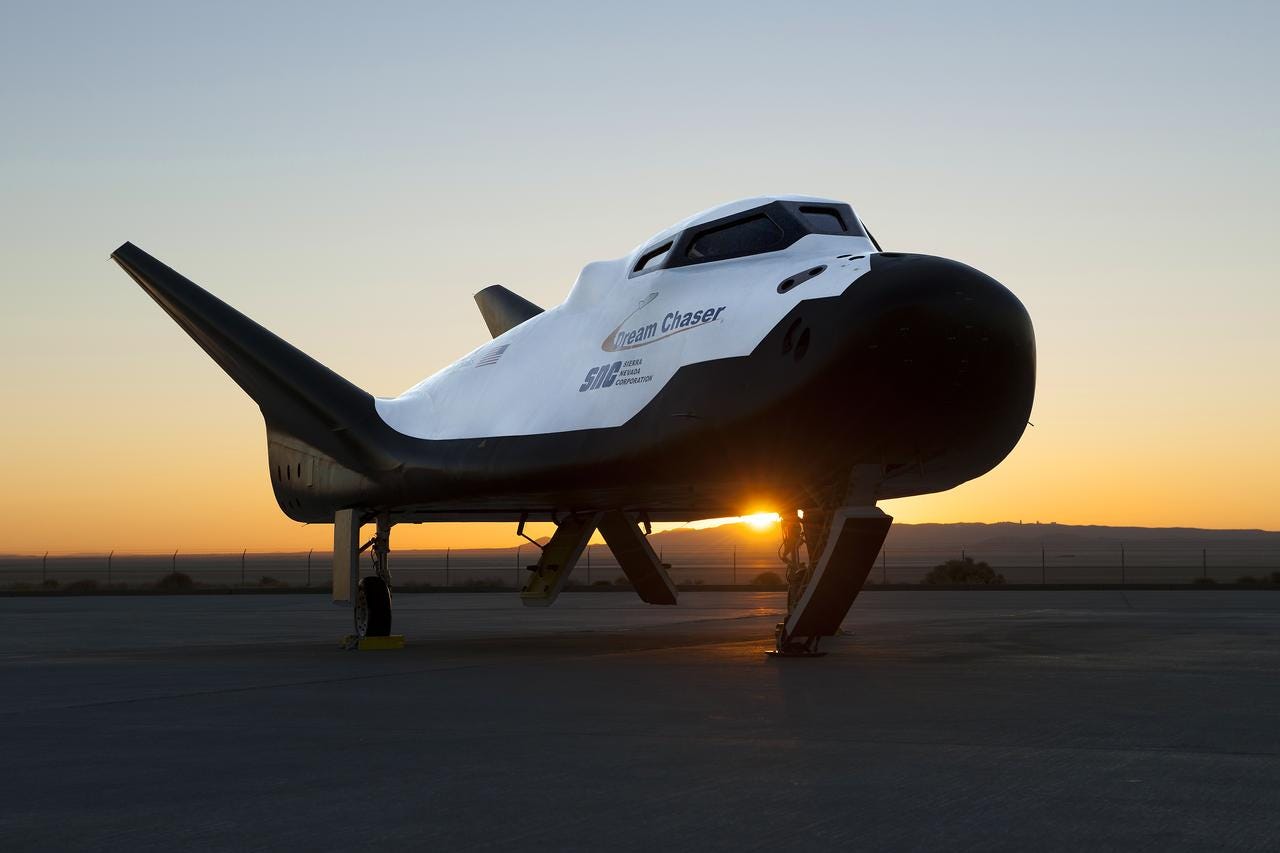
A prototype crewed version of the Sierra Nevada Dream Chaser used for drop tests at NASA Armstrong Flight Research Center, California. Image source: NASA.
It’s Who You Know
As the competition entered its final round in 2014, circumstances were complicated by Russia sending special forces to seize the Crimea region of Ukraine. Starting in March, the Obama administration imposed sanctions on the Russian government and certain individuals. One of them was Dmitry Rogozin, a deputy prime minister who oversaw the Russian space industry. Rogozin threatened to withhold RD-180 engines from the United Launch Alliance Atlas V that would booster Starliner into space, and cancel US astronaut flights on the Soyuz spacecraft.
Until commercial crew was operational, Soyuz was the only way for any nation’s astronauts to reach ISS. That was a policy decision by the Bush administration. NASA would fly the shuttle only to complete ISS, retire the shuttle, then rely on Soyuz for crew rotations until ISS was decommissioned in 2015 to pay for Bush’s Project Constellation.
Constellation was to develop a booster called Ares I to send a crew vehicle eventually called Orion to ISS, but ISS wouldn’t be there by the time Ares I was projected to be operational. The Obama administration cancelled Constellation to extend ISS to at least 2020, increase commercial cargo funding, and fund commercial crew.
Obama’s NASA intended commercial crew to be operational by 2015, but Congress kneecapped the program, cutting funding by 38% ($1.1 billion) over its first three years. This delayed the operational target date to the end of the decade, and therefore extended US reliance on Soyuz.
Much of that funding went instead to the Space Launch System, a program ordered by Congress in 2010 to protect Shuttle and Constellation legacy contractors. Congress mandated that NASA issue no-bid contracts to these companies to build a super-heavy lift rocket. Boeing was the primary contractor on its Core Stage and Exploration Upper Stage — without competitive bid.
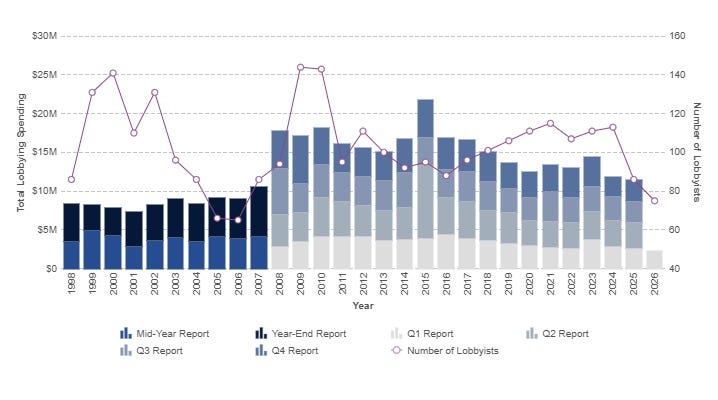
The dollar amounts spent by Boeing lobbying from 1998 through Q1 2026. Image source: Open Secrets.
In the early 2010s, Boeing was one of the most powerful lobbyists in politics. From 2010 through 2015, when OldSpace companies lobbied Congress to protect the status quo from Obama administration reforms, Boeing spent $104 million on lobbying. (These totals are for all federal lobbying, not just NASA.) In 2014, when NASA selected the commercial crew finalists, Boeing spent $16.8 million.
As for the other finalists … In 2010-2015, SpaceX spent $6.9 million on lobbying, $1.5 million in 2014. Sierra Nevada spent $3.4 million in 2010-2015, $630,000 in 2014.
Boeing brought a gun to a knife fight.
Ars Technica journalist Eric Berger reported in 2019:
Behind the scenes, Boeing was pushing hard to win all of the funding for NASA’s commercial crew program, and the company was encouraging NASA to go with the safe choice over spaceflight newcomers SpaceX and Sierra Nevada. “We were fighting to keep two providers as many in Congress, lobbyists, and some in NASA were fighting to down-select to only Boeing,” one government source familiar with the process told Ars.
In his 2025 book Rocket Dreams, Washington Post space journalist Christian Davenport wrote:
NASA and Boeing had similar cultures: formal and conservative, with a strict hierarchy and a military-like deference to authority. SpaceX could hardly have been more different. Employees were brash and iconoclastic. Their culture encouraged dissent. Hurt feelings mattered less than correct answers.
Davenport wrote how most of NASA management wanted Boeing; “the consensus inside the agency was that it could only afford to pick a single company.” Many in the astronaut corps distrusted SpaceX, which was proposing a 21st Century design with touchscreens and automated navigation systems instead of switches and joysticks. Starliner was 20th Century technology, proven and familiar.
But Boeing’s bid cost much more than SpaceX. The commercial crew program was supposed to lower costs, not perpetuate OldSpace technologies and pricing. When the two contracts were awarded in September 2014, Boeing received $4.2 billion, while SpaceX received only $2.6 billion. Neither company would be paid unless it fulfilled its fixed-price contract. The contracts required one crewed demonstration flight; after certification, each company was guaranteed at least two and up to six crewed flights to ISS.
Denied a contract, Sierra Nevada filed a protest. The Government Accountability Office, a federal agency external to NASA, denied the protest.
NASA concluded that the proposals submitted by Boeing and SpaceX represented the best value to the government. Specifically, NASA recognized Boeing’s higher price, but also considered Boeing’s proposal to be the strongest of all three proposals in terms of technical approach, management approach, and past performance, and to offer the crew transportation system with most utility and highest value to the government. NASA also recognized several favorable features in the Sierra Nevada and SpaceX proposals, but ultimately concluded that SpaceX’s lower price made it a better value than the proposal submitted by Sierra Nevada.
Lurking over the selection process was Vladimir Putin. NASA needed to get off Soyuz. But Congress didn’t seem particularly inclined to increase NASA’s commercial crew budget just to end reliance on Russia. Congress seemed more interested in promoting Boeing’s interests. As NASA deliberated its final selections, three Republican members of Congress sent a letter to administrator Charlie Bolden demanding an investigation of SpaceX’s alleged deficiencies. The three represented Colorado and Alabama, states with a significant Boeing presence.
If Congress would only provide money for one vendor, Boeing seemed the safe choice. The company had a track record, and the selection would be supported by Congress. According to Eric Berger in his 2024 book Reentry, NASA prepared a draft announcing Boeing as the lone choice for a commercial crew contract. It was hastily rewritten after NASA decided to select SpaceX as a second vendor.
That last-minute decision saved NASA from the embarrassment of relying on Russia for another decade as the agency’s sole access to ISS.
Boeing Blows It
By 2016, red lights already were flashing that Boeing was facing technical problems.
According to a September 2016 NASA OIG report, Boeing faced “issues relating to the effects of vibrations generated during launch and challenges regarding vehicle mass.” SpaceX was delayed because NASA changed its design preferences, from a propulsive land landing to a parachute water landing. (Starliner was to land in the New Mexico desert using parachutes.)
In June 2018, Starliner experienced an abort engine propellant leak during a test fire. SpaceX took the lead in March 2019 when an uncrewed test Dragon docked at ISS. Boeing attempted its own test flight in December 2019, but failed to achieve orbit, much less reach ISS. The investigation found a number of software errors that could have led to a catastrophic collision. This was after two Boeing 737 MAX planes crashed, killing 189 and 157 people. The company also went billions of dollars over costs for its KC-46 flying tanker that had its own technical problems.
Boeing’s reputation was kaput.
SpaceX won the race. Two NASA astronauts flew a demo flight to ISS in May 2020, and four astronauts flew to ISS on the first operational mission in November 2020.
A second uncrewed Starliner demo flight in August 2021 was delayed after Florida’s summer rainstorms leaked into the spacecraft’s propulsion system valves while the capsule sat atop its Atlas V on the launch pad. When it finally launched in May 2022, Starliner managed to reach ISS and return to Earth, but experienced a number of thruster failures during the mission.
NASA moved ahead anyway, scheduling a crewed test flight. Sunita Williams and Butch Willmore launched on June 5, 2024.
It did not go well.
Williams and Willmore were almost stranded in space. The maneuvering thrust system malfunctioned on approach to ISS. The astronauts finally managed to dock the crippled spacecraft. NASA had such a lack of faith in the capsule that the astronauts were reassigned to ISS crew rotation until they could return three months later on a SpaceX crew Dragon.
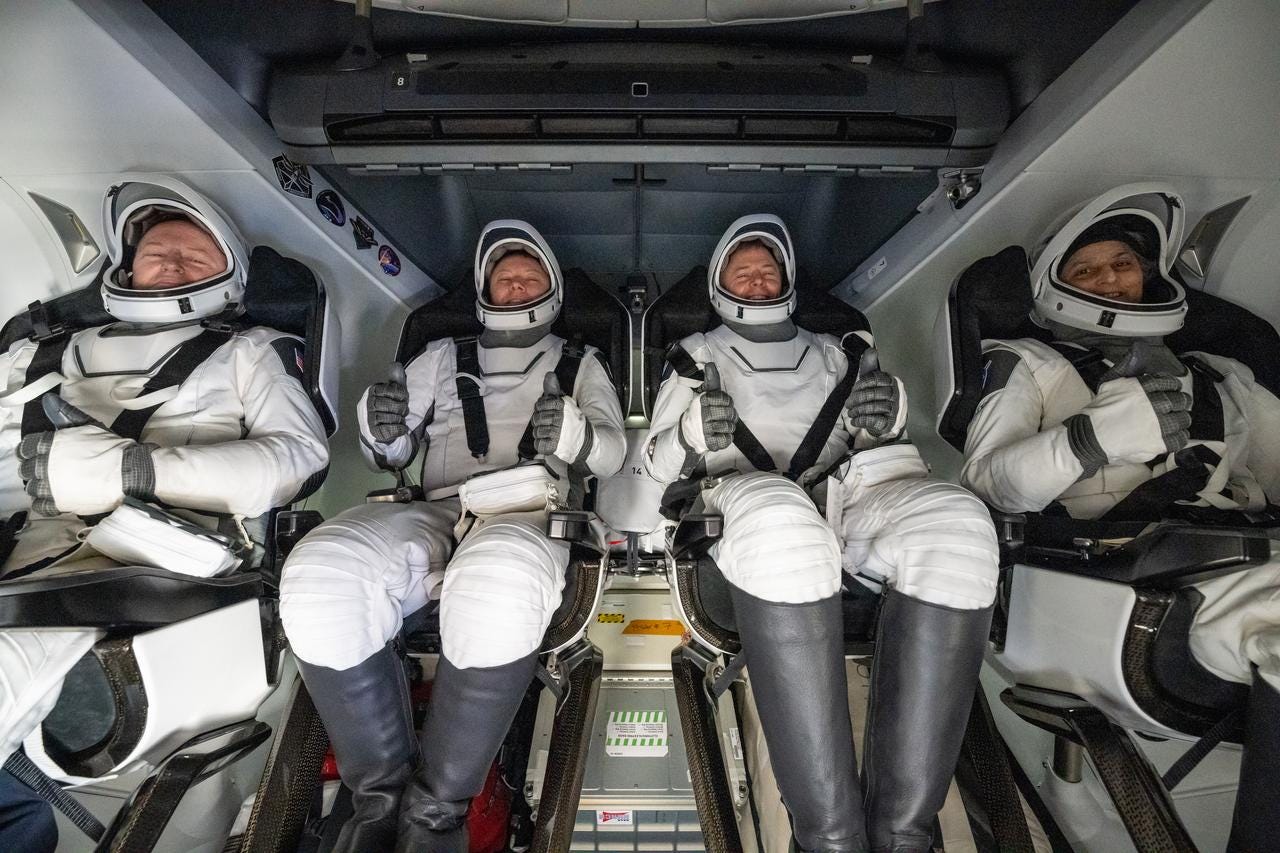
Butch Willmore (left) and Sunita Williams (right) return to Earth on a SpaceX Dragon, March 18, 2025. Inbetween are Roscosmos cosmonaut Aleksandr Gorbunov and NASA astronaut Nick Hague. Image source: NASA.
Contrary to media reports, Williams and Willmore were not “stuck.” If there had been an emergency on ISS, risking re-entry on Starliner was preferable to certain death on station. The spacecraft eventually returned unpiloted to Earth in September 2024, although it experienced navigation and thruster anomalies.
NASA’s investigation report was released to the public on February 19, 2026. It is extensive and it is embarrassing, to the agency and to Boeing.
Through 2024, Boeing had already lost $2 billion on Starliner. If this had been an OldSpace cost-plus contract, Boeing would have profited from its mistakes. But thanks to the Obama administration, this was a fixed-price program. The taxpayer isn’t paying for incompetence.
Stuck with Starliner
So what to do with Starliner?
NASA and its ISS partners are planning to decommission and deorbit the station in 2030. (There’s some sentiment in Congress to extend ISS to 2032.) NASA has converted Starliner’s next flight to uncrewed cargo delivery. Launch is unlikely until sometime in 2027.
The NASA OIG is questioning why the agency has paid $127.9 million to Boeing for Starliner flights even though the spacecraft has not yet been qualified.
These earlier-than-required payments were made despite NASA paying a substantial premium to Boeing already for the accelerated delivery of post-certification mission flights and increased mission flexibility to fly crewed missions as soon as possible.
One can understand NASA’s desire to have a second crew vehicle available in case SpaceX experiences an anomaly. With Russia still belligerent in Ukraine, the US doesn’t want to beg Roscosmos for more Soyuz crew flights. Even if Starliner-1 is successful in 2027, that leaves less than three years to insert Starliner into the crew rotation schedule.
Sierra Nevada, now called Sierra Space, had planned to fly cargo deliveries to ISS, but NASA has dropped that arrangement. Dream Chaser can fly a demonstration flight, but not dock with ISS. NASA still has the option of purchasing a Dream Chaser delivery, but that seems unlikely. If NASA intends to use Starliner for cargo deliveries, then the agency has no need for Dream Chaser. Sierra Space had once hoped to evolve Dream Chaser into a crew vehicle, but that window has closed, at least at ISS.
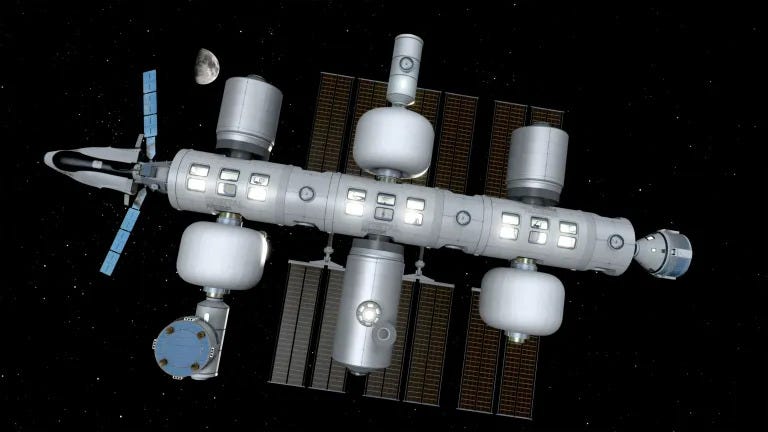
An Orbital Reef concept. Image source: NASA.
Sierra Space and Blue Origin are principal partners for a commercial space station project called Orbital Reef. Boeing and other companies are also partners in the project. NASA supports Orbital Reef through Space Act Agreements.
It’s anyone’s guess when Orbital Reef will be operational. The only reason for NASA to keep the Starliner and Dream Chaser contracts is to have those vehicles certified as operational by 2030, if Orbital Reef is open for business.
In another reality, NASA long ago would have fired Boeing. But that won’t happen. Congress wouldn’t allow it. If Russia were a reliable partner, NASA could get by until ISS is decommissioned, but NASA needs a second domestic vendor.
And so … NASA is stuck with Boeing.