
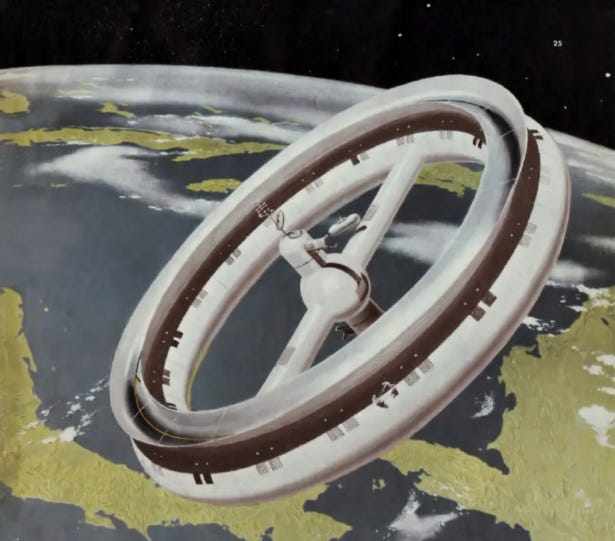
Chesley Bonestell’s painting of Wernher Von Braun’s concept for an orbital space station as it appeared in Collier’s, March 22, 1952. Image source: Scribd.
My space history book, Return to Launch, tells the tale of how Florida changed the course of the US space program. The book is available through the University of Florida Press. Click here to learn more.
Artificial Moons
In early 1952, former German rocketeer Wernher von Braun was in Huntsville, Alabama doing rocket research for the US Army. Despite his Nazi past, von Braun was easy to like, charming and affable. He and his engineers integrated into the community as they developed the Army’s first rocket, a missile called Redstone after the red clay in the hills around Huntsville.1
Von Braun was invited by Collier’s magazine to write an article about his visions for human space exploration.2 The article was published in the March 22, 1952 edition. Titled “Crossing the Last Frontier,” the article began:
Within the next 10 to 15 years, the earth will have a new companion in the skies, a man-made satellite that could be either the greatest force for peace ever devised, or one of the most terrible weapons of war — depending on who makes and controls it. Inhabited by humans, and visible from the ground as a fast-moving star, it will sweep around the earth at an incredible rate of speed in that dark void beyond the atmosphere which is known as “space.”
The first “artificial moon” as he called it didn’t launch until 1971. It was a small Soviet space station called Salyut 1. The Salyut program launched a series of short-lived orbital outposts that evolved Soviet crewed activities in low Earth orbit through the early 1990s.
Von Braun and his team, meanwhile, had transferred in 1960 to the newly created NASA. A year later, they found themselves charged by President John F. Kennedy with sending a man to the moon by the end of the decade, and returning him safely to the earth. The “artificial moon” was set aside.
Von Braun had envisioned a space station “carried into space, piece by piece, by rocket ships” that would take ten years to assemble and “cost twice as much as the atom bomb.” By one estimate, the Manhattan Project cost almost $2 billion in 1940s dollars, or about $35 billion in current dollars.
The International Space Station, the metaphorical fulfillment of von Braun’s dream, began assembly in 1998 and was completed in 2011. Assembly was delayed from January 2003 to July 2005 due to the Columbia accident, otherwise von Braun’s ten-year estimate was about right. The cost? In 2014, NASA’s inspector general estimated that “construction and program costs” were $43.7 billion.
The ISS is reaching the end of its life span. NASA and its ISS partners are planning to decommission and deorbit the station after 2030.
What comes next?
Rivers and Forts
I’ve always viewed space stations as the future equivalent of forts built along rivers and overlooking other strategic bodies of water. In the 18th and 19th centuries, rivers were critical trade and transportation arteries. Forts protected government and business interests, and also served as way stations.
Many cities grew up around those forts. Castillo de San Marcos in St. Augustine, Florida was built by Spain in the late 17th Century at the entrance to the Matanzas River to protect its Atlantic trade route. Fort Duquesne was built by France in 1754 where the Allegheny and Monongahela rivers come together to form the Ohio River, the location of today’s Pittsburgh. Fort Wayne was built in 1793 by the US where the St. Joseph and St. Mary rivers come together to form the Maumee River.
You may not think there are “rivers” in space, but there are!
Space “rivers” unlike their terrestrial equivalent are not bound by their banks. Deep space probes ride rivers created by the gravitational pull of the sun and planets. The planets are always in motion, so the space river paths are constantly in motion as well. Spacecraft uses gravitational assists, or “slingshots,” to speed up or slow down. Gravity does the work, not an engine, which would burn fuel.
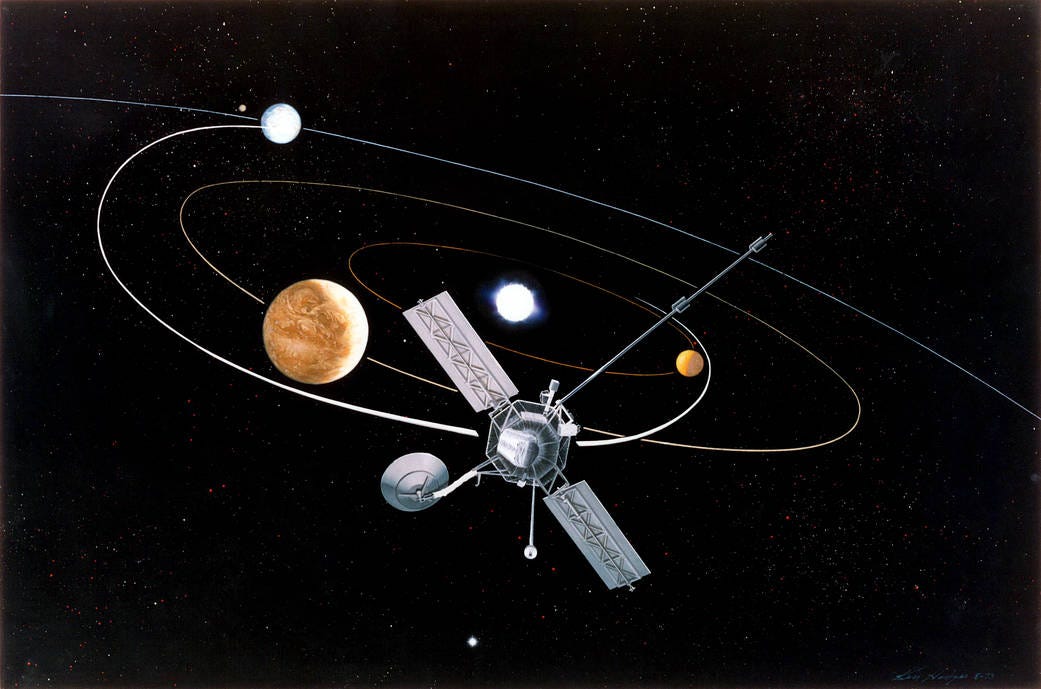
An artist’s concept of Mariner 10 using Venus to alter its course towards Mercury. Image source: NASA.
Mariner 10 was the first US spacecraft to use interplanetary gravity assist. The probe used the gravity of Venus to slingshot towards Mercury.
Imagine Mariner 10’s course as sailing along a river. Imagine Venus as a fort, a fixed stronghold, that guards that river.
Although one might not want to live on the planet’s 872°F (467°C) surface, we can imagine a space station in orbit as a waystation.
Astrodynamics is far more complex than I’m describing it. Entire textbooks are available if you really want to study the subject.
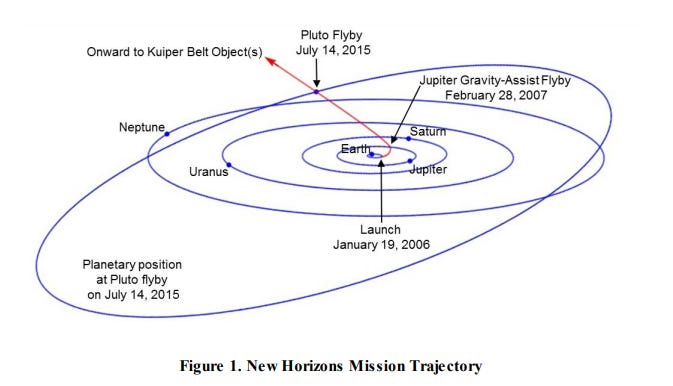
New Horizons used a Jupiter flyby as a gravity assist to send the probe on its way to Pluto. Image source: Johns Hopkins University Applied Physics Laboratory.
The most impressive example of astrodynamics, in my opinion, is the New Horizons flyby of Pluto in 2015. Jupiter was used as a gravity-assist to send the probe on its course and accelerate its velocity. The trajectory was constantly altered using optical and data measurements of the stars, just as navigators once altered course using star readings with a sextant.
Deep space probes are rare in our time. What might be the more critical locations for space “forts” in the 21st Century?
The five LaGrange points are logical strategic sites. Joseph-Louis Lagrange was an 18th Century mathematician who calculated five locations where the gravitational pulls of Earth and the Sun balance out. Each of the five points has unique advantages.
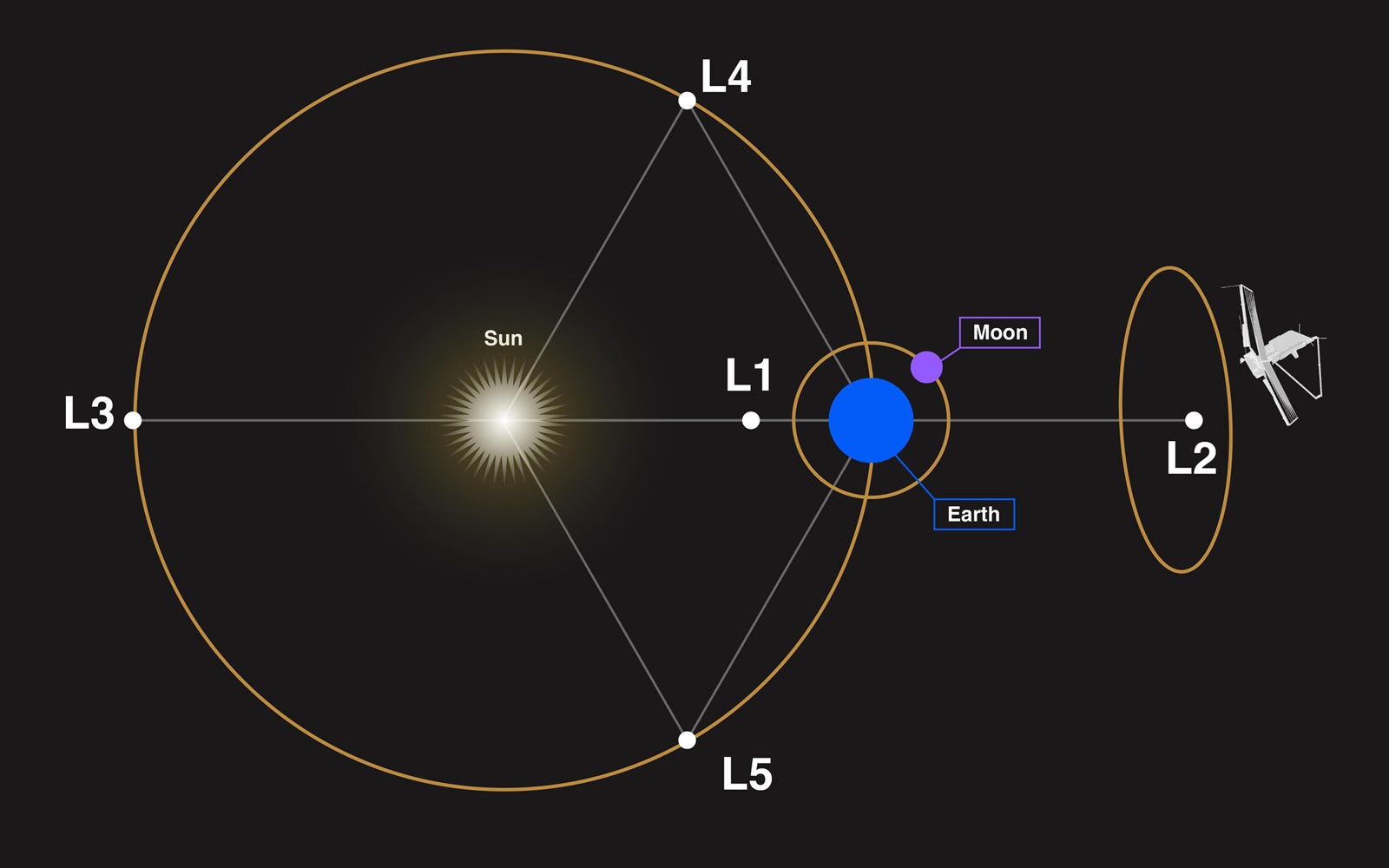
The James Webb Space Telescope orbits the L2 Lagrange Point. Image source: NASA.
Various space probes orbit the L1 and L2 points. The L1 point is best for observing the Sun. The L2 point is best for keeping a telescope in eternal darkness, such as the James Webb Space Telescope.
Are there “rivers” near Earth? Yes!
The closer to Earth, the faster an object’s velocity must be to maintain orbit, otherwise gravity pulls it back to Earth. At an altitude of 250 miles, such as the ISS, the object must travel at 17,500 mph (28,164 kph) to equal Earth’s pull.
The ISS orbits at an inclination of 51.6° to the equator, which will take the ISS over both the US launch sites at Cape Canaveral and the Russian launch sites at Baikonur, Kazakhstan. Any future space “fort” wanting to service both nations might want to occupy that inclination.
Geostationary satellites orbit on the same plane as the equator, at an altitude of 22,236 miles (35,786 km). Because they’re farther from Earth, “GEO” objects move more slowly, at a velocity of 6,879 mph (11,070 kph). GEO satellites are often used for earth observations, such as weather satellites.
One can imagine the value of space “forts” on these orbits. In the 1960s, the US Air Force worked on a project called the Manned Orbiting Laboratory. Two USAF astronauts would launch in a Gemini capsule atop a Titan II booster. Between the capsule and booster would be a laboratory the astronauts would use to conduct military reconnaissance. MOL would have flown in a low-altitude polar orbit, from 80 to 186 nautical miles (148 to 344 km). Polar orbits are popular with spy satellites, covering the entire planet about once every 24 hours. The project eventually was cancelled, but it was the first US step towards an orbital space station.
In our time, there are rumors of top-secret space vehicles in near-Earth orbits. The US Space Force has the X-37B spaceplane, which can change its course on orbit and perhaps nuzzle up to adversary targets. Four Russian military satellites recently changed course to match the orbit of a Finnish-American reconnaissance satellite. Some China GEO satellites are thought to have the capability to conduct proximity maneuvers and satellite inspections.
It’s clear that the US could use “forts” on these space “rivers” to protect its assets. But do the forts need to be crewed?
The Human Factor
Ever since human spaceflight began, public opinion has been tepid on a human presence in space.
Consistently during the Apollo era of the 1960s, a majority of Americans thought the crewed lunar program wasn’t worth the cost. A 2018 Pew Research poll found that 80% thought the ISS had been a good investment, but 86% thought sending people to the moon was unimportant or of low priority. 82% felt the same about Mars. When asked the same questions in 2023, the needle hadn’t moved — 86% still saw the moon has unimportant or of a low priority, and 88% felt the same about Mars.
If Elon Musk had his way, NASA wouldn’t waste its money on another space station.
In February 2025, Musk called for NASA to deorbit the ISS as soon as possible.
In a post on X, Musk wrote that the ISS “has served its purpose. There is very little incremental utility.” Musk wants to focus on sending people to colonize Mars, despite public apathy to the contrary.
Jeff Bezos, the other space billionaire, foresees building colonies in space that rotate to artificially create gravity. Musk has criticized Bezos’s vision, writing that it “makes no sense.”
But do we really need people in space?
The USAF MOL program was going to fly military astronauts only because the technology didn’t exist for robots to do it. Early reconnaissance satellites ejected their film in a capsule retrieved by a USAF C-119 or a Navy vessel. But by the mid-1970s, reconnaissance technology had evolved to the point that satellites could transmit images almost instantly without human operation.
Over at NASA, though, von Braun as early as 1962 was planning for what his Marshall Space Flight Center in Huntsville could do to justify a permanent space station in Earth orbit. By 1963, NASA had developed a rationale for long-duration crewed earth-orbiting laboratories, perhaps a NASA version of MOL.3
NASA’s Skylab was a converted Saturn V third stage. It was the first US crewed space station. Three Apollo crews visited Skylab, from May 1973 through February 1974. The final mission lasted 84 days.
The ISS can be traced back to President Ronald Reagan’s proclamation during his 1984 State of the Union address. He directed NASA “to develop a permanently manned space station and to do it within a decade.” It came to be known as Space Station Freedom.
Freedom suffered from a lack of political support in Congress, underfunded for years. The House of Representatives almost voted to cancel Freedom in June 1993. NASA signed partnerships with Europe, Canada, and Japan, giving Freedom geopolitical importance if not scientific importance.
When Russia joined the project in December 1993, the name changed to International Space Station. According to the Clinton Library website:
The International Space Station project gave Russia incentive to adhere to nuclear non- proliferation by providing other technological advancement aspirations and allowed Russian scientists and engineers the opportunity to develop projects and earn income outside of the military and intelligence apparatus.
ISS activities generally fall into three categories:
Could the first two have been performed without humans? Critics have argued yes. Earth observation? We’ve been doing it since the late 1950s, but it’s always nice to have another pair of eyes. Microgravity research? That’s debatable, but the argument could change with the advent of artificial intelligence and humanoid robots such as the Tesla Optimus.
Von Braun foresaw a rotating space station to create artificial gravity for its human dwellers. That would defeat the purpose of a microgravity research laboratory. Robots don’t need gravity to protect their bodies from the consequence of microgravity life.
If AI robots can do the job, then the only reason to have humans in space would be … to have humans in space.
The Next Generation
On July 6, NASA released a draft request for proposals to assess if there will be a viable marketplace for commercial space stations. NASA administrator Jared Isaacman said:
“We’re focused on supporting those efforts, enabling the capabilities that make this transition possible, and doing all we can to ensure the United States maintains a continuous human presence in low Earth orbit.”
It’s US government policy that commercial space forts will have human crews.
At least four US vendors are working on commercial space habitats:
Axiom Space has partnered with European space manufacturer Thales Alenia to build Axiom Station. The first module is planned to launch no earlier than 2028. Axiom already flies private crewed missions to ISS.
Orbital Reef is a principal partnership between Blue Origin and Sierra Space, with many other partners such as Boeing, Amazon, and Redwire. It’s unknown when the first module might launch. Blue’s New Glenn-4 exploded on the pad in late May, badly damaging the launch pad. Future launches are on hold until the pad is fixed and the cause of the explosion is resolved.
Vast Space is developing a single-module prototype called Haven-1 it hopes to launch in 2027 on a SpaceX Falcon 9. As has Axiom, Vast has purchased a crewed commercial flight to ISS.
Starlab Space is a global joint partnership of companies such as Northrop Grumman, Airbus, and Mitsubishi. The Starlab Space Station is also a single-module habitat. Starlab hopes to launch in 2029.
My personal opinion is that it’s inevitable humans will colonize space. It’s what we do. Colonial expansion has always been for commercial motivations, and governments have always been the angel investors to kick-start the next generation of exploration (and exploitation).
During the eras of sail, of rail, and of air, AI technology didn’t exist, so human lives were risked — and lost. This will be the first expansion where humans may be redundant.
Military forts during the North American colonial occupations protected government and commercial assets. Towns grew up around them. I suspect the same will happen with the commercial habitats — and they may become military adversary targets.
NASA and its partners are planning a crewed lunar base at the moon’s south pole. So are China and Russia, with their International Lunar Research Station. These will also be crewed space forts, where colonies may expand, and military assets may be deployed.
I’m skeptical that, without government investment, the strictly commercial space stations will be financially viable for some time. But certainly all four vendors have multiple partners and deep pockets. Not all will succeed, but perhaps one of them will be the next Castillo de San Marcos.
All my Substack articles are free to read! Please consider supporting this Substack by signing up for a free subscription. Click here to subscribe.
Bob Ward, Dr. Space: The Life of Wernher von Braun (Annapolis, Maryland: Naval Institute Press, 2005), 75-86.
Ward, 87-89.
W. David Compton and Charles D. Benson, Living and Working in Space: The NASA History of Skylab (Mineola, New York: Dover Publications, 1983), generally.