
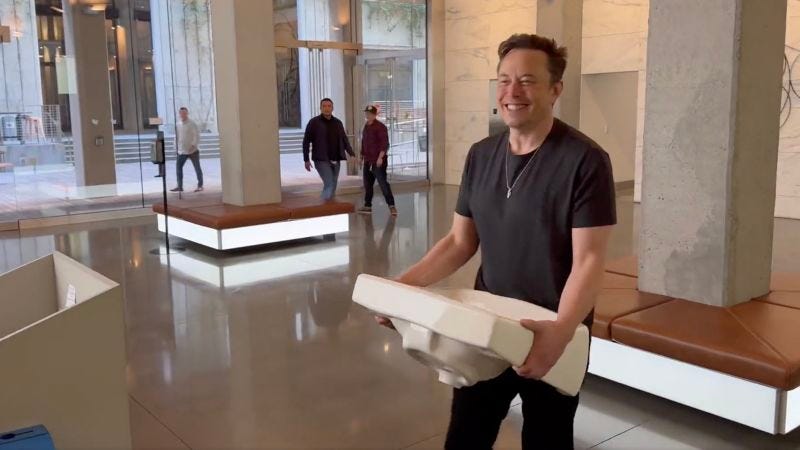
October 26, 2022 … Four years ago today, Elon Musk showed up at Twitter headquarters in San Francisco carrying a sink. Image source: CNN.
Earlier article: “Shields Down,” October 16, 2026
Who, Me?
After a ten-day outage, Starshield works again in Ukraine.
Starshield is a military communications system developed by SpaceX in collaboration with the US military. The system runs on the company’s Starlink satellite and ground terminal network.
On paper, the US military owns and operates Starshield. SpaceX owns and operates Starlink.
Ukraine’s allies, such as Germany and Poland, acquired Starlink terminals for Ukraine and also paid for Ukraine’s subscription fees. Starshield itself is provided and controlled by the US military.
Or so we thought.
On October 14, Ukraine found itself unable to defend its cities against Russian drone and missile attacks. Its own airborne weapons, which relied on Starshield for navigation, fell to the ground useless when trying to exceed 100 mph (160 kph).
The cost of the lost weaponry was in the millions of dollars, but the act of sabotage left Ukraine cities defenseless, killing people and destroying civilian targets.
Who pulled the plug?
Elon Musk tweeted on October 14, “Any limits on speed or usage are decided by the US military and ultimately POTUS.”
The Trump White House gave various explanations. President Donald Trump and White House officials denied having anything to do with it. Two Cabinet executives, Secretary of State Marco Rubio and Secretary of Defense Pete Hegseth, claimed Ukraine had violated Starlink’s terms of service.
Various news outlets reported that Musk and Trump had discussed the outage, either before or after. But no one took responsibility.
This is not the first time Starlink has been throttled.
The BBC reported on February 19 that Musk had switched off Starlink terminals operating in Ukraine, forcing users to re-register. This was in response to Russian forces using captured or pirated Starlink terminals to target Ukrainian positions. A "white list" was provided to SpaceX by the Ukraine Defense Ministry indicating which government terminals were to be exempted. (Were these Starshield terminals?)
Reuters reported on October 23 that both the Biden and Trump administrations over the years have asked SpaceX to turn off Starlink services in battlefield areas, such as when the US attacked Iran earlier this year.
Last week, US officials claimed that service had been restored, but Ukraine military leaders said Starshield was still throttled.

Volodymyr Zelenskyy tweeted on October 24 that full service has finally been restored. Image source: X.
Ukraine president Volodymyr Zelenskyy announced on October 24 that Starshield was back at full service. The nation’s military is testing full use of the service to confirm it’s operational.
The Shop Bull
After his October 14 tweet denying responsibility, Musk had been silent on the matter. That was odd for him, because he’s usually very thin-skinned about any criticism.
One example is a 2018 incident where Musk volunteered to build a miniature submarine to rescue children trapped in a Thailand cave. One member of the Thai rescue team criticized the offer as a “PR stunt.” Musk responded on Twitter by calling the man “Pedo Guy.”
The rescuer sued Musk for defamation, but lost in a Los Angeles federal court.
Musk bought Twitter for $44 billion in October 2022. He fired top executives and showed up at Twitter’s San Francisco headquarters four years ago today. He tweeted video of his arrival in the lobby carrying a sink.
Bloomberg reports on Elon Musk arriving at Twitter’s headquarters carrying a sink. Video source: Bloomberg Tech YouTube channel.
Musk immediately took Twitter shares private. That meant he would not have to disclose its operations and financial conditions to the public. It also meant Musk wouldn’t have to publicly answer to pesky shareholders.
Two months later, in late December, an impatient Musk began unplugging Twitter servers himself, despite warnings from the experts on his staff. Twitter was unstable for months, most notably during a Twitter Spaces live chat with Florida governor Ron DeSantis on May 25, 2023. DeSantis was announcing his candidacy for the Republican nomination for president. The headlines instead were about the Twitter glitch.
Musk renamed Twitter to X in July 2023.
In 2024, Musk spent $291 million helping to elect Trump and other Republicans. Trump let Musk run rampant in federal government, creating an agency called the Department of Government Efficiency (DOGE). Despite Musk’s pledge to cut at least $2 trillion from the federal budget, the actual results are much smaller. By one estimate, DOGE cut federal employment by 271,000. Federal spending, and the annual deficit, grew anyway. The BBC concluded:
While Doge may have cut a significant amount of government spending, the lack of evidence provided for its biggest claimed savings makes it impossible to independently confirm exactly how much.
The Government Accountability Office (GAO) released a report on September 29, 2026 noting that DOGE teams had tried to access systems with personally identifiable information (PII). How far they got, and what they did with the data, depends on the agency.
The DOGE escapade was a typical example of Musk’s bull-in-the-china-shop philosophy — break it and see what happens.
Musk is infamous for tolerating SpaceX launch failures, believing this accelerates development and testing.
Tesla’s Full Self-Driving (FSD) was tested on the road by Tesla drivers who acted as guinea pigs. Their results — and their accidents — were simply data collected by the company. Caveat emptor.
(FSD is a great product now. We bought our Tesla in May 2025 and sometimes use FSD for long drives. We relied on it for our Arizona vacation. But we didn’t buy the car until after FSD matured.)
Throttling Ukraine’s defenses could be the latest example of Musk breaking something to see what happens.
The Guardian reported on October 25 that the US Space Force has signed a new contract that gives SpaceX “access to its most precise data on potential collisions among satellites and other space objects, which will give Musk’s companies an advantage over competition that offers a similar service.”
“… [T]he unprecedented access to military data appears to be another step toward Musk asserting monopoly control over commercial space activity more broadly, said Cole Donovan, a former Traccs employee now with the Stand Up for Science non-profit.
Musk is now trying to buy himself another election. According to the latest reports, Musk has already spent $442 million on the 2026 midterm elections. Much of it has funneled to Texas, where his companies SpaceX and Tesla have large and growing operations.
He’s also threatened to go after any Democrats that investigate him and his business activities.
In any case, Musk’s oversized influence in US elections is frightening. He can drop nearly a half-billion dollars into an election hoping to buy favor with candidates. The US launch industry, civilian and military, has come to rely on SpaceX for its launch services. Now the US is reliant on SpaceX for military satellite defense services.
Services that one man can turn off at a whim.
Service with a Snarl
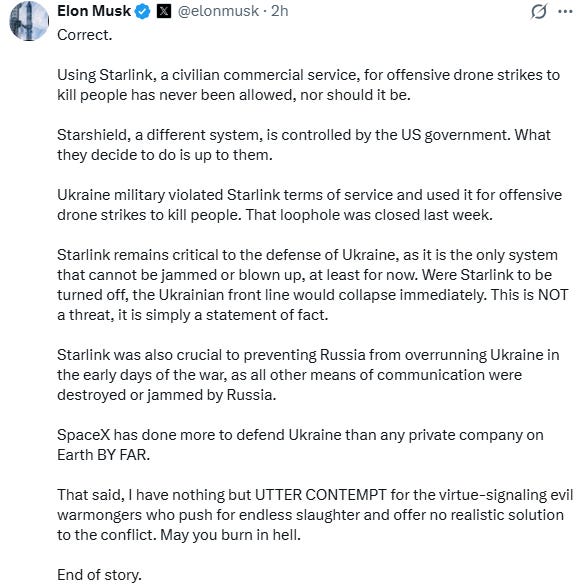
Elon Musk tweeted on October 24, 2026 that a “loophole was closed last week” which allowed Ukraine to use Starlink for offensive drone strikes. Image source: X.
Musk has finally broke his silence on the matter. He’s adopted the White House claim that Ukraine violated Starlink’s terms of service. “That loophole was closed last week.”
Various Ukraine government sources deny this, claiming that it’s impossible to use just Starlink for offensive drone missions into Russia. Those require Starshield.
Musk also repeated his October 14 claim that Starshield “is controlled by the US government. What they decide to do is up to them.”
This still doesn’t make sense.
Starshield is an application that runs on Starlink terminals. Some Starlink terminals are built specifically for Starshield use, with US military-specific hardware.
After some in the US claimed full service had been restored, Ukraine officials recently tested their drones and found they were still throttled to 100 MPH over Ukraine, but had full speed over the Black Sea. If Musk “closed a loophole,” offensive drones should have been throttled once they left Ukraine.
Starshield technology is classified, but speculation in social media is that Starshield is needed to communicate with a high-speed moving object such as a drone or missile. That said, Starlink is available for commercial aviation Wi-Fi services. A number of commercial airlines are offering Starlink for customers on their flights.
Commercial airlines typically fly about 550-600 mph. Ukraine’s drones typically fly up to 250 mph (400 kph), according to the Ukrainian defense minister. If Starlink can service a commercial jet flying much faster, it certainly seems that it can service a slower drone.
Some airline companies have turned down Starlink. Delta Airlines is one of them. Delta chose Amazon Leo instead.
Musk has attacked airline executives who turned down Starlink. But now those executives are looking like visionaries. Could Musk turn off an airline’s Starlink service because he doesn’t like the company’s executives? The airports it services? The livery of its planes?
Nations and companies are expected to start looking for alternatives. Ukraine already has signed a letter of intent with Finland tech companies Nokia and ICEYE to develop a reliable communications alternative to Starlink.
That might explain why a Russian military spacecraft last week stalked an ICEYE radar surveillance satellite with a US registry.
But no option — yet — offers features comparable to Starlink. And there’s only one Starshield — for now. China is developing its Guowang satellite network, and Russia’s Rassvet satellite constellation is viewed by Ukraine as giving Russia Starshield-equivalent technology.
Could Elon’s throttle-at-a-whim apply to his other products? When driving our Tesla, I sometimes wonder, “What if Elon finds out I don’t like his politics? Could he cripple my car?” Could Musk cap my top speed at 25 mph?
What about Tesla Optimus? Tesla has begun high-volume production of its robots. The SyFy Battlestar Galactica prequel series Caprica dealt with this very issue. A high-tech mogul started mass-producing Cylon robots as household servants. They eventually acquired sentience and ran amok, all but destroying humanity.
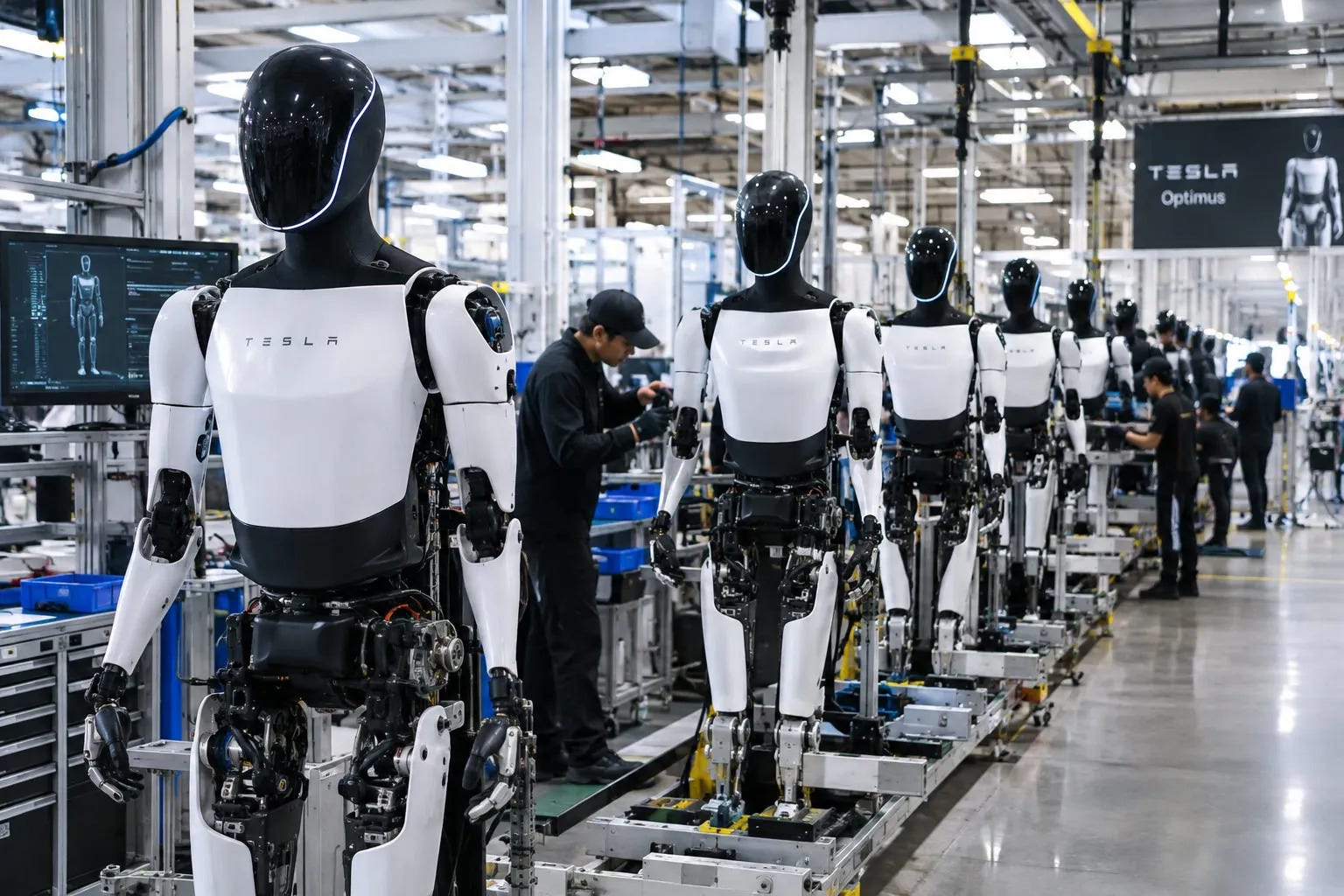
The Cylon — er, Optimus — robots roll off the Tesla assembly line. Image source: Teslarati.
If Musk has an Optimus in every household, could he use one to collect personal information on people? To record their every movement? To restrict their free speech rights? Just because they said something that pissed him off?
If a sovereign nation like Ukraine has no recourse, how do you and me defend ourselves from Elon’s whims?
The answer would seem to be … don’t buy his products.
A hard lesson nations and companies are starting to learn.