
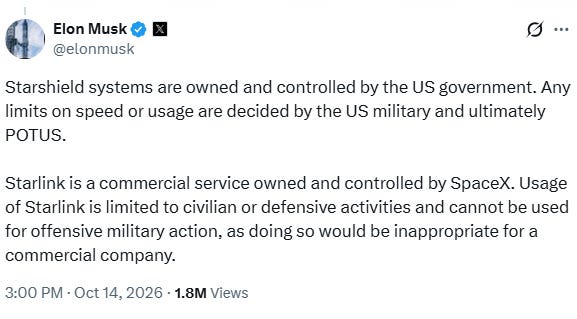
Elon Musk points the finger at President Trump. Image source: X.
WhatsApp in Space
In August 2017, US Air Force Research Laboratory held an industry day to solicit proposals for a program with the unwieldly name of “Defense Experimentation Using Commercial Space Internet.” The acronym DEUCSI wasn’t user-friendly either.
The formal announcement released two months later stated that DEUCSI sought to “establish and experiment with the capability to seamlessly move and share data among a wide variety of fixed and mobile operating locations using constantly available, high-bandwidth, beyond-line-of-sight communications.”
The vision for path agnostic communications is becoming possible due to the burgeoning commercial space internet. Multiple commercial entities have announced plans to establish space internet constellations consisting of hundreds to thousands of satellites each in order to create global internet services that will compete with and, eventually, outperform localized terrestrial internet.
While communications would be through commercial space internet networks, the military would control access to the secure communications. The announcement specified that, in a later phase, the USAF could require the vendor to modify its satellites by “removing any unnecessary equipment and adding military-unique hardware.” Think of this as like a secure encrypted call on your home’s telephone line, your cell phone, or your internet cable line. WhatsApp in space.
A Military Mother Lode
One of these “commercial entities” is Elon Musk’s SpaceX. Musk founded the company in 2002 with the goal of establishing human colonies on Mars. He was wealthy but not particularly charitable so, to pay for his Mars expeditions, Musk needed a reliable revenue source.
After several alternatives were explored, Elon Musk in January 2015 announced his plans to open an office in Seattle where engineers could develop small satellites to orbit Earth in clusters. With a portable terminal, one could access the internet from anywhere on the planet, in flight and, perhaps, in orbit.
In September 2017, SpaceX applied for the system’s trademark name — Starlink.
This was right around the time that the USAF Research Laboratory was seeking bids for its military space internet. Commercial sales revenue is great, but a military contract is the mother lode. In December 2018, the Research Laboratory awarded SpaceX a $28.7 million fixed price contract for data connectivity experiments. The USAF envisioned not only connecting resources on the ground, in the air, or in space, but also switching between various commercial vendors should one be disabled.
After demonstration tests in 2021, SpaceX unveiled its government variant in December 2022, called Starshield.
In September 2023, SpaceX signed its first contract to provide Starshield services over the Starlink network. Musk posted on Twitter, now renamed X:
Starlink needs to be a civilian network, not a participant to combat. Starshield will be owned by the US government and controlled by DoD Space Force.
Penn State doctoral student Abby Simmerman wrote in August 2026 that Starlink outages sometimes affect Starshield. Simmerman clarifies the distinction:
A primary selling point of Starshield for the military is security. Starshield promises end-to-end encryption made possible through vertical integration: SpaceX builds every piece of infrastructure that supports Starshield. This kind of vertical integration is growing in the space industry, both as a business strategy and for security purposes.
On March 16, 2024, Reuters reported that “SpaceX is building a network of hundreds of spy satellites under a classified contract with a US intelligence agency.” Unknown to the public at the time, SpaceX and the National Reconnaissance Office had signed a $1.8 billion contract in 2021. The NRO had hinted at such an arrangement in July 2021, but did not provide specifics. The first Starshield prototype had already launched in 2020.
The US military is increasingly dependent on SpaceX and Elon Musk. In May 2026, the US Space Force (part of the Air Force) awarded SpaceX $4.16 billion for a program to track and target airborne threats, as part of the Trump administration’s Golden Dome project. In July 2026, the Space Force awarded SpaceX $1.6 billion in orders for 18 Falcon 9 launches carrying Pentagon satellites.
SpaceX has a de facto launch monopoly with the US government. And that monopoly is reaching its tentacles into the national security of US allies. In September 2026, Reuters reported that Britain had spent $40 million on acquiring Starlink and Starshield. “Britain's defence ministry said it has about 1,000 Starshield terminals and 500 Starlink terminals.”
From Russia with Loathe
Starshield is a classified program, so we don’t know when it became operational or how capable are its current abilities, but it appears the system’s operational satellites began launching with NROL-146 in May 2024.
Russia invaded Ukraine on February 24, 2022. This meant that, in the early years of the war, Ukraine relied on the civilian Starlink system.
Ukraine’s vice prime minister, Mykhailo Fedorov, used Twitter to ask Elon Musk to activate Starlink in Ukraine so the nation could defend itself. Musk agreed and replied that mobile terminals were on the way to assist Ukraine forces in the field.
But after Russia threatened to target Western commercial satellites aiding Ukraine in the war, Musk’s opinions began to change.
In September 2022, Musk cut Starlink coverage to disrupt a Ukraine counteroffensive in Kherson. Ukrainian troops suffered a communications blackout.
In October 2022, Musk said SpaceX would not fund Starlink operations and terminals indefinitely in Ukraine. The Pentagon eventually agreed to pay for Starlink in Ukraine.
In September 2023, Musk refused to allow Ukraine to use Starlink for a drone attack on Russian military ships in the Black Sea. Musk said that Ukraine should cede territory to Russia and agree never to join NATO.
As Musk aligned himself politically with Donald Trump during the 2024 presidential election, rumors surfaced that Musk was having private conversations with Vladimir Putin. According to an October 25, 2024 article in The Wall Street Journal, these conversations raised national security concerns as he had access to classified intelligence information.
And then Trump regained the White House.
Trump had been impeached during his first term for pressuring Volodymyr Zelenskyy to launch a false investigation into Joe Biden. A special counsel had investigated Trump’s connections to Russian interference in the 2016 US presidential election, but the report was heavily redacted and Trump’s attorney general declared Trump exonerated.
The Washington Post reported on March 6, 2025 that Ukraine feared Trump might cut the nation’s Starlink access as he pressured Zelenskyy to capitulate.
Front-line commanders are increasingly concerned that the military has grown too reliant on Starlink, a product of Musk’s SpaceX, and it could become the latest pressure point for the White House as it pushes Ukraine to engage in peace talks with Russia and sign a deal giving the United States access to its minerals.
The Blame Game
Ukraine signed a contract in December 2024 to give 3,000 Starlink terminals already in the country access to Starshield. This was a deal signed by the outgoing Biden administration, which feared that Trump might deny Ukraine access.
Because Starshield is a classified military system, we don’t know when and how Ukraine began using Starshield.
In July 2026, Reuters reported that Russia was trying to jam Starlink’s satellite internet system. Ukraine, according to the report, was using Starlink to direct drones at targets in Russian territory. But this might have been Starshield communicating through the Starlink network.
The Ukrainian national news agency Ukrinform reported in September 2026 that Ukraine had been testing four types of drones “on the front line,” and one type had successfully downed a Russian jet drone.
Abby Simmerman wrote in her August 2026 column:
Drones require broadband service to operate, making broadband critical in war operations. For this reason, Starlink became imperative for drone-based Ukrainian defense efforts in the Russo-Ukrainian War.
Earlier this month, Russia began bombing civilian targets in Ukraine cities. In response, Ukraine drones hammered Russia’s oil industry. Trump demanded Zelenskyy stop targeting the Russian energy infrastructure. Trump claimed to have negotiated an “energy ceasefire” but both nations denied it.
Trump announced he’d negotiated a deal for the US to buy Russian diesel fuel. Zelenskyy called it “a weak decision by strong partners.” Never one to take criticism, Trump responded, “I think it's time for Ukraine to get a new president.”
Elon Musk piled on with his own tweet:
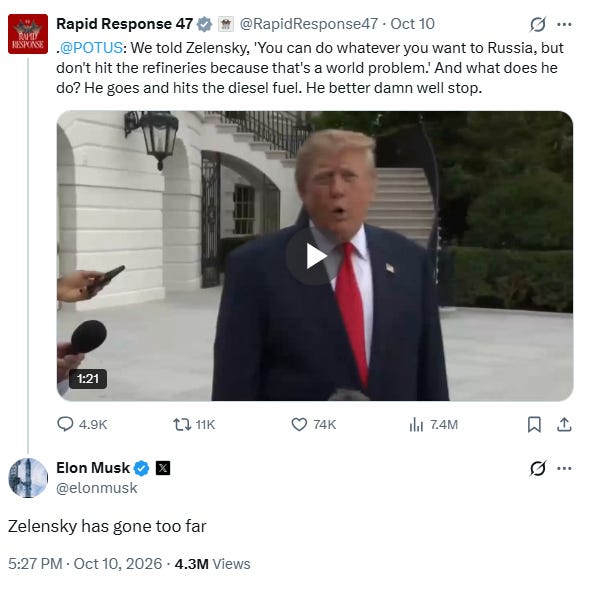
Elon Musk posts that “Zelenskyy has gone too far,” October 10, 2026. Image source: X.
Amidst this toxic stew of acrimony, the US restricted Ukraine’s Starshield access while the nation was under attack from Russia. Ukraine defenses found their drones no longer worked at speeds above 100 mph (160 kph).
According to the Kyiv Post, the act “slowed interceptor drones used to protect cities from Russian Shahed attacks — at a time when Moscow was launching hundreds of drones and missiles against Ukrainian civilian and energy infrastructure.”
Initial reports blamed SpaceX and Starlink, but Elon Musk pointed out on X that Starshield is controlled by the Pentagon. He tweeted, “Any limits on speed or usage are decided by the US military and ultimately POTUS.”
An analogy would be a bomb threat called in on a telephone network. AT&T isn’t responsible for the phone call.
Zelenskyy tweeted earlier today:
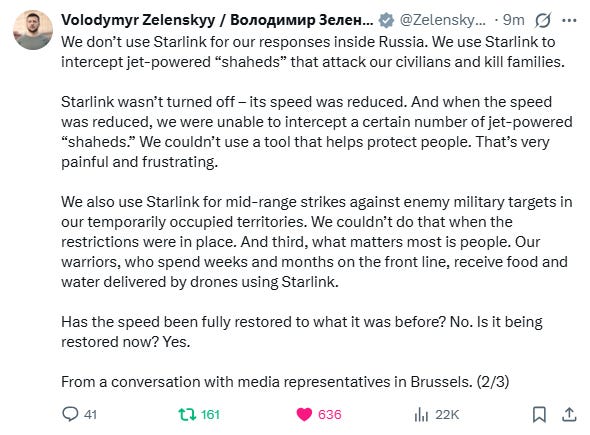
Volodymyr Zelenskyy tweeted earlier today that “Starlink” had its speed “reduced” but actually it was Starshield, the US military software communications system. Starlink is the communications network. Image source: X.
Zelenskyy wrote that the speed limit is being restored but isn’t fully operational yet.
Who was responsible?
Reuters reported yesterday that the order came “from inside the White House,” citing “two US officials and a Western official briefed on the matter.”
The British daily newspaper The Telegraph just reported that “Elon Musk approached Donald Trump with the idea of slowing down Starlink in Ukraine.”
The billionaire tech entrepreneur approached the US president with the proposal to introduce speed limits on the system, which hampered Ukraine’s drone defences, according to four sources familiar with the discussions.
One of the sources said Mr Trump “agreed” with Mr Musk’s suggestion, paving the way for the Pentagon to execute the slowdown on Starshield, the military-grade version of the satellite communications system.
As of this column’s publication, there is no independent confirmation of this report.
If it’s true, then it means Musk’s October 14 tweet pointing the finger at Trump was an attempt to defer blame from himself.
… Or the Commies Win
If the Telegraph report turns out to be accurate, no US ally will trust Starshield, nor will they trust Starlink.
This could ripple through other Musk products. Tesla plans to integrate Starlink into future Tesla vehicles, starting with Cybercab. Tesla vehicles already have integrated Grok, the SpaceX/xAI large language model, into their full self-driving software. What if Musk were to unilaterally order all Teslas to no longer exceed a speed of 10 mph? That scenario is now plausible.
I’ll be watching SpaceX (click here for SPCX) and Tesla (click here for TSLA) shares to see if their prices crater, should this be proven true.
A bipartisan group of US senators has asked the Department of Defense inspector general to investigate what happened with Starshield, but that will take time and events are moving quite fast right now.
Undermining the credibility of the US military’s encrypted space internet would be a big win for the nation’s adversaries, such as Russia and China, who may soon offer their own military space internets to their allies. Russia is already working on its own Starlink variant. China is developing its own dual-use satellite internet constellation.
Musk probably escapes legal consequences for this, because the order came from the White House. But this could be the fatal error that brings down the House of Elon.