
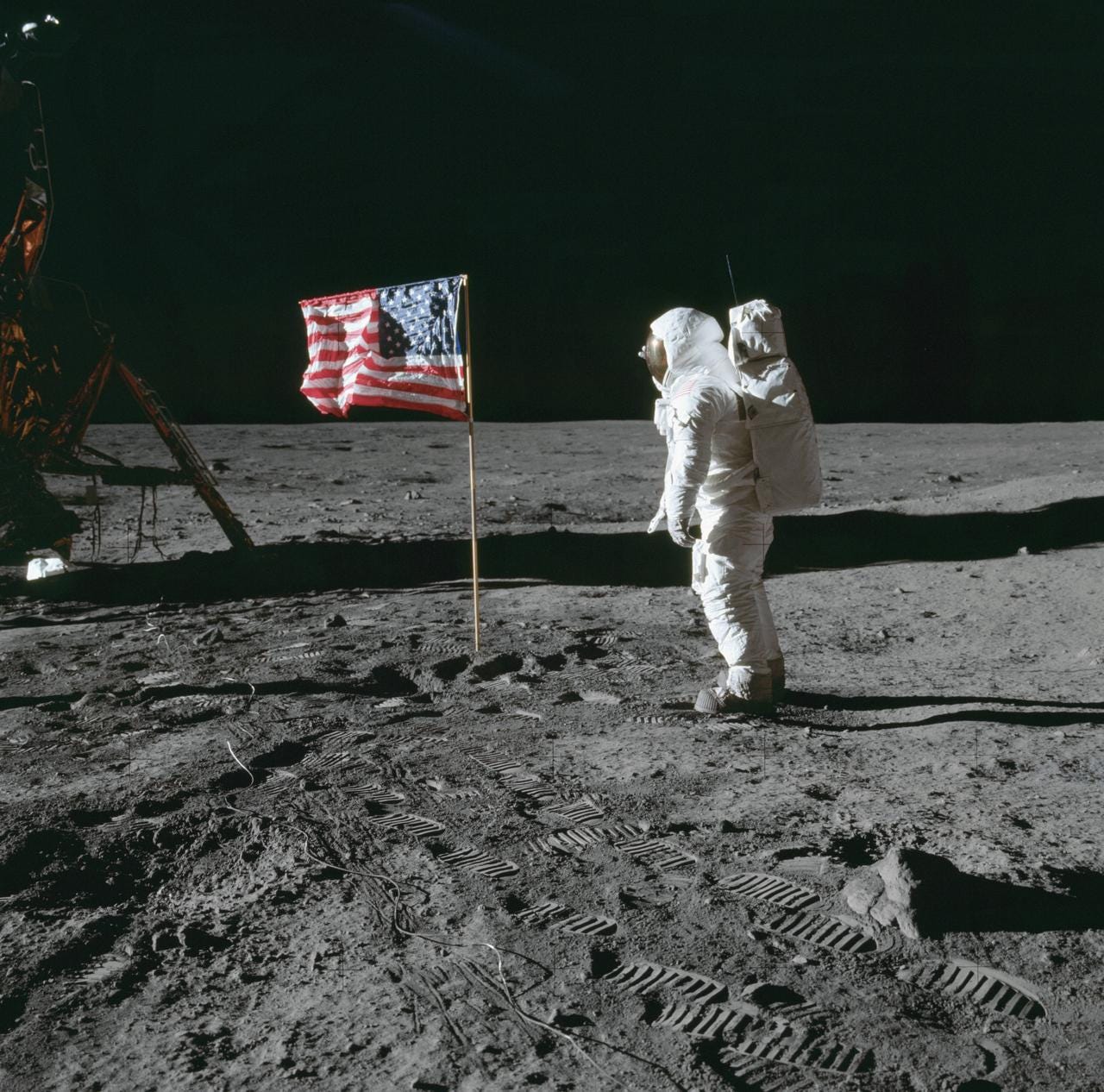
Edwin “Buzz” Aldrin salutes the US flag on the lunar surface, July 20, 1969. Image source: NASA.
Look At Me!
Buzz Aldrin showed up at the Luxe Hotel in Beverly Hills thinking he was about to be interviewed by a Japanese film company about his moon mission.1
As he approached the hotel, Aldrin was ambushed by a conspiracy theorist who accused Buzz of faking the Apollo 11 moon landing on July 20, 1969.
I won’t name the conspiracy theorist, because attention is what he sought, and continues to seek to this day.
On that Monday afternoon, September 9, 2002, the attention seeker had his own camera crew filming as he harassed Aldrin. Video showed that he demanded Aldrin swear on a bible. He told Aldrin to repent. Buzz finally had enough and threw a punch at the man.
The Los Angeles County district attorney’s office declined to file charges. The deputy assigned the case concluded that the theorist had provoked Aldrin into hitting him.2
The theorist claims to have harassed other Apollo astronauts with his swear-on-the-bible schtick.3
Don’t Believe Your Lying Eyes
Moon landing deniers began seeking attention soon after the moon missions ended with Apollo 17 in December 1972.
One of the earliest deniers was Bill Kaysing, who was a technical writer for Rocketdyne, the company that built the engines for the Saturn V stages. (Kaysing is deceased, which is why I’m naming him.) In 1976, he self-published a 76-page document called, We Never Went to the Moon.4 It’s a casserole of conspiracy theories baked by his own ad hominen accusations and disbeliefs. Why were the moon landings a hoax? Because he believed they were a hoax — and set out to find “evidence” backing his assertions.
In the science biz, this is known as confirmation bias — interpreting evidence to fit existing beliefs. There’s no peer review by independent experts.
The conspiracy theory business went big-time in the 1970s as the US public began to question the findings of the Warren Commission, which concluded that President John F. Kennedy had been slain by a lone assassin. On March 27, 1975, Geraldo Rivera’s late night show Good Night America aired a documentary about the Kennedy assassination. It was the first telecast of the Zapruder film, a home movie that inadvertently captured the assassination. Rivera had in the studio “experts” such as theorist Mark Lane, who had published one of the earliest conspiracy books about the assassination.5
The conspiracy theories led to the US House of Representatives forming a select committee to investigate the slayings of Kennedy and Dr. Martin Luther King. Their report, released on March 29, 1979, concluded that although Oswald had fired the three shots, acoustic evidence suggested there were additional shots by a second gunman. (The “acoustic evidence” was debunked three years later by the National Academy of Sciences.) The committee believed that “circumstantial evidence” suggested James Earl Ray acted as part of a conspiracy but no physical evidence existed to prove it.6
If the US government got their assassination conclusions wrong, could they also be wrong about the lunar landings?
And so began an industry to profit off denying what we’d all witnessed with our own eyes on television the evening of July 20, 1969. Apparently Walter Cronkite, Chet Huntley and David Brinkley, Jules Bergman, and legions of US and foreign press were all witting dupes in convincing we gullible Americans that the billions spent on the Apollo program over three administrations were intended to play one giant cosmic practical joke on us.
One early example is the 1977 film Capricorn One, about a faked NASA Mars mission. The movie was one of many “disaster” thrillers produced in the 1970s starring “name” actors and athletes; this one had O.J. Simpson in its cast, to the producers’ everlasting regret.7
The 2001 Fox TV program “Did We Land on the Moon?” Original video source: Internet Archive.
On February 15, 2001, the Fox TV network aired a Conspiracy Theory episode titled, “Did We Land on the Moon?” An April 9, 2001 USA Today guest column by film critic Michael Medved lambasted the program, calling it a “shameless promotion of public paranoia.”8 He called the program’s so-called experts “a constellation of ludicrously marginal and utterly uncredentialed ‘investigative journalists.’”
Opinion polls conducted in 1995 by Time/CNN and Gallup in 1999 found that only six percent believed the US government “faked” or “staged” the moon landings.9 But that’s still roughly more than 15 million people — equivalent to the number of viewers Medved estimated had watched the program.
The number of deniers has slowly increased over the years. A 2019 SatelliteInternet.com poll found that 10% of respondents believed the moon landings were faked.10 (The article did not disclose the polling methodology.) A 2021 poll by the Carsey School of Public Policy at the University of New Hampshire found that 12% believed “NASA did not land on the moon,” while 71% disagreed and 19% were unsure.11
By the way, the Carsey poll also found that 10% of respondents believed Earth is flat, while another 9% were unsure. Yikes.
Facts and Fictions
If you’re a regular reader of this virtual fishwrap, you know I worked for ten years as a communicator at the Kennedy Space Center Visitor Complex. Communicators present education lectures, lead public and private tours, and escort the retired astronaut speaker of the day.
It was very rare to encounter a moon landing denier. It was very common to be asked by the public how to deal with the deniers.
The first time I was asked the latter, I replied, “I just walk away and deny them the attention they crave.” That response earned me a rousing applause from my audience. I thought, “Well, that must be the right answer.”
And that’s the policy I followed until I retired in 2021.
No matter how much evidence you present, deniers will deny. It’s a game with them. The evidence isn’t good enough, it’s faked, I’m lying, or they’ll come up with some new whataboutism until you finally give up from exhaustion, so they can claim victory. They’re not worth the time.
You may have encountered such people, or you may have legitimate questions yourself. Let’s visit some of the more common allegations and how they can be debunked.
“I Don’t Believe It”
Some people can’t provide you with specifics. They simply choose not to believe it. They can’t tell you why.
In the 57 years since the Apollo 11 landing, not one person has come forward with evidence that they were bribed to fake something. No “evidence” has surfaced that has survived credible peer view by qualified experts.
If the landings were “faked” on a sound stage, why hasn’t one person who worked on those productions stepped forward? Where was the sound stage? Isn’t there a rental receipt? Why hasn’t one cameraman, one lighting technician, one effects person come forward to expose the fraud?
Why didn’t the Soviet Union step forward to say it was fake? To the contrary, the Soviet newspaper Pravda on July 22, 1969 reported “the first lunar expedition.”
We cannot help but admire the courage and endurance of the astronauts who bravely faced the unknown.
A variant of this is that the Soviets were willing participants in the conspiracy — an allegation with no actual evidence to support it.
“The Launches Were Faked”
Upwards to a million people came to Brevard County to watch the Apollo launches.12 Were they part of the conspiracy?
Lots of people filmed the launches with their 8mm cameras. You can find their home movies on YouTube.
More typical is the allegation that the rockets somehow crashed downrange, as did the astronauts. Or perhaps they weren’t ever aboard, even though the multitudes at the press site saw them get into the spacecraft. Is there not one sailor willing to step forward with a picture of his warship retrieving the crew from the ocean? Crickets.
“The Physics Don’t Work”
Of course they do.
The physics for such a mission were worked out long ago.
In his 1865 science fiction novel From the Earth to the Moon, Jules Verne posited that a crewed mission would take 97 hours and 20 minutes. Verne wasn’t far off; it took Apollo 11 about 76 hours to achieve an elliptical lunar orbit. The launch site was in Florida, although it was near Tampa, not Brevard County.13 A Kent State physics major concluded, “it is clearly impressive just how close Jules Verne came to today’s more precise measurements.”14
Russian physicist Konstantin Tsiolkovsky worked it out in 1903, although British mathematician William Moore had the basics in 1810. Tsiolkovsky even suggested the use of liquid oxygen and liquid hydrogen as a propellant, used by today’s Space Launch System, although he acknowledged that metallurgy needed to advance for this to be practical.15
Since warp drive doesn’t yet exist (another conspiracy theory), spacecraft need to rely on old-fashioned orbital mechanics. The principles go back to an Isaac Newton thought experiment in 1728 called Newton’s cannonball. Fire an object with enough velocity and it will escape Earth orbit.16
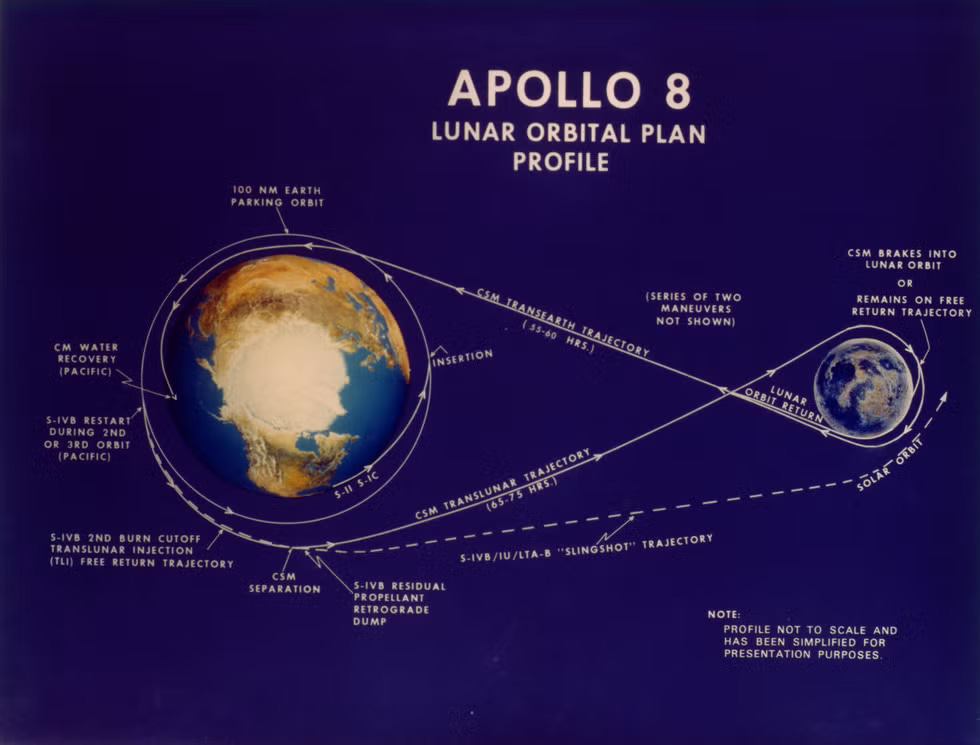
Apollo 8’s lunar orbital flight plan. Original source: NASA.
As the spacecraft approaches, the moon’s gravitation pull becomes stronger than Earth’s. Propellant is used only for course corrections and for slowing down to achieve lunar orbit.
“The Radiation Would Have Killed Them”
The Apollo spacecraft passed through the Van Allen radiation belts, but they did so quickly. Dosimeters worn by the astronauts showed they experienced minimal radiation absorption. It also helped that no significant solar storm events occurred during the flights. The trajectory through the belt also affected exposure time.17
While on the moon outside the lunar module, the astronauts wore space suits with various layers of materials to protect from the radiation.18
“It’s Impossible to Land on the Moon”
Before the Apollo crews landed on the moon, both the US and USSR did it many times with robotic crafts. The Soviet Luna 9 soft-landed on the moon on February 3, 1966 and transmitted back images. NASA analyzed those images for Project Apollo.19
In the 1970s, the Soviets launched several Luna missions that robotically returned lunar samples to Earth, and deployed robotic rovers on the lunar surface.20
The US Surveyor missions deployed robotic landers on the moon to scout for possible crewed landing locations. Apollo 12 crew members visited the Surveyor 3 landing site and brought back several pieces.21
“We Can’t See the Landing Sites”
With the naked eye, no.
Nor can you with the Hubble Space Telescope, another common accusation. But that’s because Hubble wasn’t designed to look at extremely close objects. It’s designed to look into deep space.
To demonstrate, put your hand in front of your eyes. As you move your hand closer to your eyes, the hand goes out of focus. Same principle.
But we do have modern photos of the Apollo landing sites.
NASA’s Lunar Reconnaissance Orbiter took pictures of the sites in 2011. They’re online if you want to see them for yourself.
If that’s not good enough for you, the Indian Space Research Organization’s Chandrayaan-2 mission in April 2021 photographed the Apollos 11 and 12 landing sites.22
Is India now part of the conspiracy?!
“The Shadows Are All Wrong”
I’ve had this one hurled at me. Someone pointed at a photo of Apollo astronauts on the moon and claimed the shadows were all wrong. I didn’t see what he saw.
The Discovery network program MythBusters debunked this one in August 2008. They recreated the Apollo 11 landing site and found that topography can cause shadows to cast in different directions.
The MythBusters episode “NASA Moon Landing” aired on August 27, 2008. It was the second episode of their sixth season. Video source: Tony YouTube channel.
“There’s No Way to Prove They Walked on the Surface”
Several Apollo landing missions deployed various instruments on the surface, such as monitoring for seismic waves and solar winds. The data were transmitted back to Earth long after the astronauts departed. The program was called the Apollo Lunar Surface Experiments Package. The data were sent over the Manned Space Flight Network and received by stations all over Earth. The data couldn’t have been received if the astronauts hadn’t landed on the moon and deployed the instruments.23
Both Apollo astronauts and Soviet Lunakhod rovers deployed mirrors on the moon. Earthbound observatories bounce lasers off the mirrors to measure the time it takes for the beam to return. This tells scientists how far the moon is from Earth. The Soviets proved you don’t need astronauts to deploy the mirrors, but the US mirrors are where NASA says the astronauts placed them.24
“The Rocks Are Fake”
How do we know that the geological samples brought back from the moon are real?
Because they formed in an entirely different environment.
The moon has no atmosphere, therefore no oxygen or water for the rocks to absorb. Nothing causes the rocks to weather. Without rain to drive storms and flooding, sedimentation can’t occur. No water, no rust or clay either.25
In 2015, scientists at the Southwest Research Institute issued a press release with describing technical differences.26
Lunar rocks closely resemble Earth rocks in many respects, but Moon rocks are more depleted in volatile elements like potassium, sodium, and zinc, which tend to have lower boiling points and vaporize readily.
Just Walk Away
Hopefully you found answers to some questions you may have had about how we can prove to honest skeptics that astronauts really did go to the moon.
But not all skeptics are honest.
I was ambushed once by a denier who had a smartphone on a stick. He asked me to do a video interview for his podcast.
I told him we had a policy that all such requests had to go through media relations. But he insisted he wasn’t “real” media, just more of a travelogue, with some simple questions.
When I relented, his first question was, “How do you hide the truth about UFOs?”
I looked at him and said, “You lied to me, so this interview is over” and walked away.
I’m sure he hyped it on his pathetic podcast for his few loser followers, but I didn’t give him the confrontation he wanted.
I also notified my supervisor in case the video surfaced and made it appear I’d granted an interview.
These people are unscrupulous. They’re narcissists.
Skepticism is healthy. It’s part of the scientific method.
But this isn’t science. It’s trolling for attention.
The only way to win with such people is to walk away. If they want to deny the moon landings, deny them attention. That’s how you win.
Kenneth Reich, “Police Probe Astronaut’s First Launch,” Los Angeles Times, September 11, 2002.
“Astronaut Avoids Assault Charges,” Los Angeles Times, September 21, 2002.
Eric Spitznagel, “Don’t Stop Denying,” Popular Mechanics, July 19, 2019.
Bill Kaysing and Randy Reid, We Never Went to the Moon (Pomeroy, Washington: Health Research, 1974), available on the Internet Archive.
“Assassination of President Kennedy,” Good Night America, March 27, 1975. A clip from the episode is on the Geraldo Rivera YouTube channel. Mark Lane’s 1966 book Rush to Judgment is available on Archive.org.
House Select Committee on Assassinations Report, National Archives. “Report of the Committee on Ballistic Acoustics,” National Academy of Sciences, 1982.
The complete movie is on the Shout! Studios YouTube channel.
Michael Medved, “Faking a Hoax,” USA Today, April 9, 2001, 13A.
Frank Newport, “Landing a Man on the Moon: The Public’s View,” Gallup News Service, July 20, 1999.
Rebecca Lee Armstrong, “New Survey Suggests 10% of Americans Believe the Moon Landing Was Fake,” SatelliteInternet.com, July 10, 2019.
Lawrence Hamilton, “Conspiracy vs. Science: A Survey of US Public Beliefs,” University of New Hampshire, Carsey School of Public Policy, April 25, 2022.
Jules Verne, From the Earth to the Moon (New York: Scribner, Armstrong & Company, 1874). Sarah A. Loff, “Apollo 11 Mission Overview,” April 17, 2015.
Paul Billig, “What Would It Take to Build Jules Verne’s Space Cannon,” Kent State University, unknown date.
William Moore, A Treatise on the Motion of Rockets, (London: G and S Robinson, 1813.) A.A. Blagonravov, Collected Works of K.E. Tsiolkovsky, Volume II — Reactive Flying Machines (1954, Moscow), NASA English translation. Tsiolkovsky’s discussion of LOX and LH₂ is on page 86.
Dave Doody, “Basics of Spaceflight,” Chapter 3, “Gravity & Mechanics,” NASA Science website. Michael Fowler, “Discovering Gravity,” University of Virginia Physics 152 course, Spring 2002.
Robert A. English et al, “Apollo Experience Report — Protection Against Radiation,” NASA, March 1973.
Joseph J. Kosmo, “Space Suit Extravehicular Hazards Protection Development,” NASA, August 1987.
“First Photo from the Surface of the Moon,” NASA Science, September 26, 2017. “Analysis of Luna 9 Photography,” Lockheed Electronics Company, February 1968.
Cathleen Lewis, “Revisiting the Soviet Lunar Sample Return Missions,” National Air and Space Museum, December 16, 2020.
“Apollo 12 and Surveyor 3,” NASA Science.
Brie Stimson, “Orbiter Photos Show Lunar Modules from First 2 Moon Landings More Than 50 Years Later,” Fox News, January 2, 2025.
Roy L. Eason, Jr., “Apollo Experience Report: Apollo Lunar Surface Experiments Package Data Processing System,” NASA, September 1974.
William Steigerwald, “Laser Beams Reflected Between Earth and Moon Boost Science,” NASA, August 10, 2020.
Sara Loy, “How Moon Rocks Differ From Earth Rocks,” Indiana Public Media, August 10, 2021.
Deb Schmid, “SwRI Scientists Explain Why Moon Rocks Contain Fewer Volatiles than Earth’s,” Southwest Research Institute press release, November 9, 2015.