
Jared Isaacman kicks off NASA’s daylong Project Artemis “Ignition” event on March 24, 2026. Video source: NASA via SpaceSPAN YouTube channel.
The Vision Thing
"It's like déjà vu all over again.” — Yogi Berra.
NASA held a daylong event on March 24 to unveil its revamp of Project Artemis.
Administrator Jared Isaacman repeatedly lavished undeserved praise on President Donald Trump, who did little for this reboot other than sign an executive order last December. Isaacman said that NASA is now committed to “return to the moon before the end of President Trump’s term,” which to my knowledge is the first time that the agency’s raison d'etre is to pad a president’s résumé.
During the Biden administration, NASA targeted the first crewed landing for 2027. That was unrealistic, because neither company’s lander (SpaceX or Blue Origin) will be ready by 2027. Neither will be ready by 2028 either. Trump’s executive order changed the target date from 2027 to 2028.
It also directed that NASA establish “initial elements of a permanent lunar outpost by 2030,” but that also pre-existed Trump’s second term. My December 31, 2025 Substack column documented NASA moon base plans going back to at least 2019, although it was the Biden administration that refined those plans. And if you really want to go back to its origin, that would be the Obama administration’s NextSTEP program, which envisioned commercial cislunar operations.
When President John F. Kennedy proposed the United States land a man on the moon and return him safely to the Earth by the end of the 1960s, NASA thought it might be possible to achieve the objective as early as 1967, but “before this decade is out” allowed for delays and setbacks. Kennedy never said, “by the time my second term is up,” which seems to be how we do things now under Trump.
So let’s push past the political blarney and revisit all the times US presidents have unveiled grand visions, to see if history gives us any reason to think this one will succeed.
Dwight Eisenhower
President Eisenhower abhorred stunts. His administration’s creation of NASA in 1958 was a political response to the hysteria surrounding the Soviet Sputnik launches of late 1957.
Anyone paying attention would have known that the USSR planned to launch a satellite as part of the International Geophysical Year, from July 1957 through December 1958. So did the US, a program called Project Vanguard. Both had been announced in the summer of 1955. At the National Academy of Sciences on September 30, 1957, a Soviet delegate presented their launch plans and even the radio frequencies where the Sputnik “beep-beep” could be heard. The delegate didn’t say when it might launch, other than during the IGY.
It wasn’t a race. It was never intended to be a race.
But after Sputnik 1 launched on October 4, 1957, and Vanguard’s December 6, 1957 test launch explosion live on national television, Democratic majorities in both houses of Congress staged emergency hearings to look into the supposed inferiority of US missile technology. That wasn’t true, as Eisenhower knew from secret intelligence briefings, but it was the impression many Americans had from media hysteria and political pontification.
The White House and Congress finally settled on creating a space version of the old National Advisory Committee for Aeronautics, which since 1915 had researched and developed aviation technology to transfer to the private sector. The National Aeronautics and Space Administration essentially married the NACA to civilian space programs within the Department of Defense.
Out of that wedding came Project Mercury, the first US crewed program, and engine development that led to the Apollo Saturn V first stage. Project Apollo also began during the Eisenhower administration, although it was only a vague sequel to Mercury, sending a three-crew spacecraft beyond Earth orbit with the moon as a possible destination.
John F. Kennedy
Because Eisenhower abhorred stunts, Senator Kennedy exploited that reluctance by accusing the administration of creating a “missile gap.” The allegation was a theme during his 1960 presidential campaign against the Republican candidate, Vice President Richard Nixon, but the gap didn’t exist.
After the Soviet Union launched Yuri Gagarin on April 12, 1961, shortly followed by the Bay of Bigs Cuba invasion failure, US press declared that Kennedy had now inherited the “gap” and had to do something about it.
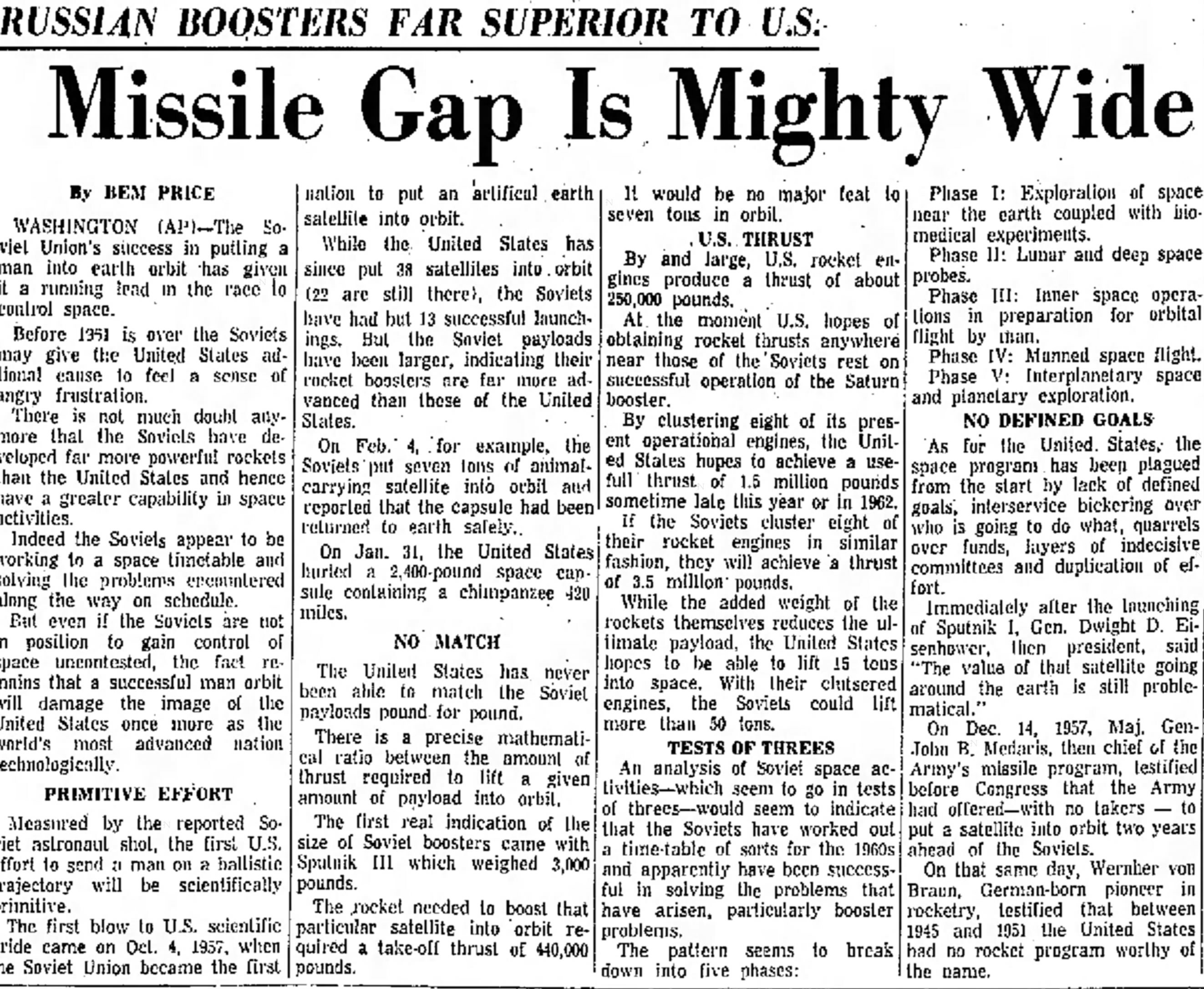
Associated Press military affairs reporter Bem Price’s analysis after Yuri Gagarin orbited Earth, as it appeared in the April 13, 1961 Denton, Texas Record-Chronicle. The column was printed in newspapers across the United States.
My May 25, 2025 Substack column “Kennedy’s Urgent National Need” detailed the events that led to Kennedy proposing a crewed lunar mission by the end of the 1960s.
NASA succeeded, but at an extreme cost. Not only were astronaut lives lost here on Earth, but in today’s dollars Project Apollo cost somewhere between $225 billion to $300 billion, according to various estimates. NASA was transformed from a space version of the NACA into a propaganda organ that subsidized government contractor jobs across the nation.
To this day, NASA still placates members of Congress that order the agency to perpetuate obsolete and inefficient technologies such as the Space Launch System, in the name of protecting contractor jobs and the generous campaign contributions they receive from contractor lobbyists.
Richard Nixon
When he took office in January 1969, the Apollo 11 moon landing was all but inevitable. One of the questions President Nixon’s administration had to answer was what to do once Kennedy’s objective was achieved.
Nixon appointed a Space Task Group on February 13, 1969 to recommend what the nation’s future should be in space. The report, delivered in September 1969, envisioned a robust program with a crewed Mars mission as a long-range goal. “Groups of men” would live and work in cislunar space “for extended periods of time.”
The task group proposed the creation of a “space transportation system” to service a “modular space station.” This system comprised a reusable shuttle operating like an airplane; a “reusable space tug” to transfer crews and other vehicles into different orbits; and a “reusable nuclear stage” for deep space operations.
Nixon saw all this as far too costly. The only proposal he approved was the shuttle spaceplane. NASA’s Space Shuttle was formally named the “Space Transportation System,” after the task group’s original term, but the other components never were approved.
Ronald Reagan
To most people, President Reagan’s space legacy probably is proposing Space Station Freedom during his January 25, 1984 State of the Union address.
Tonight, I am directing NASA to develop a permanently manned space station and to do it within a decade. A space station will permit quantum leaps in our research in science, communications, in metals, and in lifesaving medicines which could be manufactured only in space. We want our friends to help us meet these challenges and share in their benefits. NASA will invite other countries to participate so we can strengthen peace, build prosperity, and expand freedom for all who share our goals.
If you’ve never heard of Space Station Freedom, that’s because the project withered due to NASA’s usual design delays, cost overruns, and congressional underfunding. On June 23, 1993, Freedom survived a proposed cancellation in the House of Representatives by one vote.
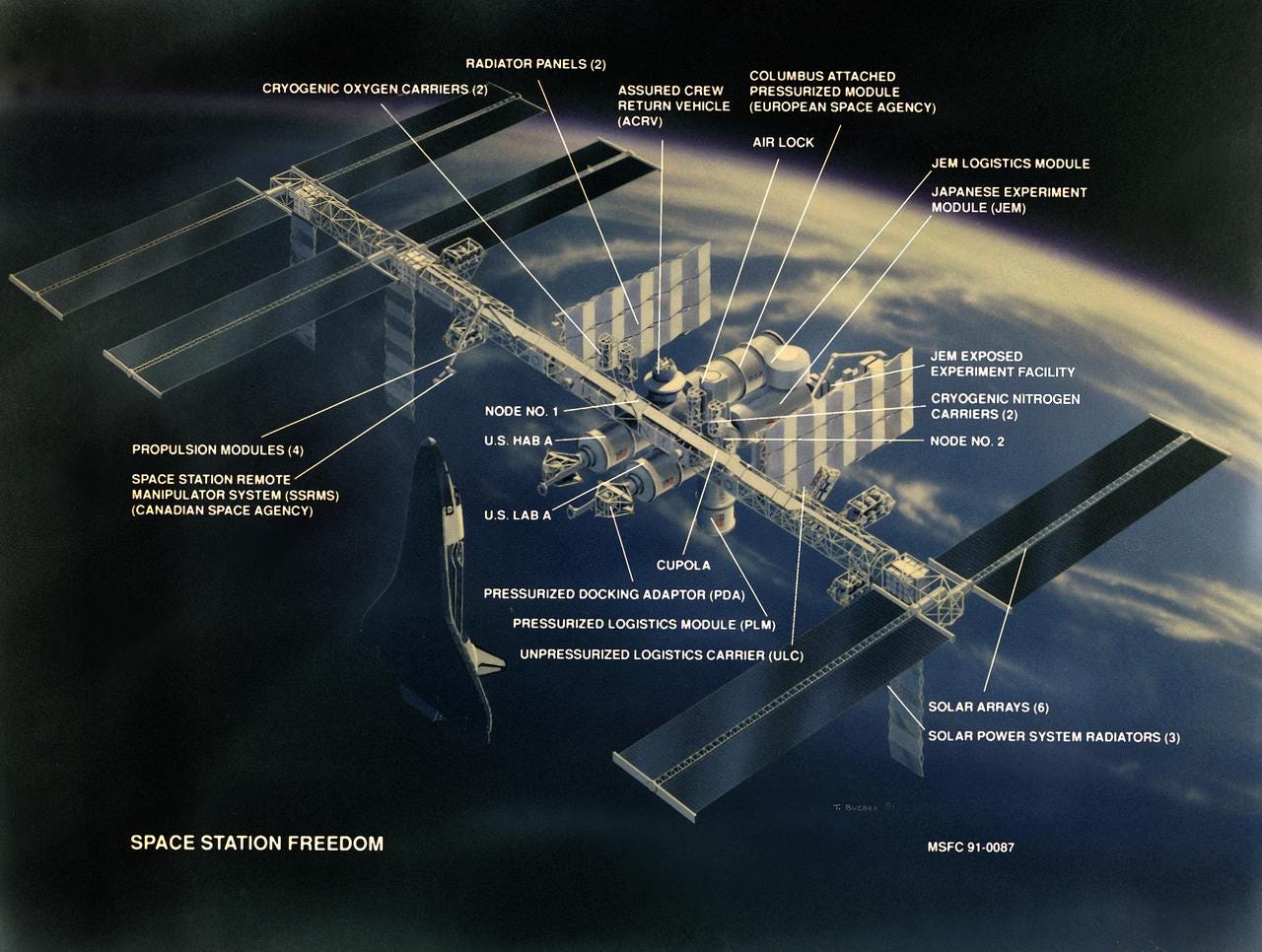
A 1991 artist’s concept of Space Station Freedom. Image source: NASA.
After the fall of the Soviet Union, the United States and Russia began negotiations to cooperate in space. In November 1993, the Clinton administration announced that a diminished Freedom would be redesigned for compatibility with Russian modules to create an international space station. At the time, NASA estimated the ISS (then called “Alpha”) would cost $19.4 billion (in 1993 dollars). The final cost was about $100 billion (in 2010 dollars), with about half of that spent by the US. The first three-member crew (two Russians, one American) began residence in November 2000.
Generally overlooked is the Reagan administration’s contributions to commercial spaceflight. Reagan signed an amendment to NASA’s charter which required the agency to “seek and encourage, to the maximum extent possible, the fullest commercial use of space.” The administration encouraged commercialization of US expendable launch vehicles and “free market competition.” After the Challenger accident, Reagan issued an executive order directing that commercial payloads transition from Shuttle to US expendable rockets.
In October 1984, Reagan created a National Commission on Space to “study existing and proposed United States space activities; formulate an agenda for the United States civilian space program; and identify long range goals, opportunities, and policy options for civilian space activity for the next twenty years.” The commission’s report was published in May 1986. As with Nixon’s Space Task Group report, it offered a grandiose vision that was largely ignored.
George H.W. Bush
I was in Washington, DC on July 20, 1989 when President Bush stood on the steps of the National Air and Space Museum to speak about the 20th anniversary of the Apollo 11 landing. Sitting near him were Neil Armstrong, Buzz Aldrin, and Michael Collins.
In his speech, Bush directed Vice President Dan Quayle “to lead the National Space Council in determining specifically what's needed for the next round of exploration: the necessary money, manpower, and materials; the feasibility of international cooperation; and develop realistic timetables -- milestones -- along the way.”
The council’s report became known as the Space Exploration Initiative. A “90-Day Study” released by NASA on November 20, 1989 proposed that humans once again travel beyond Earth orbit to the moon with the eventual goal of a Mars landing. Although the report contained no costs, eventual estimates were $400 billion to $500 billion. Congress declined to fund SEI. Another vision forgotten.
George W. Bush
The Columbia accident forced a reevaluation of NASA’s human spaceflight program. On January 14, 2004, at NASA Headquarters in Washington DC, President George W. Bush delivered what came to be known as the Vision for Space Exploration speech.
Today I announce a new plan to explore space and extend a human presence across our solar system. We will begin the effort quickly, using existing programs and personnel. We’ll make steady progress — one mission, one voyage, one landing at a time.
Bush listed three goals:
Completion of the ISS by 2010, to “meet our obligations to our 15 international partners on this project.”
Return Shuttle to flight for the sole purpose of completing ISS. “In 2010, the Space Shuttle — after nearly 30 years of duty — will be retired from service.”
Return to the moon by 2020, using a new spacecraft called the Crew Exploration Vehicle (later called Orion).
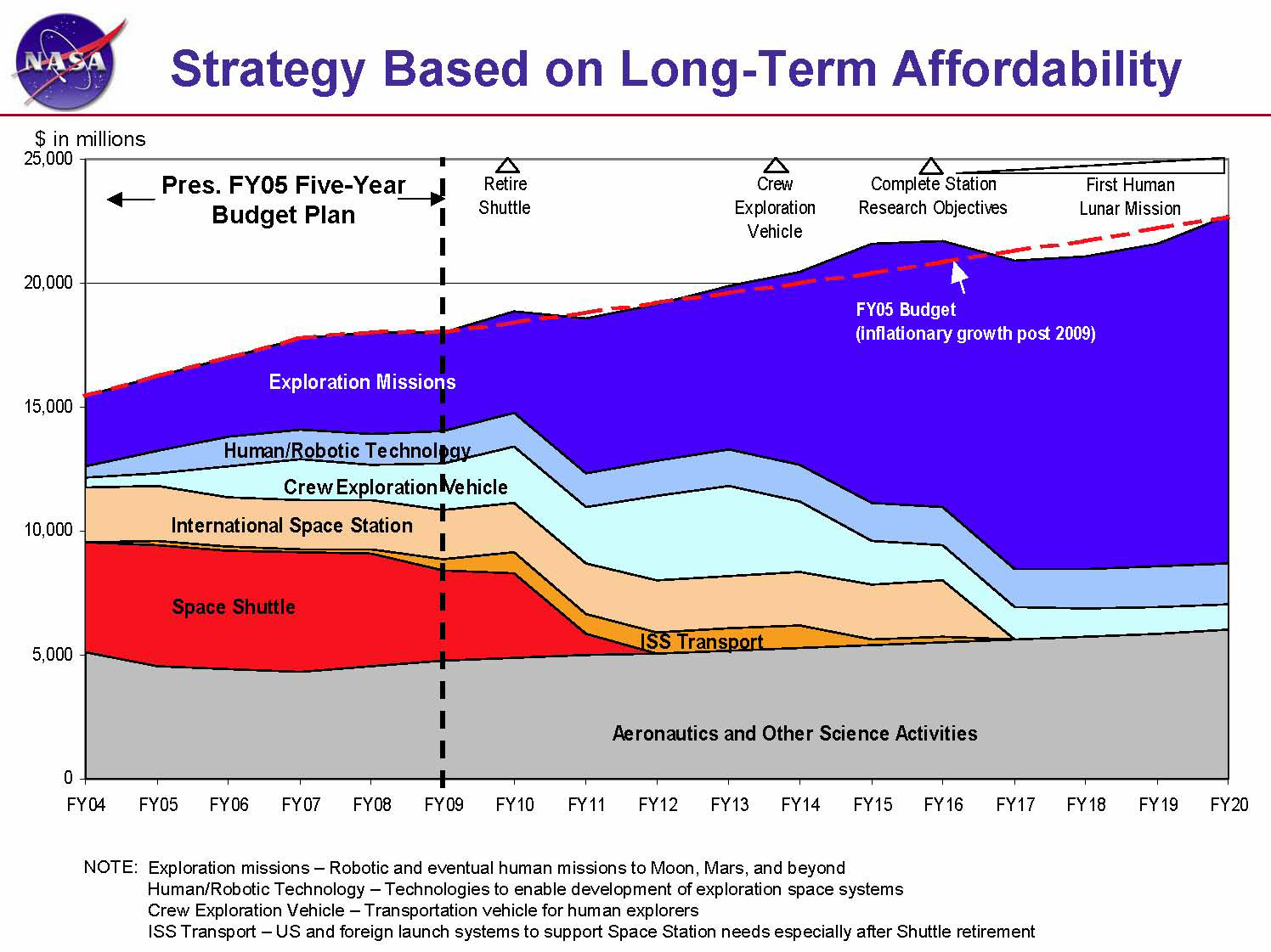
The Vision Sand Chart presented to the Senate Science Committee on January 28, 2004. The chart showed the Bush administration’s intent to end the ISS by 2015 to fund cislunar flight.
On January 28, 2004, NASA administrator Sean O’Keefe testified to the Senate Committee on Commerce, Science, and Transportation. O’Keefe presented what came to be known as the Vision Sand Chart. It showed that the administration intended to complete ISS to “meet our obligations” only to decommission it five years later to pay for what was now called Project Constellation.
O’Keefe was succeeded in April 2005 by Michael Griffin, who scrapped the Constellation plans to date in favor of what he called “Apollo on Steroids.” He proposed a $100 billion project that would send astronauts to the moon for seven-day missions.
Congress wasn’t inclined to spend that kind of money on a “steroids” project, but Griffin’s architecture became the program of record.
In 2009, after taking office, President Obama appointed a Review of US Human Spaceflight Plans Committee. Their report, released in October 2009, began:
The U.S. human spaceflight program appears to be on an unsustainable trajectory. It is perpetuating the perilous practice of pursuing goals that do not match allocated resources.
The Bush administration in November 2005 opened the Commercial Crew and Cargo Project Office, which eventually led to today’s commercial programs servicing the ISS.
Barack Obama
The Obama administration’s NASA Fiscal Year 2011 budget proposed cancelling Constellation in favor of commercial cargo and crew programs, extending the ISS through at least 2020, and development of new engine technologies.
Congress was outraged. Constellation meant guaranteed jobs for workforces at NASA centers and legacy contractors, even if the program itself was a failure. The US was in the depths of the Great Recession. The last thing politicians wanted was to go along with cancelling jobs in their districts and states, even if those jobs couldn’t be justified on merit.
Critics demanded that President Obama give them “a JFK moment” — an Apollo redo with a stated goal, a destination, and a timeline.
So on April 15, 2010, Obama came to Kennedy Space Center to deliver the JFK moment they wanted. He proposed a crewed asteroid rendezvous mission as the first step towards sending astronauts to Mars in the 2030s.
But that didn’t save existing jobs today, so the speech failed to quiet his critics.
In the end, Senators Bill Nelson (D-FL) and Kay Bailey Hutchison (R-TX) crafted a compromise that cancelled Constellation, authorized the commercial programs, and extended ISS. In exchange, NASA had to build a new super-heavy rocket based on Shuttle technology called the Space Launch System. The legislation mandated that NASA issue no-bid contracts to Shuttle and Constellation contractors to build SLS, protecting the existing workforce. The bill passed the Senate and House, and was signed by President Obama.
The Obama administration didn’t write off the moon. They left lunar exploration to the private sector, through a program called NextSTEP — Next Space Technologies for Exploration Partnerships. NextSTEP is providing many of the technologies that are part of Project Artemis.
My book Return to Launch discusses in detail the events of 2010. You can order through the University of Florida Press website at this link.
Donald Trump (First Term)
By the time Donald Trump became president in January 2017, the asteroid program was all but dead. It was politically unpopular and underfunded by Congress. The asteroid mission was defunded in April, three months after Trump took office.
In December 2017, Trump issued his Space Policy Directive-1, amending Obama’s 2010 national space policy. It deleted Obama’s 2030 Mars target date, and replaced Obama’s “far-reaching exploration milestones” paragraph with an order directing “the return of humans to the Moon for long-term exploration and utilization, followed by human missions to Mars and other destinations” with no target dates. If you read the directive, it leaves intact the rest of Obama’s fourteen-page National Space Policy.
Contrary to what Administrator Isaacman recently claimed on X, Trump did not “create the Artemis program.” According to Christian Davenport of The Washington Post in his 2025 book Rocket Dreams, the name came from NASA chief economist Alex MacDonald. Then-administrator Jim Bridenstine in May 2019 was searching for a name for NASA’s disparate deep space programs. Roaming the halls of NASA Headquarters, he encountered MacDonald, who suggested Artemis. Bridenstine adopted the name and announced it during a teleconference. He did not consult with Trump or the White House before announcing Artemis. The White House was not happy.
Credit Where Credit Is Due
If you’re looking for “great leaps” in the history of US government spaceflight, my list would include:
Eisenhower and Congress creating NASA in 1958.
Kennedy lunar “propaganda stunt” that changed NASA into a fundamentally different agency
Nixon’s Space Shuttle approval.
Reagan proposing Space Station Freedom and transitioning commercial payloads to expendable rockets.
George W. Bush creating the foundation for crewed commercial spaceflight.
Obama’s transition to commercial cargo and crew (the latter went unfunded by W. Bush), as well as the NextSTEP program.
With the exception of Kennedy, none of these presidents got the grand vision they sought. Fear of the Soviet Union cajoled Congress into funding the crewed lunar missions.
If you’re looking for who gets to take credit for Artemis, many presidents contributed, starting with W. Bush, although the foundation was laid by Obama’s NASA reforms and his national space policy.
Trump lowered expectations, turning NASA away from Mars back to the moon — which was the right call. But the Artemis hardware components and mission plans predate Trump’s second term.
All he’s doing now is trying to take credit for his predecessors’ achievements. His mandate that NASA land astronauts on the moon for the seventh time before he leaves office won’t happen — yet another presidential ambition that will go unfulfilled.