
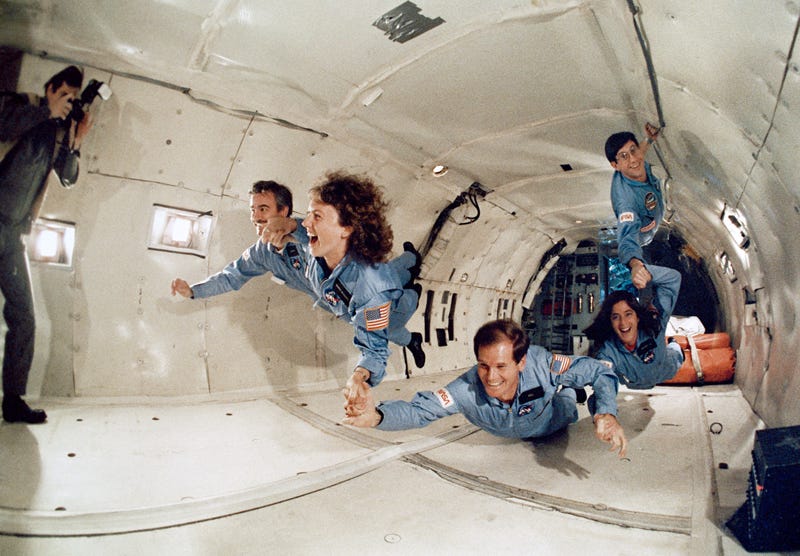
Rep. Bill Nelson (D-FL) flies microgravity training along STS-51L Challenger crew member Christa McAuliffe and other astronaut trainees on November 20, 1985. Image source: NASA.
This article is based on content in my new book, Return to Launch: Florida and America’s Space Industry, now available through the University Press of Florida. Order before March 31 using the promo code 31DC326 and it’s $25. Starting on March 31, it will cost $38.
A February 2026 Gallup poll found that only 16% of respondents approve of “the way Congress is handling its job.”1
None of these members of Congress, to my knowledge, have asked NASA to fly them to space.
But it happened twice in the mid-1980s, during Ronald Reagan’s presidential administration.
Although those flights were viewed as the ultimate junket, for one of those members his flight helped him investigate the Challenger accident and expose NASA’s failure to enforce contractual requirements that might have saved the crew.
The Old Boy Network
In its early days, NASA portrayed the Space Shuttle as routine and affordable access to low Earth orbit. Unlike earlier programs, which were restricted to military test pilots, Shuttle was safe enough to fly civilian crew members. Commercial companies could send their employees to space aboard Shuttle to conduct experiments and deploy payloads. Shuttle was billed as a space pickup truck that could come and go at will.
Taking this seriously, celebrities, politicians, journalists, and others lobbied NASA for a ride. NASA Administrator James Beggs, besieged by these requests, commissioned an informal task force to evaluate the practicality of flying private citizens on Shuttle. Their report recommended “a modest program to fly private citizens as observers who would then communicate their experiences to the more general public be initiated as a first step, and we have suggested appropriate criteria to be met and selection procedures to be deployed.”
But the authors warned:
It would be easy for people to misunderstand such a program as a self-serving public relations gimmick trivializing the space program, despite what is clear to us as NASA’s well-meaning intentions.
The report recommended establishing “candidate suitability criteria” and an independent peer group selection process. “The review process would have to be so open as to appear to be fair and not an ‘old boy network.’”
Out of the task force report came what was eventually known as the Space Flight Participant Program (SFPP). Alan Ladwig, a NASA civil service employee, was assigned in March 1984 to manage the SFPP. Its first program was Teacher in Space, which selected New Hampshire school teacher Christa McAuliffe to fly on Challenger with the STS-51L mission in January 1986.
Unknown to Ladwig, a parallel process was under way by Beggs to select members of Congress to fly on Shuttle.
Senator Jake Garn (R-UT) had been lobbying Beggs since the earliest days of Shuttle flights in 1981. Garn chaired the Senate appropriations subcommittee that oversaw NASA’s budget. NASA contractor Morton Thiokol manufactured Shuttle’s solid rocket boosters in Garn’s state.
Many other members of the House and Senate lobbied Beggs for a Shuttle flight. One was Rep. Bill Nelson (D-FL). After the task force report was released, Nelson sent a letter in early July 1983 to Administrator Beggs asking that he be considered for a Shuttle flight. Since the report had recommended that priority be given to communicators, Nelson told The Orlando Sentinel that “he would communicate his experiences in talks to his colleagues or other audiences.”
When the 99th Session of Congress began in January 1985, Nelson was elected by fellow members of the House Space Science and Applications Subcommittee to be its chairman. The subcommittee had jurisdiction over NASA operations.
Senator Jake Garn was Rep. Bill Nelson’s guest on Nelson’s public affairs talk show, which aired February 24, 1985 on WFTV Channel 9 in Orlando. Video source: Space SPAN YouTube channel courtesy of Bill Nelson and the University of Florida.
Garn and Nelson discussed the accusations that they were seeking a junket at the taxpayers’ expense. Garn commented:
They can’t have it both ways. They can’t on the one hand say to you and I as members of Congress, when something happens in an agency, “Why didn’t you know that? Why weren’t you exercising your oversight responsibilities?”… That’s part of yours and my responsibility. Not just to pass new laws, but to make certain the ones we’ve already passed work, to look at the funding that’s already been approved, seeing that it’s being spent as efficiently as possible.
Challenger would prove Garn right.
Congressional Observers
When Garn’s flight was announced, the education community was outraged. When President Reagan announced the Teacher in Space program on August 27, 1984, he’d promised that “the first citizen passenger in the history of our space program” would be a teacher. But now it would be a politician. The Council of Chief State School Officers threatened to withdraw their support for Teacher in Space.
Ladwig was assured that the selected teacher would fly before Jake Garn. That turned out to be untrue. Garn was classified as a “congressional observer” on a separate track from “citizen passenger.”
Garn flew on STS-51D Discovery in April 1985. Nelson’s formal invitation letter was sent on September 6, 1985. Beggs wrote:
Given your NASA oversight responsibilities, we think it appropriate that you consider making an inspection tour and flight aboard the shuttle.
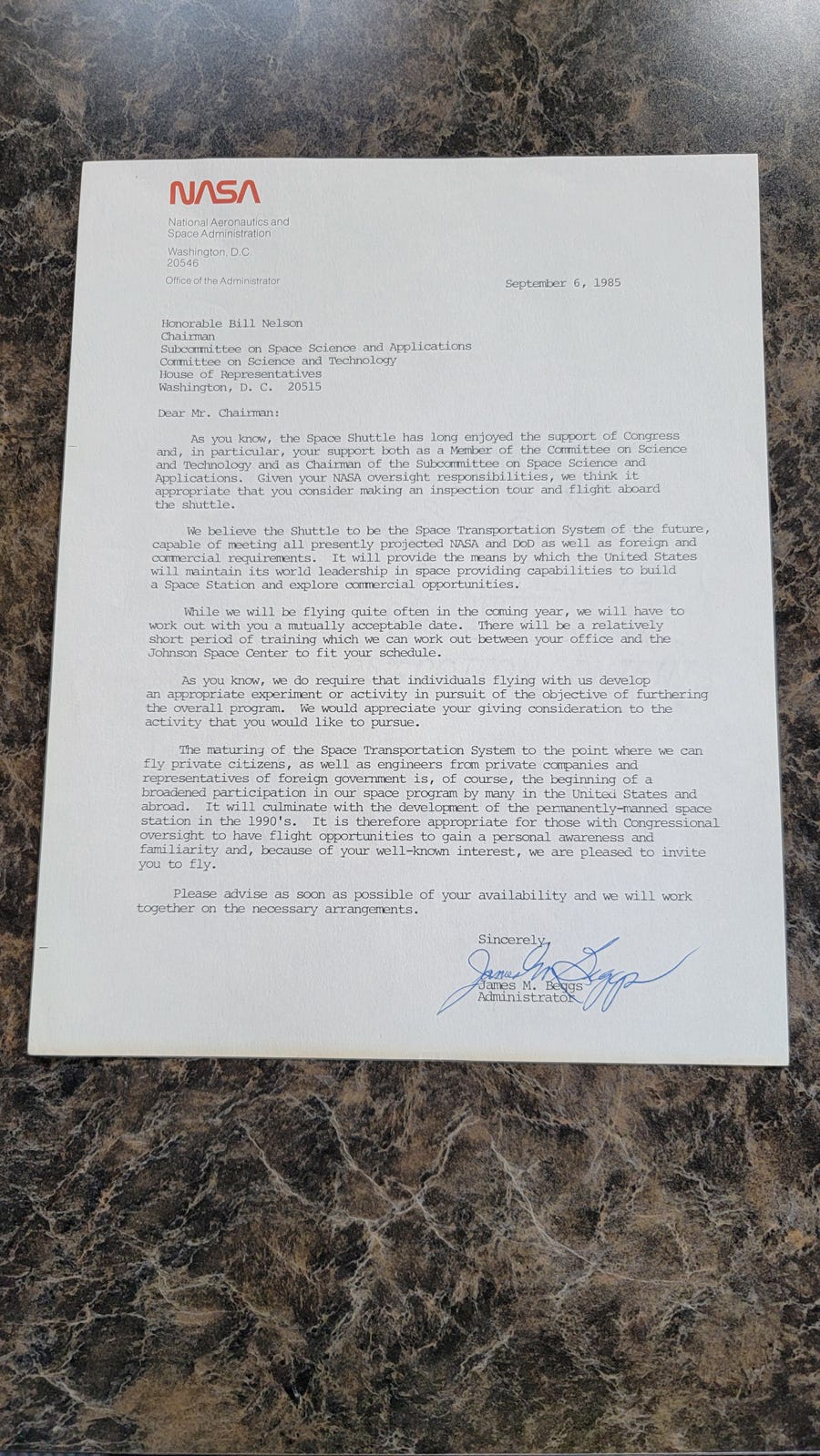
The letter sent on September 6, 1985 from NASA administrator James Beggs to Rep. Bill Nelson. Image source: University of Florida Smathers Libraries.
Fulfilling his pledge to “communicate his experiences,” Nelson wrote a periodic “space diary” during his training for Florida Today and other local newspapers. In his October 2, 1985 column, Nelson wrote that Administrator Beggs called him during a flight suit visor fitting “to discuss possible flight assignments.”
A myth arose that Nelson was somehow responsible for the death of payload specialist Greg Jarvis aboard Challenger. Jarvis was a Hughes Aircraft employee who was to fly on a mission that would deploy the company’s Leasat 5 satellite. Some would later accuse Nelson of ordering NASA to bump Jarvis to a later flight so he could fly on STS-61C Columbia.2
No public evidence exists to support the allegations. Flight assignments were made by NASA based on the mission manifest. Hughes delayed deployment of Leasat 5 because some Leasat satellites in orbit were suffering technical issues. That opened an earlier slot for Nelson. At one point, Nelson was to fly on STS-51L Challenger with Christa McAuliffe, but was moved up to STS-61C after Hughes withdrew Leasat 5 and Jarvis from the manifest.
STS-61C Columbia launched from Kennedy Space Center on January 12, 1986, and landed six days later at Edwards Air Force Base in California. At a post-mission press conference on January 23, Nelson said the flight left him “both fan and critic” of the space agency. He believed that the experience had given him insight to where several improvements were possible. “I am going to make a recommendation in several areas as to increased efficiencies in the operation of the whole system.”
Nelson told his story in Mission: An American Congressman’s Voyage to Space, a book published in June 1988 by Harcourt Brace Jovanovich. The book was described in its dedication as, “A report to the American People and their representatives in Congress.” The book was republished last September by the University Press of Florida.
Superiority and Arrogance
Nelson was in his Washington, DC office the morning of January 28, 1986 when STS-51L Challenger launched from Kennedy Space Center’s Pad 39B. Like much of the nation, he saw Challenger destroyed on live television. The thought crossed his mind, “There, but for the grace of God, go I.”
Rep. Bill Nelson and the House Science and Technology Committee hold a press conference on January 28, 1986. Video source: Space SPAN YouTube channel.
The House Science and Technology Committee called a press conference that afternoon to discuss the tragedy. When he arrived, the reporters requested that Nelson take the dais to answer questions. This was a scenario Administrator Beggs never foresaw when he envisioned flying members of Congress, but on that dark day Nelson was in a unique position to speak knowledgeably about the Shuttle program. He defended the agency when asked if NASA might have compromised safety in its pursuit of a more frequent launch schedule. “NASA does not launch until they feel that everything is right.”
President Reagan appointed an independent commission, which released its findings on June 6, 1986. They concluded that a flawed solid rocket booster design led to an O-ring failure in cold weather at liftoff. Contributing to the accident were communication failures within NASA management, and between NASA management and its contractor employees at Morton Thiokol, the Utah-based company that designed, built, and refurbished the solid rocket motors. The commission found that launch constraints due to O-ring limitations had been waived by the SRB project manager at Marshall Space Flight Center in Huntsville, Alabama. The constraints and waivers were not communicated to higher decision makers. Thiokol engineers had raised concerns, but those concerns were not elevated to NASA upper management. The night before the launch, Thiokol executives felt pressured by NASA senior management at Marshall and Kennedy to prove it wasn’t safe to launch, rather than it was safe. When the Thiokol executives held a caucus to discuss the weather’s effect on the SRBs, a senior vice president told his engineering executive to “take off your engineering hat and put on your management hat.”
The House Science and Technology Committee then held its own hearings. Nelson used much of his time to grill NASA and Thiokol executives about documents he had uncovered which suggested that Thiokol had been required by their NASA contract to conduct an analysis of how the SRB would perform during extreme temperatures. NASA executives finally acknowledged that such an analysis had not been done, but that NASA nonetheless had certified the boosters for operational use. Nelson contended that the loss of Challenger never would have happened if NASA and Thiokol had followed the temperature-testing requirements.
In his 1988 memoir, Nelson saved the final chapter to comment on the Challenger tragedy, its causes and its consequences. He wrote, “… there is no excuse for bad management and poor communications. It is those areas NASA is now struggling to change and improve.”
A certain superiority and arrogance was to blame. NASA believed in itself. Why shouldn’t it? It had had twenty-five years of success. And it expected others to believe in it, too. NASA expected Congress to rubber-stamp what it wanted; if NASA didn’t get what it wanted, it would generally try to do what it wanted anyway. If NASA did not like something in a congressional spending bill, the agency had been known to wait until it was too late to change course and then explain to Congress that it was impossible to follow Congress’s directive.
He had plenty of blame for his congressional colleagues too. Nelson believed, “A mindset developed within NASA: it was not accountable -- to anyone nor to any institution.” But he also blamed Congress for being a bit lax in enforcing its oversight responsibilities. His Science and Technology Committee “should have tried to hold NASA more accountable than it did … congressional oversight was no more than a matter for NASA to tolerate.”
Nelson left the House in 1990 to run for Florida governor, but was defeated in the Democratic primary. In 2000, Floridians elected him to the US Senate, where he served three terms before being defeated for re-election in 2018. He was in retirement when President Joe Biden in 2021 nominated him to be NASA administrator, where he served until Donald Trump became president in January 2025.
When James Beggs decided to fly members of Congress on Shuttle, he never could have imagined that he would be grooming his successor, 35 years later.
Nor could have Beggs foreseen that he was grooming a congressman to ask informed and incisive questions that would expose NASA’s failure to properly police its contractor.
Nelson’s performance during the Challenger hearings validated Garn’s perspective that they were exercising their oversight responsibilities by flying as congressional observers. It was no different from visiting a Veterans Administration hospital, or flying in an Air Force bomber, or riding in an Army tank. What might have been intended as a junket to curry favor with a member of Congress led to exposing NASA’s failure to properly supervise its solid rocket motor contractor.
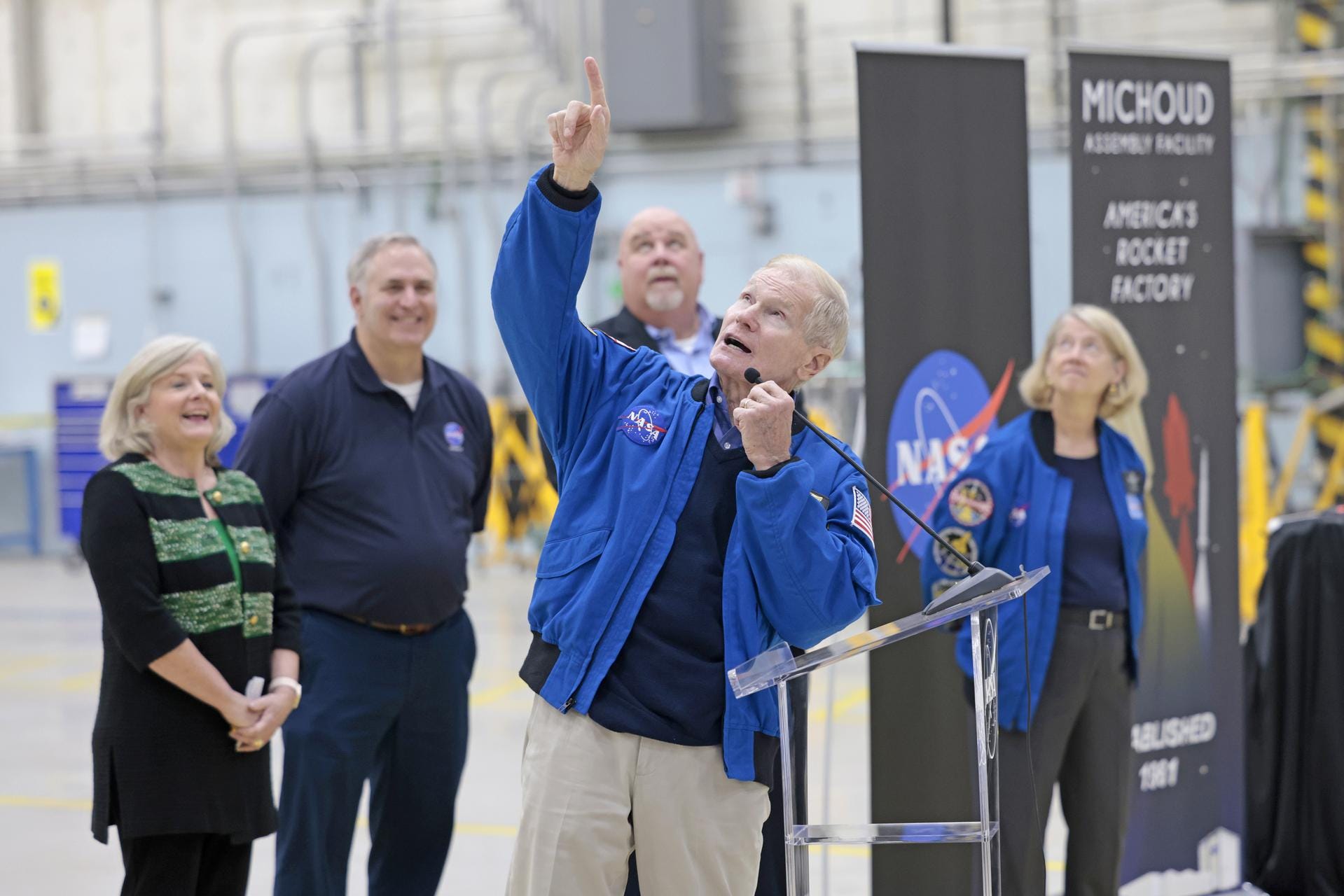
NASA Administrator Bill Nelson visits the Michoud Assembly Facility in New Orleans on December 8, 2021. Image source: NASA.
“Congress and the Public,” Gallup webpage.
An example is a Washington Post article published on January 29, 1986, the day after the Challenger accident. The article falsely claimed that Jarvis had been bumped twice, first by Garn, then by Nelson. Mary Thornton, “Jarvis: Bumped from Two Flights by Members of Congress,” Washington Post, January 29, 1986.