
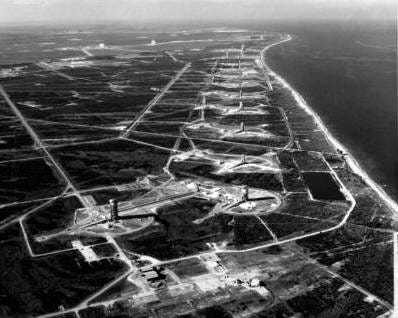
ICBM Row with Launch Complex 36 in the foreground, November 13, 1964. Image source: Cape Canaveral Space Force Museum.
Where Failures Began
“ICBM Row” was one of the most iconic images of the 1960s Space Race. Eight launch pads were built at Cape Canaveral in a line parallel to the Atlantic Ocean. The four to the south — Launch Complexes 11,12, 13, and 14 — were to test and launch Atlas intercontinental ballistic missiles. The four to the north — 15, 16, 19, and 20 — were for a second generation ICBM called Titan.1
ICBM Row was soon to have two bookends. Launch Complex 34 was to be built north of 20 for a next-generation Army program called Saturn, which was soon transferred to the newly created National Aeronautics and Space Administration. Launch Complex 36 was to be built south of 11 for an Atlas variant called the Atlas-Centaur.
Because ICBM Row was built to test new rockets, “anomalies” were common and accepted as part of the test process.
LC-34 was the site of the Apollo 1 tragedy on January 27, 1967. During a pad rehearsal, with the three astronauts in their spacecraft, a fire broke out in the cabin. The astronauts were dead within seconds. The rehearsal was not considered hazardous. The Saturn IB rocket was not fueled. Support technicians stood by outside the hatch. But what no one had considered was the possibility of frayed wiring sparking a flash fire in the cabin’s oxygen-rich air.
LC-36 has had its share of failures. One of the more notorious was on March 26, 1987, when the Atlas-Centaur AC-67 was launched despite the weather data. Because the launch commit criteria specifically didn’t mention the potential for triggered lightning, the launch director gave the go-ahead for launch. The rocket flew through an electrically charged field that created lightning and led to the vehicle’s destruction. A US Navy communications satellite was lost.
NASA Safety and Mission Assurance chief Bryan O’Connor discusses the cause of the Atlas-Centaur AC-67 accident on March 26, 1987. Video source: NASA APPEL YouTube channel.
In its nearly 76-year history, the Cape’s launch sites have never experienced a failure on the scale of what happened at LC-36 the evening of May 28, 2026.
Blue Origin was conducting a static test fire of New Glenn-4, which was to launch 48 Amazon Leo satellites into low Earth orbit. The satellites weren’t aboard; that was a lesson learned from the SpaceX Amos-6 anomaly at LC-40 on September 1, 2016. SpaceX chose to conduct a static test fire with the payload aboard. When the rocket went kaboom, so did the payload. The cause was traced to an upper stage helium bottle failure, although Elon Musk peddled the conspiracy theory that a sniper shot the rocket.
No one is talking conspiracy theories — yet — but early photos suggest catastrophic damage to the complex. One lightning tower was destroyed, with the other compromised. The transporter-erector, used to roll the rocket to the pad and tilt it vertical, is gone. Some Blue personnel have been allowed access to the site by Space Force personnel to conduct initial inspections.
Blue Origin’s New Glenn 4 explodes during a static test fire at Launch Complex 36, May 28, 2026. Video source: Spaceflight Now YouTube channel.
It will be months before we know for certain what caused NG-4 to blow up. The explosion is the largest experienced on the Cape, because this was the largest rocket to blow up on the Cape. Some compare it to the Soviet N-1 failure on July 3, 1969. The N-1 was the Soviets’ belated attempt to create a rocket comparable to NASA’s Saturn V. The cause was traced to an engine turbopump explosion at liftoff. The N-1 failure is considered to have been the largest rocket explosion in history.
No Moon for You
Along with SpaceX, Blue Origin is one of two primary contractors NASA is trusting to deliver astronauts to the moon as part of Project Artemis.
NASA administrator Jared Isaacman has redefined the project’s raison d'être as a testament to the legacy of Donald Trump. During NASA’s Ignition event on March 24 to detail his new direction for Artemis, Isaacman said:
NASA is committed to achieving the near‑impossible once again, to return to the Moon before the end of President Trump’s term, build a Moon base, establish an enduring presence, and do the other things needed to ensure American leadership in space.
For the first time in NASA’s history, the agency’s goal is to achieve an objective before a specific person leaves office.
John F. Kennedy’s May 25, 1961 congressional address proposed the US land a man on the moon by the end of the 1960s (and return him safely to Earth). Kennedy was told privately that a landing by 1967 was possible, but “before this decade is out” allowed for delays and setbacks. That moved the goal line beyond the end of a theoretical Kennedy second term, which would have ended on January 20, 1969 had he not been assassinated. The wisdom of that extra time was proven when the moon race was set back by the Apollo 1 fire.
But there’s no evidence that Kennedy saw Apollo as a monument to his legacy. He was more interested in being re-elected, after his first term began with the Soviets launching the first person into space, followed by the Bay of Pigs debacle. Kennedy sought a dramatic reset.
Trump has been very busy planning monuments to himself, such as the White House ballroom, the Triumphal Arch, and renaming the Kennedy Center. Richard Nixon established the precedent when he added his signature to the Apollo 11 lunar lander plaque, so it’s not much of a stretch to imagine Trump wanting his name prominently displayed on the Artemis landers.
As I’ve written in earlier articles, Isaacman was first nominated before Trump even resumed office. But Trump withdrew the nomination after a spat with Elon Musk, who has a business relationship with Isaacman. Trump was told about past donations by Isaacman to Democrats. Believing Isaacman to be insufficiently loyal, Trump withdrew the nomination.
Unable to find anyone else (other than Transportation secretary Sean Duffy, who reportedly wanted to fold NASA into his agency), Trump finally renominated Isaacman.
So it’s understandable that Isaacman, like virtually all of Trump’s cabinet-level appointees, bends over to lavish praise, crediting Trump with Artemis milestones achieved by prior presidents.
The NG-4 anomaly puts Isaacman in the unenviable position of having to explain to Trump why his moon monument won’t happen.
Isaacman hasn’t admitted that, but he has been busy doing what NASA should be doing at this time — stepping up to help Blue rebuild and fly again.
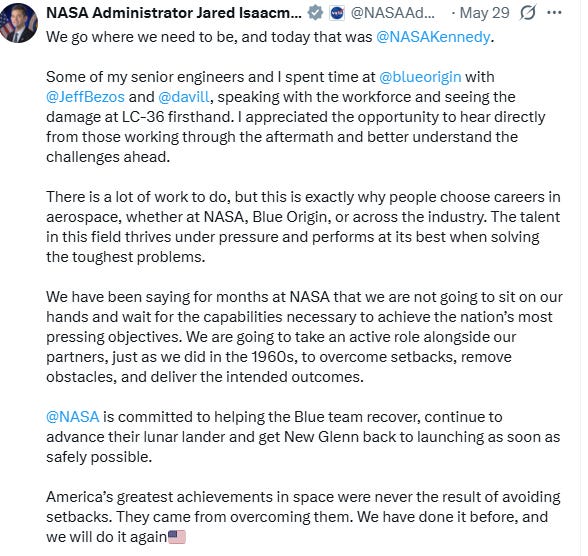
Jared Isaacman’s post on X (Twitter) May 29, 2026. Image source: Jared Isaacman on X.
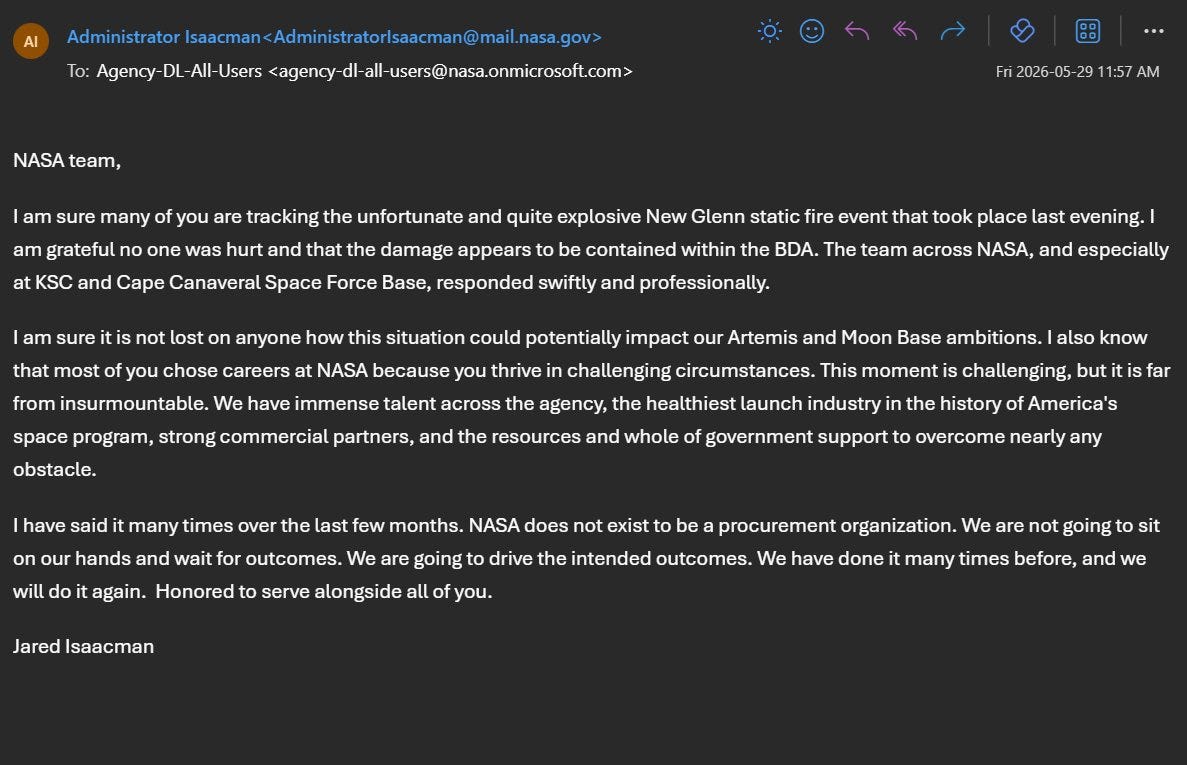
Jared Isaacman’s internal email to the NASA civil workforce on May 29, 2026. Image source: Matthew Travis on X.
Isaacman has yet to acknowledge that his aggressive Artemis schedule is no longer feasible.
As recently as Tuesday May 26, two days before the failure, Isaacman led a media event at NASA Headquarters to announce new lunar rover contracts as well as an Artemis timeline update. He said that “Moon Base I” — the Blue Origin Blue Moon Mark 1 small robotic lander — would launch no earlier than this fall. It was to launch on New Glenn.
UPDATE June 4, 2026 — Spaceflight Now reports that Jared Isaacman said NASA is “de-coupling the lander from the launch vehicle and the pad itself” for Moon Base I. This means launching Blue Moon Mark 1 on another company’s vehicle, presumably a SpaceX Falcon Heavy (in my opinion).
Moon Base II, with the Astrobiotic Griffin 1 payload, is scheduled to launch on a SpaceX Falcon Heavy. NASA has said that Griffin 1 is also targeting a launch by the end of this year.
Moon Base III, with Intuitive Machines’ IM-3 lunar lander, is also targeting a launch by the end of this year. The payload will launch on a SpaceX Falcon 9.
At the May 26 event, NASA announced awards to Astrolab for $219 million and Lunar Outpost for $220 million to build Lunar Terrain Vehicle (LTV) rovers. The agency awarded Blue the delivery contract:
To deliver these rovers to the Moon’s South Pole region, NASA awarded Blue Origin $188 million with an option period worth $280.4 million for two task orders, which includes an option period based on initial phase performance. NASA can choose to extend the task order for payload delivery.
Moon Base I clearly is on hold, and one has to question the rover launch timeline. NASA gave the contractors eighteen months to “qualify flight units for operational readiness.” Maybe New Glenn and LC-36 will be operational by then. Maybe not.
The Artemis III timeline is more dubious than ever. In February, NASA announced that this mission would launch sometime in 2027, repurposed “to test out systems and operational capabilities in low Earth orbit to prepare for an Artemis IV landing in 2028.”
This new mission will endeavor to include a rendezvous and docking with one or both commercial landers from SpaceX and Blue Origin, in-space tests of the docked vehicles, integrated checkout of life support, communications, and propulsion systems, as well as tests of the new Extravehicular Activity (xEVA) suits.
Blue seems out of the running, but SpaceX has yet to demonstrate a successful orbital flight with its new Starship design, and has yet to fly its lunar lander variant. The Federal Aviation Administration has grounded Starship until after the agency completes its investigation into a booster anomaly with the last test flight.
Return to Flight
When will New Glenn fly again?
It’s too soon to say.
In the first days after the Challenger accident in January 1986, some thought NASA might fly again in a few months. Others thought it might be years. The answer boiled down to the accident investigation findings and recommendations — and funding from Congress to return to flight.
NASA has had three crewed accidents in its history — Apollo 1, Challenger in January 1986, and Columbia in February 2003. None of those anomalies destroyed a launch site.
The SpaceX Amos-6 explosion during a static test fire on September 1, 2016. Video source: USLaunchReport YouTube channel.
The SpaceX anomaly during the Amos-6 test fire is not much of a measuring stick. Amos-6 sat atop a Falcon 9 Block 3, which had a liftoff thrust of 6,804 kN (1.5 million lbf). New Glenn 4 had 19,928 kN (4.5 million lbf). This kaboom was much more catastrophic.
The FAA had just cleared New Glenn for return to flight, after the NG-3 upper stage failed to place its satellite payload in a viable orbit. The FAA investigation of Amos-6 took four months to clear SpaceX to return to flight. But this White House has been known to meddle with investigations, so it’s certainly possible that Trump orders the FAA to certify Blue cleared for flight.
Another question is who will pay for the repairs. Yes, Blue’s founder Jeff Bezos is extremely rich, but Space Florida and the Florida Department of Transportation have subsidized Blue’s presence on the Space Coast with unknown millions of dollars. In 2016, Space Florida announced that it would spend $26 million to help build what is today the Blue Origin Rocket Park. On May 22, Florida governor Ron DeSantis announced that the state’s Spaceport Improvement Program will help finance a major Rocket Park expansion; dollar amounts were not disclosed.
Will Blue lay off New Glenn workers? After Challenger, about 2,000 Shuttle contractor employees lost their jobs until the program resumed 32 months later. It’s doubtful that Jeff Bezos will keep everyone on payroll if New Glenn’s return to flight takes that long.
Another factor is that Blue has never had a culture of urgency. The corporate motto is “Gradatim Ferociter,” Latin for “Step by step, ferociously.” The corporate mascot is a tortoise.
Jared Isaacman has prodded Artemis contractors to pick up the pace. Did that prodding cause Blue to proceed with NG-4 before ready? There’s no evidence of it but, if corners were cut to meet timelines, the investigation should call it out — just as happened with the three NASA tragedies.
My expectation is that Blue will take their time to understand what happened. Elon Musk and SpaceX have a “damn the torpedoes, full speed ahead” culture. That’s not Jeff Bezos and Blue Origin.
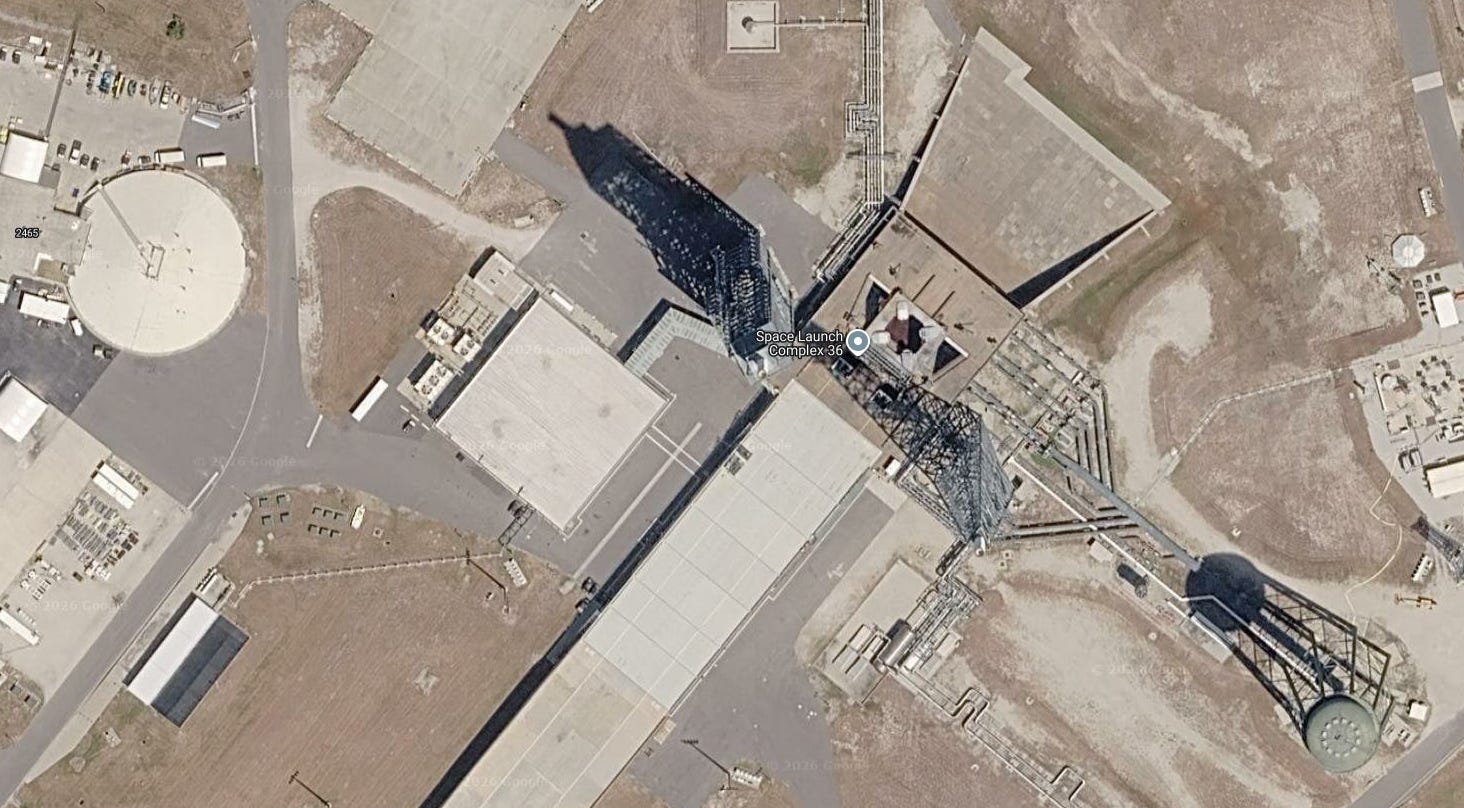
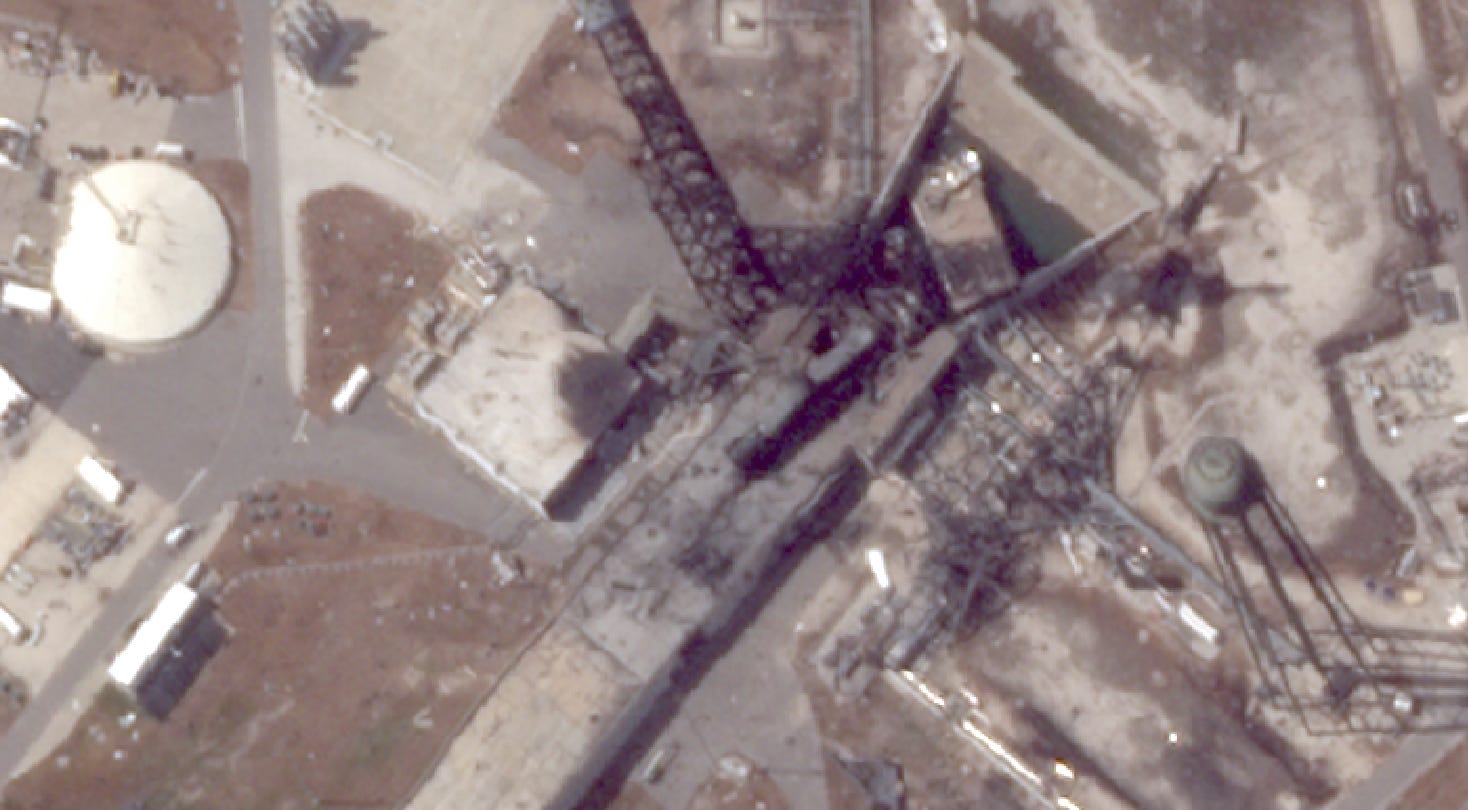
Launch Complex 36 before and after the explosion. Images source: Planet via SpaceFromSpace.com.
Why the gap in the numbers? Pad numbers were assigned chronologically based on when a new project requested a new number from the US Air Force, which managed the range. Launch Complexes 17 (Thor) and 18 (Vanguard) were elsewhere at the station.